Event submissions
Events2026 International Online Conference on Tropical Medicine and Infectious Disease
Published
This submission belongs to the session S1. Vector-Borne Diseases of the event 2026 International Online Conference on Tropical Medicine and Infectious Disease
Published date
26 Jun, 2026
Academic Editor
'%3e%3cpath%20d='M12.6657%2010.9104C12.4185%2010.325%2012.0599%209.79327%2011.6097%209.34482C11.1609%208.89508%2010.6293%208.5365%2010.0442%208.28888C10.0389%208.28626%2010.0337%208.28495%2010.0285%208.28233C10.8446%207.69279%2011.3752%206.73249%2011.3752%205.64904C11.3752%203.8542%209.92103%202.39999%208.1262%202.39999C6.33136%202.39999%204.87715%203.8542%204.87715%205.64904C4.87715%206.73249%205.40774%207.69279%206.22393%208.28364C6.21869%208.28626%206.21345%208.28757%206.20821%208.29019C5.62129%208.5378%205.09463%208.89284%204.64265%209.34613C4.1929%209.79493%203.83432%2010.3266%203.58671%2010.9117C3.34345%2011.4845%203.21226%2012.0987%203.20023%2012.7209C3.19988%2012.7349%203.20233%2012.7488%203.20744%2012.7619C3.21255%2012.7749%203.22022%2012.7867%203.22998%2012.7968C3.23975%2012.8068%203.25142%2012.8147%203.26431%2012.8202C3.2772%2012.8256%203.29105%2012.8284%203.30504%2012.8284H4.09109C4.14874%2012.8284%204.19459%2012.7825%204.1959%2012.7262C4.2221%2011.7148%204.62823%2010.7676%205.34617%2010.0497C6.08899%209.30683%207.0755%208.89808%208.1262%208.89808C9.17689%208.89808%2010.1634%209.30683%2010.9062%2010.0497C11.6242%2010.7676%2012.0303%2011.7148%2012.0565%2012.7262C12.0578%2012.7838%2012.1037%2012.8284%2012.1613%2012.8284H12.9474C12.9613%2012.8284%2012.9752%2012.8256%2012.9881%2012.8202C13.001%2012.8147%2013.0126%2012.8068%2013.0224%2012.7968C13.0322%2012.7867%2013.0398%2012.7749%2013.0449%2012.7619C13.0501%2012.7488%2013.0525%2012.7349%2013.0522%2012.7209C13.0391%2012.0947%2012.9094%2011.4855%2012.6657%2010.9104ZM8.1262%207.9024C7.52486%207.9024%206.9589%207.6679%206.53312%207.24211C6.10733%206.81633%205.87283%206.25037%205.87283%205.64904C5.87283%205.0477%206.10733%204.48174%206.53312%204.05596C6.9589%203.63018%207.52486%203.39567%208.1262%203.39567C8.72753%203.39567%209.29349%203.63018%209.71927%204.05596C10.1451%204.48174%2010.3796%205.0477%2010.3796%205.64904C10.3796%206.25037%2010.1451%206.81633%209.71927%207.24211C9.29349%207.6679%208.72753%207.9024%208.1262%207.9024Z'%20fill='%235D1EE1'/%3e%3c/g%3e%3c/svg%3e) John Frean
John FreanCitation
Thabo Mashatola, Basil Brooke, Zuziwe Mthiyane, Shüné Oliver, Jaishree Raman, Givemore Munhenga, Diversity and Insecticide Susceptibility of Anopheles Mosquitoes in Bushbuckridge, a Residual Malaria Transmission Setting in South Africa, in Proceedings of 2026 International Online Conference on Tropical Medicine and Infectious Disease, 1 July–2 July 2026, MDPI: Basel, Switzerland
Share
Email
Facebook
Twitter
LinkedIn
Diversity and Insecticide Susceptibility of Anopheles Mosquitoes in Bushbuckridge, a Residual Malaria Transmission Setting in South Africa
'%3e%3cpath%20d='M12.6647%2010.9104C12.4176%2010.325%2012.0589%209.7933%2011.6088%209.34485C11.16%208.89511%2010.6283%208.53653%2010.0432%208.28891C10.038%208.28629%2010.0327%208.28498%2010.0275%208.28236C10.8437%207.69282%2011.3743%206.73252%2011.3743%205.64907C11.3743%203.85423%209.92005%202.40002%208.12522%202.40002C6.33038%202.40002%204.87618%203.85423%204.87618%205.64907C4.87618%206.73252%205.40677%207.69282%206.22296%208.28367C6.21772%208.28629%206.21248%208.2876%206.20724%208.29022C5.62031%208.53783%205.09365%208.89287%204.64167%209.34616C4.19192%209.79496%203.83334%2010.3266%203.58573%2010.9117C3.34247%2011.4846%203.21128%2012.0987%203.19925%2012.721C3.1989%2012.735%203.20135%2012.7489%203.20646%2012.7619C3.21157%2012.7749%203.21924%2012.7868%203.22901%2012.7968C3.23877%2012.8068%203.25045%2012.8148%203.26334%2012.8202C3.27623%2012.8256%203.29007%2012.8284%203.30406%2012.8284H4.09012C4.14776%2012.8284%204.19362%2012.7825%204.19493%2012.7262C4.22113%2011.7148%204.62726%2010.7676%205.34519%2010.0497C6.08802%209.30686%207.07452%208.89811%208.12522%208.89811C9.17592%208.89811%2010.1624%209.30686%2010.9052%2010.0497C11.6232%2010.7676%2012.0293%2011.7148%2012.0555%2012.7262C12.0568%2012.7839%2012.1027%2012.8284%2012.1603%2012.8284H12.9464C12.9604%2012.8284%2012.9742%2012.8256%2012.9871%2012.8202C13%2012.8148%2013.0117%2012.8068%2013.0214%2012.7968C13.0312%2012.7868%2013.0389%2012.7749%2013.044%2012.7619C13.0491%2012.7489%2013.0515%2012.735%2013.0512%2012.721C13.0381%2012.0947%2012.9084%2011.4856%2012.6647%2010.9104ZM8.12522%207.90243C7.52388%207.90243%206.95792%207.66793%206.53214%207.24215C6.10636%206.81636%205.87185%206.2504%205.87185%205.64907C5.87185%205.04773%206.10636%204.48177%206.53214%204.05599C6.95792%203.63021%207.52388%203.3957%208.12522%203.3957C8.72655%203.3957%209.29252%203.63021%209.7183%204.05599C10.1441%204.48177%2010.3786%205.04773%2010.3786%205.64907C10.3786%206.2504%2010.1441%206.81636%209.7183%207.24215C9.29252%207.66793%208.72655%207.90243%208.12522%207.90243Z'%20fill='%235D1EE1'/%3e%3c/g%3e%3c/svg%3e)
Thabo Mashatola 1
Basil Brooke 1,2
Zuziwe Mthiyane 2,3
Shüné Oliver 1,2
Jaishree Raman 1,2
Givemore Munhenga 1,2
1. Centre for Emerging and Zoonotic and Parasitic Diseases, National Institute for Communicable Diseases and Wits Research Institute for Malaria, School of Pathology, University of the Witwatersrand, Johannesburg, South Africa
2. Wits Research Institute for Malaria, School of Pathology, Faculty of Health Sciences, University of the Witwatersrand, Johannesburg, South Africa
3. Mpumalanga Department of Health, Malaria Control Programme, Mbombela, South Africa
Abstract
Introduction:
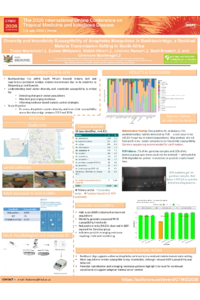
Bushbuckridge subdistrict, located in the northeastern lowveld of South Africa, lies within the country’s malaria-endemic belt and borders Kruger National Park, as well as being near Mozambique and Eswatini. Despite significant progress toward malaria elimination, the area remains vulnerable to residual and cross-border transmission. Understanding local Anopheles vector dynamics and insecticide susceptibility is therefore essential for sustaining malaria control. This study assessed Anopheles species diversity and insecticide susceptibility to inform entomological surveillance priorities aligned with the WHO Entomological Surveillance Planning Tool (ESPT).
Methods:
Larval Anopheles mosquitoes were collected from natural habitats between June 2022 and April 2024 and reared to adulthood. Adult males and females underwent WHO tube bioassays with deltamethrin (0.05%), DDT (4%), and pirimiphos-methyl (0.25%). Species were identified using morphological keys and PCR assays.
Results:
A total of 4454 adults emerged (45.1% males, 54.9% females), representing 18 taxa, including primary, secondary, and non-vector species, highlighting ecological complexity. Anopheles pretoriensis was most abundant (33.4%), followed by An. quadriannulatus (20.7%) and An. rufipes (20.0%). The primary malaria vector An. arabiensis represented 7.1%, demonstrating its persistence in residual transmission areas and the need for targeted control. Two specimens indicated potential hybridisation between An. arabiensis and An. quadriannulatus. PCR identification failed in 3% of An. gambiae complex and 16% of An. funestus group specimens. Bioassays showed high susceptibility overall, but An. funestus group males exposed to DDT had 94.6% mortality, suggesting possible resistance.
Conclusions:
This study highlights a diverse Anopheles community in a residual transmission setting. While susceptibility remains high, emerging resistance and hybridisation underscore the need for continued species-specific, ESPT-informed surveillance to guide adaptive malaria vector control strategies.
Keywords
Anopheles mosquitoes
malaria vectors
insecticide susceptibility
vector surveillance
malaria elimination.
Poster
sciforum-175731_CTMID_2026_poster_Thabo_Mashatola.pdf
Climate-Driven Expansion of Aedes aegypti and Its Impact on the Changing Epidemiology of Dengue Fever
Epidemiology of human Brucellosis in rural South Africa: Household survey of seroprevalence and risk factors, 2022–2023.