Event submissions
Events2026 International Online Conference on Tropical Medicine and Infectious Disease
Published
This submission belongs to the session S2. One Health – Zoonotic Diseases of the event 2026 International Online Conference on Tropical Medicine and Infectious Disease
Published date
26 Jun, 2026
Academic Editor
'%3e%3cpath%20d='M12.6657%2010.9104C12.4185%2010.325%2012.0599%209.79327%2011.6097%209.34482C11.1609%208.89508%2010.6293%208.5365%2010.0442%208.28888C10.0389%208.28626%2010.0337%208.28495%2010.0285%208.28233C10.8446%207.69279%2011.3752%206.73249%2011.3752%205.64904C11.3752%203.8542%209.92103%202.39999%208.1262%202.39999C6.33136%202.39999%204.87715%203.8542%204.87715%205.64904C4.87715%206.73249%205.40774%207.69279%206.22393%208.28364C6.21869%208.28626%206.21345%208.28757%206.20821%208.29019C5.62129%208.5378%205.09463%208.89284%204.64265%209.34613C4.1929%209.79493%203.83432%2010.3266%203.58671%2010.9117C3.34345%2011.4845%203.21226%2012.0987%203.20023%2012.7209C3.19988%2012.7349%203.20233%2012.7488%203.20744%2012.7619C3.21255%2012.7749%203.22022%2012.7867%203.22998%2012.7968C3.23975%2012.8068%203.25142%2012.8147%203.26431%2012.8202C3.2772%2012.8256%203.29105%2012.8284%203.30504%2012.8284H4.09109C4.14874%2012.8284%204.19459%2012.7825%204.1959%2012.7262C4.2221%2011.7148%204.62823%2010.7676%205.34617%2010.0497C6.08899%209.30683%207.0755%208.89808%208.1262%208.89808C9.17689%208.89808%2010.1634%209.30683%2010.9062%2010.0497C11.6242%2010.7676%2012.0303%2011.7148%2012.0565%2012.7262C12.0578%2012.7838%2012.1037%2012.8284%2012.1613%2012.8284H12.9474C12.9613%2012.8284%2012.9752%2012.8256%2012.9881%2012.8202C13.001%2012.8147%2013.0126%2012.8068%2013.0224%2012.7968C13.0322%2012.7867%2013.0398%2012.7749%2013.0449%2012.7619C13.0501%2012.7488%2013.0525%2012.7349%2013.0522%2012.7209C13.0391%2012.0947%2012.9094%2011.4855%2012.6657%2010.9104ZM8.1262%207.9024C7.52486%207.9024%206.9589%207.6679%206.53312%207.24211C6.10733%206.81633%205.87283%206.25037%205.87283%205.64904C5.87283%205.0477%206.10733%204.48174%206.53312%204.05596C6.9589%203.63018%207.52486%203.39567%208.1262%203.39567C8.72753%203.39567%209.29349%203.63018%209.71927%204.05596C10.1451%204.48174%2010.3796%205.0477%2010.3796%205.64904C10.3796%206.25037%2010.1451%206.81633%209.71927%207.24211C9.29349%207.6679%208.72753%207.9024%208.1262%207.9024Z'%20fill='%235D1EE1'/%3e%3c/g%3e%3c/svg%3e) John Frean
John FreanCitation
Ilze du Plooy, Riann Christian, Malitaba Agrenet Mlangeni, Ana Mbokeleng Tsotetsi-Khambule, Prevalence of Taeniosis among humans in Mpumalanga Province, South Africa, in Proceedings of 2026 International Online Conference on Tropical Medicine and Infectious Disease, 1 July–2 July 2026, MDPI: Basel, Switzerland
Share
Email
Facebook
Twitter
LinkedIn
Prevalence of Taeniosis among humans in Mpumalanga Province, South Africa

Ilze du Plooy 1,2
'%3e%3cpath%20d='M12.6647%2010.9104C12.4176%2010.325%2012.0589%209.7933%2011.6088%209.34485C11.16%208.89511%2010.6283%208.53653%2010.0432%208.28891C10.038%208.28629%2010.0327%208.28498%2010.0275%208.28236C10.8437%207.69282%2011.3743%206.73252%2011.3743%205.64907C11.3743%203.85423%209.92005%202.40002%208.12522%202.40002C6.33038%202.40002%204.87618%203.85423%204.87618%205.64907C4.87618%206.73252%205.40677%207.69282%206.22296%208.28367C6.21772%208.28629%206.21248%208.2876%206.20724%208.29022C5.62031%208.53783%205.09365%208.89287%204.64167%209.34616C4.19192%209.79496%203.83334%2010.3266%203.58573%2010.9117C3.34247%2011.4846%203.21128%2012.0987%203.19925%2012.721C3.1989%2012.735%203.20135%2012.7489%203.20646%2012.7619C3.21157%2012.7749%203.21924%2012.7868%203.22901%2012.7968C3.23877%2012.8068%203.25045%2012.8148%203.26334%2012.8202C3.27623%2012.8256%203.29007%2012.8284%203.30406%2012.8284H4.09012C4.14776%2012.8284%204.19362%2012.7825%204.19493%2012.7262C4.22113%2011.7148%204.62726%2010.7676%205.34519%2010.0497C6.08802%209.30686%207.07452%208.89811%208.12522%208.89811C9.17592%208.89811%2010.1624%209.30686%2010.9052%2010.0497C11.6232%2010.7676%2012.0293%2011.7148%2012.0555%2012.7262C12.0568%2012.7839%2012.1027%2012.8284%2012.1603%2012.8284H12.9464C12.9604%2012.8284%2012.9742%2012.8256%2012.9871%2012.8202C13%2012.8148%2013.0117%2012.8068%2013.0214%2012.7968C13.0312%2012.7868%2013.0389%2012.7749%2013.044%2012.7619C13.0491%2012.7489%2013.0515%2012.735%2013.0512%2012.721C13.0381%2012.0947%2012.9084%2011.4856%2012.6647%2010.9104ZM8.12522%207.90243C7.52388%207.90243%206.95792%207.66793%206.53214%207.24215C6.10636%206.81636%205.87185%206.2504%205.87185%205.64907C5.87185%205.04773%206.10636%204.48177%206.53214%204.05599C6.95792%203.63021%207.52388%203.3957%208.12522%203.3957C8.72655%203.3957%209.29252%203.63021%209.7183%204.05599C10.1441%204.48177%2010.3786%205.04773%2010.3786%205.64907C10.3786%206.2504%2010.1441%206.81636%209.7183%207.24215C9.29252%207.66793%208.72655%207.90243%208.12522%207.90243Z'%20fill='%235D1EE1'/%3e%3c/g%3e%3c/svg%3e)
Riann Christian 1
Malitaba Agrenet Mlangeni 1
Ana Mbokeleng Tsotetsi-Khambule 1
1. Department of Life and Consumer Sciences, College of Agriculture and Environmental Sciences, University of South Africa, Florida 1709, South Africa
2. Department of Microbiology, Ampath National Reference Laboratory, Centurion 0157, South Africa
Abstract
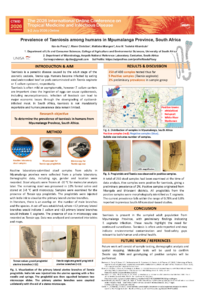
Introduction: Taeniosis is a parasitic disease caused by the adult stage of the zoonotic cestode, Taenia spp. Humans become infected by eating raw/undercooked beef or pork contaminated with Taenia saginata or T. solium cysticerci, respectively. Taenia infections can result in serious diseases such as neurocysticercosis and lead to major economic losses through the downgrading of cysticerci-infected meat. Although taeniosis is a major risk factor for cysticercosis, there are currently few reports on the prevalence of taeniosis in South Africa. Accordingly, this research aims to determine the prevalence of taeniosis in Mpumalanga Province using morphological and molecular techniques.
Methods: Routine laboratory-submitted stool samples originating from adults were obtained from a private pathology laboratory. Samples were examined for the presence of tapeworm proglottids macroscopically, and the detection of taeniid ova was performed by examining wet mounts of the stool samples using microscopy. Species identification was carried out by injecting adult tapeworm proglottids with Indian ink to highlight morphological differences.
Results: Out of 221 stool samples tested thus far, a 2.26% prevalence of taeniosis has been recorded, with positive samples originating from Nkangala and Ehlanzeni districts of the province. Proglottids observed in the positive samples were all identified to be from T. saginata. The preliminary results from this study correlate with published findings in KwaZulu-Natal and the Eastern Cape, with prevalence ranging between 0.78% and 3.8%. Molecular techniques are yet to be conducted to confirm the prevalence of taeniosis in Mpumalanga Province.
Conclusion: South African cases of taeniosis are not mandatorily reportable, despite the clinical and consequential economic impact when livestock become infected. There is a need for targeted public health interventions, improved food safety measures, and enhanced surveillance strategies to mitigate the burden of taeniosis in endemic regions such as South Africa.
Keywords
Zoonosis
Taeniosis
Cysticercosis
Taenia saginata
Taenia solium
Mpumalanga
South Africa
Poster
Ilze_du_Plooy_CTMID_2026_ sciforum-178737_Prevalence of Taeniosis among humans in Mpumalanga Province, South Africa .pdf
Epidemiology of human Brucellosis in rural South Africa: Household survey of seroprevalence and risk factors, 2022–2023.
Severe Mpox in people with advanced HIV disease complicated by disseminated tuberculosis: a report of three cases from Nigeria