Event submissions
Events2026 International Online Conference on Tropical Medicine and Infectious Disease
Published
This submission belongs to the session S2. One Health – Zoonotic Diseases of the event 2026 International Online Conference on Tropical Medicine and Infectious Disease
Published date
26 Jun, 2026
Academic Editor
'%3e%3cpath%20d='M12.6657%2010.9104C12.4185%2010.325%2012.0599%209.79327%2011.6097%209.34482C11.1609%208.89508%2010.6293%208.5365%2010.0442%208.28888C10.0389%208.28626%2010.0337%208.28495%2010.0285%208.28233C10.8446%207.69279%2011.3752%206.73249%2011.3752%205.64904C11.3752%203.8542%209.92103%202.39999%208.1262%202.39999C6.33136%202.39999%204.87715%203.8542%204.87715%205.64904C4.87715%206.73249%205.40774%207.69279%206.22393%208.28364C6.21869%208.28626%206.21345%208.28757%206.20821%208.29019C5.62129%208.5378%205.09463%208.89284%204.64265%209.34613C4.1929%209.79493%203.83432%2010.3266%203.58671%2010.9117C3.34345%2011.4845%203.21226%2012.0987%203.20023%2012.7209C3.19988%2012.7349%203.20233%2012.7488%203.20744%2012.7619C3.21255%2012.7749%203.22022%2012.7867%203.22998%2012.7968C3.23975%2012.8068%203.25142%2012.8147%203.26431%2012.8202C3.2772%2012.8256%203.29105%2012.8284%203.30504%2012.8284H4.09109C4.14874%2012.8284%204.19459%2012.7825%204.1959%2012.7262C4.2221%2011.7148%204.62823%2010.7676%205.34617%2010.0497C6.08899%209.30683%207.0755%208.89808%208.1262%208.89808C9.17689%208.89808%2010.1634%209.30683%2010.9062%2010.0497C11.6242%2010.7676%2012.0303%2011.7148%2012.0565%2012.7262C12.0578%2012.7838%2012.1037%2012.8284%2012.1613%2012.8284H12.9474C12.9613%2012.8284%2012.9752%2012.8256%2012.9881%2012.8202C13.001%2012.8147%2013.0126%2012.8068%2013.0224%2012.7968C13.0322%2012.7867%2013.0398%2012.7749%2013.0449%2012.7619C13.0501%2012.7488%2013.0525%2012.7349%2013.0522%2012.7209C13.0391%2012.0947%2012.9094%2011.4855%2012.6657%2010.9104ZM8.1262%207.9024C7.52486%207.9024%206.9589%207.6679%206.53312%207.24211C6.10733%206.81633%205.87283%206.25037%205.87283%205.64904C5.87283%205.0477%206.10733%204.48174%206.53312%204.05596C6.9589%203.63018%207.52486%203.39567%208.1262%203.39567C8.72753%203.39567%209.29349%203.63018%209.71927%204.05596C10.1451%204.48174%2010.3796%205.0477%2010.3796%205.64904C10.3796%206.25037%2010.1451%206.81633%209.71927%207.24211C9.29349%207.6679%208.72753%207.9024%208.1262%207.9024Z'%20fill='%235D1EE1'/%3e%3c/g%3e%3c/svg%3e) John Frean
John FreanCitation
Rashmi Kavindya, Nayana Gunathilaka, Nipul Kithsiri Gunawardena, Nilmini Chandrasena, Deepika Amarasinghe, Parasitic Contamination of Fresh Green Leafy Vegetables Sold in Open Markets in Sri Lanka during the Second Inter-Monsoon Season: A Cross-Sectional Study, in Proceedings of 2026 International Online Conference on Tropical Medicine and Infectious Disease, 1 July–2 July 2026, MDPI: Basel, Switzerland
Share
Email
Facebook
Twitter
LinkedIn
Parasitic Contamination of Fresh Green Leafy Vegetables Sold in Open Markets in Sri Lanka during the Second Inter-Monsoon Season: A Cross-Sectional Study
'%3e%3cpath%20d='M12.6647%2010.9104C12.4176%2010.325%2012.0589%209.7933%2011.6088%209.34485C11.16%208.89511%2010.6283%208.53653%2010.0432%208.28891C10.038%208.28629%2010.0327%208.28498%2010.0275%208.28236C10.8437%207.69282%2011.3743%206.73252%2011.3743%205.64907C11.3743%203.85423%209.92005%202.40002%208.12522%202.40002C6.33038%202.40002%204.87618%203.85423%204.87618%205.64907C4.87618%206.73252%205.40677%207.69282%206.22296%208.28367C6.21772%208.28629%206.21248%208.2876%206.20724%208.29022C5.62031%208.53783%205.09365%208.89287%204.64167%209.34616C4.19192%209.79496%203.83334%2010.3266%203.58573%2010.9117C3.34247%2011.4846%203.21128%2012.0987%203.19925%2012.721C3.1989%2012.735%203.20135%2012.7489%203.20646%2012.7619C3.21157%2012.7749%203.21924%2012.7868%203.22901%2012.7968C3.23877%2012.8068%203.25045%2012.8148%203.26334%2012.8202C3.27623%2012.8256%203.29007%2012.8284%203.30406%2012.8284H4.09012C4.14776%2012.8284%204.19362%2012.7825%204.19493%2012.7262C4.22113%2011.7148%204.62726%2010.7676%205.34519%2010.0497C6.08802%209.30686%207.07452%208.89811%208.12522%208.89811C9.17592%208.89811%2010.1624%209.30686%2010.9052%2010.0497C11.6232%2010.7676%2012.0293%2011.7148%2012.0555%2012.7262C12.0568%2012.7839%2012.1027%2012.8284%2012.1603%2012.8284H12.9464C12.9604%2012.8284%2012.9742%2012.8256%2012.9871%2012.8202C13%2012.8148%2013.0117%2012.8068%2013.0214%2012.7968C13.0312%2012.7868%2013.0389%2012.7749%2013.044%2012.7619C13.0491%2012.7489%2013.0515%2012.735%2013.0512%2012.721C13.0381%2012.0947%2012.9084%2011.4856%2012.6647%2010.9104ZM8.12522%207.90243C7.52388%207.90243%206.95792%207.66793%206.53214%207.24215C6.10636%206.81636%205.87185%206.2504%205.87185%205.64907C5.87185%205.04773%206.10636%204.48177%206.53214%204.05599C6.95792%203.63021%207.52388%203.3957%208.12522%203.3957C8.72655%203.3957%209.29252%203.63021%209.7183%204.05599C10.1441%204.48177%2010.3786%205.04773%2010.3786%205.64907C10.3786%206.2504%2010.1441%206.81636%209.7183%207.24215C9.29252%207.66793%208.72655%207.90243%208.12522%207.90243Z'%20fill='%235D1EE1'/%3e%3c/g%3e%3c/svg%3e)
Rashmi Kavindya 1
Nayana Gunathilaka 1
Nipul Kithsiri Gunawardena 1
Nilmini Chandrasena 1
Deepika Amarasinghe 2
1. Department of Parasitology, Faculty of Medicine, University of Kelaniya, Sri Lanka
2. Department of Zoology and Environmental Management, Faculty of Science, University of Kelaniya, Sri Lanka
Abstract
Introduction
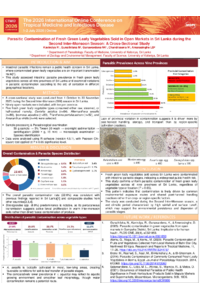
Intestinal parasitic infections remain a public health concern in Sri Lanka, where contaminated green leafy vegetables are an important transmission route. This study assessed intestinal parasite prevalence in fresh green leafy vegetables across all nine provinces of Sri Lanka and examined variations in parasitic contamination according to the site of collection in different geographical locations.
Methods
A cross-sectional study was conducted from October 1 to November 30, 2025, during the Second Inter-Monsoon (SIM) season across all nine provinces of Sri Lanka. Ninety open markets were included, with ten per province. Five fresh green leafy vegetable types consumed either raw, steamed, or half-cooked namely; Centella asiatica (Gotukola, [n=84]), Alternanthera sessilis (Mukunuwenna, [n=86]), Ipomoea aquatica (Kankun, [n=83]), Trianthema portulacastrum (Sarana, [n=52]), and Amaranthus viridis (Thampala, [n=44]) were selected. Approximately 50g of each sample was processed with a Tween 20 (5%) wash followed by overnight sedimentation, and centrifugation (2000×g, 15 min). Microscopic examination of parasites was performed on both the supernatant and sediment of each sample.
Results
The overall parasitic contamination was 22.6% (n=79). A. sessilis recorded the highest prevalence (24/86; 27.9%), while I. aquatica exhibited the lowest (10/83; 12.1%). Medically important parasites, including protozoans (Balantidium coli, Cystoisospora belli, coccidian oocysts morphologically consistent with Toxoplasma gondii) and helminths (Ascaris spp., Hymenolepis spp., Strongyloides spp., Capillaria spp., Toxocara spp., hookworm and taeniid eggs) were detected. Strongyloides spp. was the most prevalent parasite (31/349; 8.9%). No statistically significant differences were observed in the distribution of parasitic species across vegetable types or in prevalence across provinces (P > 0.05).
Conclusions
This study confirms uniform parasitic contamination of fresh green leafy vegetables across all nine provinces of Sri Lanka, regardless of vegetable type or geographical location during the Second Inter-Monsoon season.
Keywords
parasitic
contamination
Sri Lanka
Leafy Vegetables
Second Inter-Monsoon Season
Poster
poster presentation - Rashmi.pdf
Acute-on-Chronic Liver Failure Triggered by Dengue Infection in a Patient with Probable Autoimmune Hepatitis
Identity, not sex or menstrual cycle, drives human body odor and attractiveness to Anopheles gambiae mosquitoes