Event submissions
Events2026 International Online Conference on Tropical Medicine and Infectious Disease
Published
This submission belongs to the session S4. Antimicrobial Resistance of the event 2026 International Online Conference on Tropical Medicine and Infectious Disease
Published date
26 Jun, 2026
Academic Editor
'%3e%3cpath%20d='M12.6657%2010.9104C12.4185%2010.325%2012.0599%209.79327%2011.6097%209.34482C11.1609%208.89508%2010.6293%208.5365%2010.0442%208.28888C10.0389%208.28626%2010.0337%208.28495%2010.0285%208.28233C10.8446%207.69279%2011.3752%206.73249%2011.3752%205.64904C11.3752%203.8542%209.92103%202.39999%208.1262%202.39999C6.33136%202.39999%204.87715%203.8542%204.87715%205.64904C4.87715%206.73249%205.40774%207.69279%206.22393%208.28364C6.21869%208.28626%206.21345%208.28757%206.20821%208.29019C5.62129%208.5378%205.09463%208.89284%204.64265%209.34613C4.1929%209.79493%203.83432%2010.3266%203.58671%2010.9117C3.34345%2011.4845%203.21226%2012.0987%203.20023%2012.7209C3.19988%2012.7349%203.20233%2012.7488%203.20744%2012.7619C3.21255%2012.7749%203.22022%2012.7867%203.22998%2012.7968C3.23975%2012.8068%203.25142%2012.8147%203.26431%2012.8202C3.2772%2012.8256%203.29105%2012.8284%203.30504%2012.8284H4.09109C4.14874%2012.8284%204.19459%2012.7825%204.1959%2012.7262C4.2221%2011.7148%204.62823%2010.7676%205.34617%2010.0497C6.08899%209.30683%207.0755%208.89808%208.1262%208.89808C9.17689%208.89808%2010.1634%209.30683%2010.9062%2010.0497C11.6242%2010.7676%2012.0303%2011.7148%2012.0565%2012.7262C12.0578%2012.7838%2012.1037%2012.8284%2012.1613%2012.8284H12.9474C12.9613%2012.8284%2012.9752%2012.8256%2012.9881%2012.8202C13.001%2012.8147%2013.0126%2012.8068%2013.0224%2012.7968C13.0322%2012.7867%2013.0398%2012.7749%2013.0449%2012.7619C13.0501%2012.7488%2013.0525%2012.7349%2013.0522%2012.7209C13.0391%2012.0947%2012.9094%2011.4855%2012.6657%2010.9104ZM8.1262%207.9024C7.52486%207.9024%206.9589%207.6679%206.53312%207.24211C6.10733%206.81633%205.87283%206.25037%205.87283%205.64904C5.87283%205.0477%206.10733%204.48174%206.53312%204.05596C6.9589%203.63018%207.52486%203.39567%208.1262%203.39567C8.72753%203.39567%209.29349%203.63018%209.71927%204.05596C10.1451%204.48174%2010.3796%205.0477%2010.3796%205.64904C10.3796%206.25037%2010.1451%206.81633%209.71927%207.24211C9.29349%207.6679%208.72753%207.9024%208.1262%207.9024Z'%20fill='%235D1EE1'/%3e%3c/g%3e%3c/svg%3e) Constantinos Tsioutis
Constantinos TsioutisCitation
Bayode Romeo ADEGBITE, Maradona Daouda Agbanrin, Bacterial spectrum and proportion of multidrug-resistant bacteria in clinical samples from a secondary hospital in Lambaréné, Gabon, in Proceedings of 2026 International Online Conference on Tropical Medicine and Infectious Disease, 1 July–2 July 2026, MDPI: Basel, Switzerland
Share
Email
Facebook
Twitter
LinkedIn
Bacterial spectrum and proportion of multidrug-resistant bacteria in clinical samples from a secondary hospital in Lambaréné, Gabon
'%3e%3cpath%20d='M12.6647%2010.9104C12.4176%2010.325%2012.0589%209.7933%2011.6088%209.34485C11.16%208.89511%2010.6283%208.53653%2010.0432%208.28891C10.038%208.28629%2010.0327%208.28498%2010.0275%208.28236C10.8437%207.69282%2011.3743%206.73252%2011.3743%205.64907C11.3743%203.85423%209.92005%202.40002%208.12522%202.40002C6.33038%202.40002%204.87618%203.85423%204.87618%205.64907C4.87618%206.73252%205.40677%207.69282%206.22296%208.28367C6.21772%208.28629%206.21248%208.2876%206.20724%208.29022C5.62031%208.53783%205.09365%208.89287%204.64167%209.34616C4.19192%209.79496%203.83334%2010.3266%203.58573%2010.9117C3.34247%2011.4846%203.21128%2012.0987%203.19925%2012.721C3.1989%2012.735%203.20135%2012.7489%203.20646%2012.7619C3.21157%2012.7749%203.21924%2012.7868%203.22901%2012.7968C3.23877%2012.8068%203.25045%2012.8148%203.26334%2012.8202C3.27623%2012.8256%203.29007%2012.8284%203.30406%2012.8284H4.09012C4.14776%2012.8284%204.19362%2012.7825%204.19493%2012.7262C4.22113%2011.7148%204.62726%2010.7676%205.34519%2010.0497C6.08802%209.30686%207.07452%208.89811%208.12522%208.89811C9.17592%208.89811%2010.1624%209.30686%2010.9052%2010.0497C11.6232%2010.7676%2012.0293%2011.7148%2012.0555%2012.7262C12.0568%2012.7839%2012.1027%2012.8284%2012.1603%2012.8284H12.9464C12.9604%2012.8284%2012.9742%2012.8256%2012.9871%2012.8202C13%2012.8148%2013.0117%2012.8068%2013.0214%2012.7968C13.0312%2012.7868%2013.0389%2012.7749%2013.044%2012.7619C13.0491%2012.7489%2013.0515%2012.735%2013.0512%2012.721C13.0381%2012.0947%2012.9084%2011.4856%2012.6647%2010.9104ZM8.12522%207.90243C7.52388%207.90243%206.95792%207.66793%206.53214%207.24215C6.10636%206.81636%205.87185%206.2504%205.87185%205.64907C5.87185%205.04773%206.10636%204.48177%206.53214%204.05599C6.95792%203.63021%207.52388%203.3957%208.12522%203.3957C8.72655%203.3957%209.29252%203.63021%209.7183%204.05599C10.1441%204.48177%2010.3786%205.04773%2010.3786%205.64907C10.3786%206.2504%2010.1441%206.81636%209.7183%207.24215C9.29252%207.66793%208.72655%207.90243%208.12522%207.90243Z'%20fill='%235D1EE1'/%3e%3c/g%3e%3c/svg%3e)
Bayode Romeo ADEGBITE 1
Maradona Daouda Agbanrin 1
1. Centre de Recherches Médicales de Lambaréné (CERMEL), Lambaréné BP 242, Gabon
Abstract
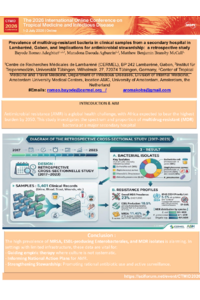
Background: Antimicrobial resistance (AMR) remains a pressing global health challenge, disproportionately affecting low- and middle-income countries (LMICs). This study investigates the spectrum and proportion of multidrug-resistant (MDR) bacteria isolated from clinical samples processed at the Microbiology lab of the Centre de Recherches Médicales de Lambaréné, Lambaréné, Gabon.
Methods: Microbiological laboratory results from 2017 to 2023 were retrospectively analysed to assess the non-susceptibility rates of the most common isolates from seven major types of clinical specimens (urine, blood, stool, wound swabs, urethral swabs, ear swabs, and throat swabs). Standard cultures and interpretation of results were done according to Clinical Laboratory Standards Institute (CLSI) guidelines.
Results: A total of 5,401 were clinically relevant bacterial isolates. The most frequently identified pathogens were Escherichia coli (273/1050; 26%), Staphylococcus aureus (192/1050; 18%), β-hemolytic Streptococci (160/1050; 15%), and Klebsiella pneumoniae (69/1050; 6.6%). Urine samples predominantly yielded E. coli and K. pneumoniae, while S. aureus was most common in wound and blood cultures. Overall, (242/1050; 23%) of isolates were classified as MDR, with E. coli accounting for 40%(96/1050;) of these cases. The proportion of ESBL producers among Enterobacterales was 10.5% (55/522). Resistance to third-generation cephalosporins was notably high, especially among K. pneumoniae (28/69; 41%) and E. coli (34/273; 13%). Methicillin-resistant S. aureus (MRSA) represented 12% (22/192) of S. aureus isolates. According to the WHO 2024 bacterial priority pathogen list, 58/1050 (5.5%) of isolates including carbapenem-resistant Acinetobacter baumannii(3) and ESBL-producing Enterobacterales(55).
Conclusion: This study highlighted the spectrum of bacteria leading causes of clinical infections, in Lambaréné, with urinary isolates dominated by E. coli and wound/blood cultures by S. aureus. Antimicrobial resistance is widespread, with nearly one‑quarter of isolates classified as multidrug resistant, including ESBL-producing Enterobacterales and MRSA. The presence of WHO “Critical Priority” pathogens highlights an urgent need for strengthened surveillance, antimicrobial stewardship, and infection‑control strategies to curb the growing threat of resistance.
Keywords
AMR
MDR
ESBL
bacterial priority pathogen
antimicrobial stedwarship
Poster
sciforum-178295 poster.pdf
Broad-Spectrum Antiviral Activity of 3CLpro Inhibitors against Bat Coronaviruses Utilizing ACE2 or DPP4 Receptors
Rabies Virus Diagnostic Testing—Evidence towards updating tissue sampling DFA testing