Event submissions
Published
This submission belongs to the session S1. Digitalization of NDT Data of the event The 1st International Online Conference on Non-Destructive Testing
Published date
26 Jun, 2026
Academic Editor
'%3e%3cpath%20d='M12.6657%2010.9104C12.4185%2010.325%2012.0599%209.79327%2011.6097%209.34482C11.1609%208.89508%2010.6293%208.5365%2010.0442%208.28888C10.0389%208.28626%2010.0337%208.28495%2010.0285%208.28233C10.8446%207.69279%2011.3752%206.73249%2011.3752%205.64904C11.3752%203.8542%209.92103%202.39999%208.1262%202.39999C6.33136%202.39999%204.87715%203.8542%204.87715%205.64904C4.87715%206.73249%205.40774%207.69279%206.22393%208.28364C6.21869%208.28626%206.21345%208.28757%206.20821%208.29019C5.62129%208.5378%205.09463%208.89284%204.64265%209.34613C4.1929%209.79493%203.83432%2010.3266%203.58671%2010.9117C3.34345%2011.4845%203.21226%2012.0987%203.20023%2012.7209C3.19988%2012.7349%203.20233%2012.7488%203.20744%2012.7619C3.21255%2012.7749%203.22022%2012.7867%203.22998%2012.7968C3.23975%2012.8068%203.25142%2012.8147%203.26431%2012.8202C3.2772%2012.8256%203.29105%2012.8284%203.30504%2012.8284H4.09109C4.14874%2012.8284%204.19459%2012.7825%204.1959%2012.7262C4.2221%2011.7148%204.62823%2010.7676%205.34617%2010.0497C6.08899%209.30683%207.0755%208.89808%208.1262%208.89808C9.17689%208.89808%2010.1634%209.30683%2010.9062%2010.0497C11.6242%2010.7676%2012.0303%2011.7148%2012.0565%2012.7262C12.0578%2012.7838%2012.1037%2012.8284%2012.1613%2012.8284H12.9474C12.9613%2012.8284%2012.9752%2012.8256%2012.9881%2012.8202C13.001%2012.8147%2013.0126%2012.8068%2013.0224%2012.7968C13.0322%2012.7867%2013.0398%2012.7749%2013.0449%2012.7619C13.0501%2012.7488%2013.0525%2012.7349%2013.0522%2012.7209C13.0391%2012.0947%2012.9094%2011.4855%2012.6657%2010.9104ZM8.1262%207.9024C7.52486%207.9024%206.9589%207.6679%206.53312%207.24211C6.10733%206.81633%205.87283%206.25037%205.87283%205.64904C5.87283%205.0477%206.10733%204.48174%206.53312%204.05596C6.9589%203.63018%207.52486%203.39567%208.1262%203.39567C8.72753%203.39567%209.29349%203.63018%209.71927%204.05596C10.1451%204.48174%2010.3796%205.0477%2010.3796%205.64904C10.3796%206.25037%2010.1451%206.81633%209.71927%207.24211C9.29349%207.6679%208.72753%207.9024%208.1262%207.9024Z'%20fill='%235D1EE1'/%3e%3c/g%3e%3c/svg%3e) Fabio Tosti
Fabio TostiCitation
Ruogu Tang, A Simulation-Based Non-Destructive Framework for Assessing Polymer Chain Flexibility, in Proceedings of The 1st International Online Conference on Non-Destructive Testing, 1 July–3 July 2026, MDPI: Basel, Switzerland
Share
Email
Facebook
Twitter
LinkedIn
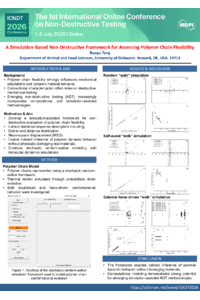
A Simulation-Based Non-Destructive Framework for Assessing Polymer Chain Flexibility

Ruogu Tang 1
1. Department of Chemistry, University of Massachusetts Lowell, Lowell, Massachusetts 01854, USA
Abstract
Non-destructive testing (NDT) increasingly incorporates computational and model-based approaches to enable indirect evaluation of material behavior without physical alteration or damage. In this context, digital and simulation-assisted strategies provide a pathway to infer internal material properties through externally observable responses. In this study, a software-based simulation framework is developed to support non-destructive assessment of polymer chain flexibility and dynamic response under thermal motion and externally applied forces. Polymer chain dynamics are modeled using a stochastic random-walker-based approach combined with molecular motion simulations implemented in the Large-scale Atomic/Molecular Massively Parallel Simulator (LAMMPS), enabling representation of both equilibrium and force-driven behavior at the molecular level.
To establish relevance to NDT, the framework explicitly links internal chain conformation to quantifiable response descriptors that can serve as proxies for measurable signals. Key statistical metrics, including end-to-end distance distributions and mean-square displacement scaling, are extracted to characterize conformational evolution and flexibility under varying conditions. These descriptors provide a predictive basis for interpreting how polymer systems would respond to external probing, thereby enabling indirect inference of material properties without destructive mechanical testing.
Simulation results demonstrate systematic and reproducible changes in polymer chain conformation in response to applied forces, highlighting the sensitivity of the approach to flexibility-related parameters. Overall, this work establishes a simulation-assisted NDT paradigm in which molecular-level modeling supports non-invasive characterization of polymer materials and contributes to the integration of digital methodologies within emerging non-destructive testing frameworks.
Keywords
Non-destructive testing
Polymer flexibility
Computational modeling
Random walk simulation
Digital material assessment
Poster
Poster_Ruogu Tang.pdf
Nondestructive testing digital twin definition
Digitalisation and Multi-Modal Integration of NDT and Remote Sensing Data for Coastal Heritage Monitoring: The Reculver Towers Demonstrator