Event submissions
Events2026 International Online Conference on Tropical Medicine and Infectious Disease
Published
This submission belongs to the session S4. Antimicrobial Resistance of the event 2026 International Online Conference on Tropical Medicine and Infectious Disease
Published date
26 Jun, 2026
Academic Editor
'%3e%3cpath%20d='M12.6657%2010.9104C12.4185%2010.325%2012.0599%209.79327%2011.6097%209.34482C11.1609%208.89508%2010.6293%208.5365%2010.0442%208.28888C10.0389%208.28626%2010.0337%208.28495%2010.0285%208.28233C10.8446%207.69279%2011.3752%206.73249%2011.3752%205.64904C11.3752%203.8542%209.92103%202.39999%208.1262%202.39999C6.33136%202.39999%204.87715%203.8542%204.87715%205.64904C4.87715%206.73249%205.40774%207.69279%206.22393%208.28364C6.21869%208.28626%206.21345%208.28757%206.20821%208.29019C5.62129%208.5378%205.09463%208.89284%204.64265%209.34613C4.1929%209.79493%203.83432%2010.3266%203.58671%2010.9117C3.34345%2011.4845%203.21226%2012.0987%203.20023%2012.7209C3.19988%2012.7349%203.20233%2012.7488%203.20744%2012.7619C3.21255%2012.7749%203.22022%2012.7867%203.22998%2012.7968C3.23975%2012.8068%203.25142%2012.8147%203.26431%2012.8202C3.2772%2012.8256%203.29105%2012.8284%203.30504%2012.8284H4.09109C4.14874%2012.8284%204.19459%2012.7825%204.1959%2012.7262C4.2221%2011.7148%204.62823%2010.7676%205.34617%2010.0497C6.08899%209.30683%207.0755%208.89808%208.1262%208.89808C9.17689%208.89808%2010.1634%209.30683%2010.9062%2010.0497C11.6242%2010.7676%2012.0303%2011.7148%2012.0565%2012.7262C12.0578%2012.7838%2012.1037%2012.8284%2012.1613%2012.8284H12.9474C12.9613%2012.8284%2012.9752%2012.8256%2012.9881%2012.8202C13.001%2012.8147%2013.0126%2012.8068%2013.0224%2012.7968C13.0322%2012.7867%2013.0398%2012.7749%2013.0449%2012.7619C13.0501%2012.7488%2013.0525%2012.7349%2013.0522%2012.7209C13.0391%2012.0947%2012.9094%2011.4855%2012.6657%2010.9104ZM8.1262%207.9024C7.52486%207.9024%206.9589%207.6679%206.53312%207.24211C6.10733%206.81633%205.87283%206.25037%205.87283%205.64904C5.87283%205.0477%206.10733%204.48174%206.53312%204.05596C6.9589%203.63018%207.52486%203.39567%208.1262%203.39567C8.72753%203.39567%209.29349%203.63018%209.71927%204.05596C10.1451%204.48174%2010.3796%205.0477%2010.3796%205.64904C10.3796%206.25037%2010.1451%206.81633%209.71927%207.24211C9.29349%207.6679%208.72753%207.9024%208.1262%207.9024Z'%20fill='%235D1EE1'/%3e%3c/g%3e%3c/svg%3e) Josette Raymond
Josette RaymondCitation
Adnan Abdulkarim Alsaei, Ayah Adel Binrajab, Fatema Nader Rahimi, Ahmad Naim Zarwi, G. Roshan Deen, Beyond “Resistant or Susceptible”: A Framework for Heteroresistance and Within-Host Evolution of Pseudomonas aeruginosa in Cystic Fibrosis, in Proceedings of 2026 International Online Conference on Tropical Medicine and Infectious Disease, 1 July–2 July 2026, MDPI: Basel, Switzerland
Share
Email
Facebook
Twitter
LinkedIn
Beyond “Resistant or Susceptible”: A Framework for Heteroresistance and Within-Host Evolution of Pseudomonas aeruginosa in Cystic Fibrosis
'%3e%3cpath%20d='M12.6647%2010.9104C12.4176%2010.325%2012.0589%209.7933%2011.6088%209.34485C11.16%208.89511%2010.6283%208.53653%2010.0432%208.28891C10.038%208.28629%2010.0327%208.28498%2010.0275%208.28236C10.8437%207.69282%2011.3743%206.73252%2011.3743%205.64907C11.3743%203.85423%209.92005%202.40002%208.12522%202.40002C6.33038%202.40002%204.87618%203.85423%204.87618%205.64907C4.87618%206.73252%205.40677%207.69282%206.22296%208.28367C6.21772%208.28629%206.21248%208.2876%206.20724%208.29022C5.62031%208.53783%205.09365%208.89287%204.64167%209.34616C4.19192%209.79496%203.83334%2010.3266%203.58573%2010.9117C3.34247%2011.4846%203.21128%2012.0987%203.19925%2012.721C3.1989%2012.735%203.20135%2012.7489%203.20646%2012.7619C3.21157%2012.7749%203.21924%2012.7868%203.22901%2012.7968C3.23877%2012.8068%203.25045%2012.8148%203.26334%2012.8202C3.27623%2012.8256%203.29007%2012.8284%203.30406%2012.8284H4.09012C4.14776%2012.8284%204.19362%2012.7825%204.19493%2012.7262C4.22113%2011.7148%204.62726%2010.7676%205.34519%2010.0497C6.08802%209.30686%207.07452%208.89811%208.12522%208.89811C9.17592%208.89811%2010.1624%209.30686%2010.9052%2010.0497C11.6232%2010.7676%2012.0293%2011.7148%2012.0555%2012.7262C12.0568%2012.7839%2012.1027%2012.8284%2012.1603%2012.8284H12.9464C12.9604%2012.8284%2012.9742%2012.8256%2012.9871%2012.8202C13%2012.8148%2013.0117%2012.8068%2013.0214%2012.7968C13.0312%2012.7868%2013.0389%2012.7749%2013.044%2012.7619C13.0491%2012.7489%2013.0515%2012.735%2013.0512%2012.721C13.0381%2012.0947%2012.9084%2011.4856%2012.6647%2010.9104ZM8.12522%207.90243C7.52388%207.90243%206.95792%207.66793%206.53214%207.24215C6.10636%206.81636%205.87185%206.2504%205.87185%205.64907C5.87185%205.04773%206.10636%204.48177%206.53214%204.05599C6.95792%203.63021%207.52388%203.3957%208.12522%203.3957C8.72655%203.3957%209.29252%203.63021%209.7183%204.05599C10.1441%204.48177%2010.3786%205.04773%2010.3786%205.64907C10.3786%206.2504%2010.1441%206.81636%209.7183%207.24215C9.29252%207.66793%208.72655%207.90243%208.12522%207.90243Z'%20fill='%235D1EE1'/%3e%3c/g%3e%3c/svg%3e)
Adnan Abdulkarim Alsaei 1
Ayah Adel Binrajab 1
Fatema Nader Rahimi 1
Ahmad Naim Zarwi 1

G. Roshan Deen 1
1. School of Medicine, Royal college of surgeons in Ireland – Bahrain(RCSI), Busaiteen, Kingdom of Bahrain
Abstract
Introduction: Chronic Pseudomonas aeruginosa infection remains a leading driver of morbidity in cystic fibrosis (CF) and is tightly linked to antimicrobial resistance (AMR). However, treatment failure often occurs even when routine susceptibility testing suggests activity. Emerging evidence indicates that CF airways can act as an evolutionary niche where P. aeruginosa diversifies into co-existing subpopulations with distinct resistance and tolerance profiles. This abstract proposes a framework describing how within-host diversity and heteroresistance contribute to persistent infection and recurrent antibiotic exposure.
Methods: We developed a conceptual framework by synthesizing established mechanisms in CF microbiology and AMR research and mapping them to clinical decision points. The model integrates (i) spatially structured biofilms and mucus-associated microenvironments, (ii) adaptive evolution under repeated antibiotic selection, and (iii) phenotypic heterogeneity (including heteroresistance and tolerant subpopulations) that may be under-detected by single-colony testing. We outline measurable indicators suitable for evaluation, including longitudinal culture patterns, multi-isolate susceptibility profiles, genomic diversity signals, and recurrence-related outcomes.
Results: The framework identifies three mechanisms that can sustain apparent “discordance” between lab susceptibility and clinical response: (1) coexistence of minority resistant subpopulations that expand during therapy, (2) biofilm-associated tolerance reducing effective antibiotic killing despite susceptibility in planktonic assays, and (3) rapid adaptive shifts during repeated treatment cycles. These processes may increase antibiotic burden, promote selection pressure, and accelerate progression to difficult-to-treat phenotypes in CF.
Conclusions: CF-associated P. aeruginosa AMR is not solely a single-strain resistance problem but a dynamic within-host ecosystem challenge. Incorporating within-host diversity into diagnostics and stewardship such as multi-isolate testing and longitudinal surveillanc may better align therapy with real-world AMR biology and reduce treatment failure.
Keywords
Cystic Fibrosis
P.aeurignosa
Antimicrobial Resistance
Heteroresistance
Poster
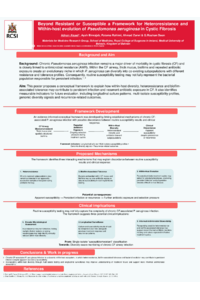
Poster - Tropical Med. Conf..pdf
Rabies Virus Diagnostic Testing—Evidence towards updating tissue sampling DFA testing
Bridging the Diagnostic Gap: Evaluating the Concordance of Genotypic and Phenotypic AMR Detection in a Philippine Tropical Disease Center