Event submissions
Published
This submission belongs to the session S3. Advanced Sensing Technologies of the event The 1st International Online Conference on Non-Destructive Testing
Published date
26 Jun, 2026
Academic Editor
'%3e%3cpath%20d='M12.6657%2010.9104C12.4185%2010.325%2012.0599%209.79327%2011.6097%209.34482C11.1609%208.89508%2010.6293%208.5365%2010.0442%208.28888C10.0389%208.28626%2010.0337%208.28495%2010.0285%208.28233C10.8446%207.69279%2011.3752%206.73249%2011.3752%205.64904C11.3752%203.8542%209.92103%202.39999%208.1262%202.39999C6.33136%202.39999%204.87715%203.8542%204.87715%205.64904C4.87715%206.73249%205.40774%207.69279%206.22393%208.28364C6.21869%208.28626%206.21345%208.28757%206.20821%208.29019C5.62129%208.5378%205.09463%208.89284%204.64265%209.34613C4.1929%209.79493%203.83432%2010.3266%203.58671%2010.9117C3.34345%2011.4845%203.21226%2012.0987%203.20023%2012.7209C3.19988%2012.7349%203.20233%2012.7488%203.20744%2012.7619C3.21255%2012.7749%203.22022%2012.7867%203.22998%2012.7968C3.23975%2012.8068%203.25142%2012.8147%203.26431%2012.8202C3.2772%2012.8256%203.29105%2012.8284%203.30504%2012.8284H4.09109C4.14874%2012.8284%204.19459%2012.7825%204.1959%2012.7262C4.2221%2011.7148%204.62823%2010.7676%205.34617%2010.0497C6.08899%209.30683%207.0755%208.89808%208.1262%208.89808C9.17689%208.89808%2010.1634%209.30683%2010.9062%2010.0497C11.6242%2010.7676%2012.0303%2011.7148%2012.0565%2012.7262C12.0578%2012.7838%2012.1037%2012.8284%2012.1613%2012.8284H12.9474C12.9613%2012.8284%2012.9752%2012.8256%2012.9881%2012.8202C13.001%2012.8147%2013.0126%2012.8068%2013.0224%2012.7968C13.0322%2012.7867%2013.0398%2012.7749%2013.0449%2012.7619C13.0501%2012.7488%2013.0525%2012.7349%2013.0522%2012.7209C13.0391%2012.0947%2012.9094%2011.4855%2012.6657%2010.9104ZM8.1262%207.9024C7.52486%207.9024%206.9589%207.6679%206.53312%207.24211C6.10733%206.81633%205.87283%206.25037%205.87283%205.64904C5.87283%205.0477%206.10733%204.48174%206.53312%204.05596C6.9589%203.63018%207.52486%203.39567%208.1262%203.39567C8.72753%203.39567%209.29349%203.63018%209.71927%204.05596C10.1451%204.48174%2010.3796%205.0477%2010.3796%205.64904C10.3796%206.25037%2010.1451%206.81633%209.71927%207.24211C9.29349%207.6679%208.72753%207.9024%208.1262%207.9024Z'%20fill='%235D1EE1'/%3e%3c/g%3e%3c/svg%3e) Fabio Tosti
Fabio TostiCitation
Natalia Carolina Lara Davila, Jorge Andres Montoya Cardona, Taper-Like Longitudinal Variations in Etched SMS Fibers: Modal Evolution and Spectral Response for Optical Sensing, in Proceedings of The 1st International Online Conference on Non-Destructive Testing, 1 July–3 July 2026, MDPI: Basel, Switzerland
Share
Email
Facebook
Twitter
LinkedIn
Taper-Like Longitudinal Variations in Etched SMS Fibers: Modal Evolution and Spectral Response for Optical Sensing
'%3e%3cpath%20d='M12.6647%2010.9104C12.4176%2010.325%2012.0589%209.7933%2011.6088%209.34485C11.16%208.89511%2010.6283%208.53653%2010.0432%208.28891C10.038%208.28629%2010.0327%208.28498%2010.0275%208.28236C10.8437%207.69282%2011.3743%206.73252%2011.3743%205.64907C11.3743%203.85423%209.92005%202.40002%208.12522%202.40002C6.33038%202.40002%204.87618%203.85423%204.87618%205.64907C4.87618%206.73252%205.40677%207.69282%206.22296%208.28367C6.21772%208.28629%206.21248%208.2876%206.20724%208.29022C5.62031%208.53783%205.09365%208.89287%204.64167%209.34616C4.19192%209.79496%203.83334%2010.3266%203.58573%2010.9117C3.34247%2011.4846%203.21128%2012.0987%203.19925%2012.721C3.1989%2012.735%203.20135%2012.7489%203.20646%2012.7619C3.21157%2012.7749%203.21924%2012.7868%203.22901%2012.7968C3.23877%2012.8068%203.25045%2012.8148%203.26334%2012.8202C3.27623%2012.8256%203.29007%2012.8284%203.30406%2012.8284H4.09012C4.14776%2012.8284%204.19362%2012.7825%204.19493%2012.7262C4.22113%2011.7148%204.62726%2010.7676%205.34519%2010.0497C6.08802%209.30686%207.07452%208.89811%208.12522%208.89811C9.17592%208.89811%2010.1624%209.30686%2010.9052%2010.0497C11.6232%2010.7676%2012.0293%2011.7148%2012.0555%2012.7262C12.0568%2012.7839%2012.1027%2012.8284%2012.1603%2012.8284H12.9464C12.9604%2012.8284%2012.9742%2012.8256%2012.9871%2012.8202C13%2012.8148%2013.0117%2012.8068%2013.0214%2012.7968C13.0312%2012.7868%2013.0389%2012.7749%2013.044%2012.7619C13.0491%2012.7489%2013.0515%2012.735%2013.0512%2012.721C13.0381%2012.0947%2012.9084%2011.4856%2012.6647%2010.9104ZM8.12522%207.90243C7.52388%207.90243%206.95792%207.66793%206.53214%207.24215C6.10636%206.81636%205.87185%206.2504%205.87185%205.64907C5.87185%205.04773%206.10636%204.48177%206.53214%204.05599C6.95792%203.63021%207.52388%203.3957%208.12522%203.3957C8.72655%203.3957%209.29252%203.63021%209.7183%204.05599C10.1441%204.48177%2010.3786%205.04773%2010.3786%205.64907C10.3786%206.2504%2010.1441%206.81636%209.7183%207.24215C9.29252%207.66793%208.72655%207.90243%208.12522%207.90243Z'%20fill='%235D1EE1'/%3e%3c/g%3e%3c/svg%3e)
Natalia Carolina Lara Davila 1

Jorge Andres Montoya Cardona 1
1. Department of Electronic and Telecommunications Engineering, Institución Universitaria ITM, A. A ,050013 Medellin, Colombia
Abstract
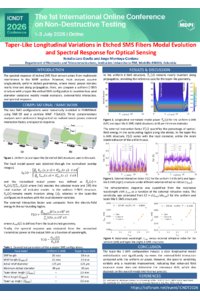
Since their early development, fiber optic sensors have established themselves as functional tools in industrial and scientific applications. Among them, interferometric configurations based on singlemode–multimode–singlemode (SMS) fibers have become attractive due to their ease of fabrication, low cost, and high sensitivity. Their spectral response is governed by multimode interference (MMI) within the multimode fiber (MMF) section.
In etched SMS (E-SMS) configurations, the reduced MMF diameter increases the overlap between the guided optical field and the surrounding medium, which is directly related to refractometric response and is relevant for non-destructive optical sensing schemes. However, most analyses assume longitudinally uniform geometries, where the modal power distribution Pm (z) remains approximately invariant along the propagation coordinate z. This limits the understanding of how longitudinal variations, such as taper-like longitudinal diameter variations, influence modal evolution and external-field interaction, and the resulting transmission spectrum.
In this work, a computational framework is developed to compare a uniformly E-SMS structure with configurations exhibiting taper-like longitudinal diameter variations in the MMF section. The analysis focuses on how these axial geometry changes affect the evolution of the modal amplitudes along the propagation coordinate z and, consequently, the redistribution of optical power within the device. A power-normalized modal decomposition is used to obtain the longitudinal modal amplitudes am(z) and corresponding modal power distributions Pm(z) = |am(z)|2, allowing the excited modes in both configurations to be identified and their contribution to MMI to be examined. In addition, a mode-resolved external interaction factor is introduced from the electric-field energy in the surrounding region, linking modal evolution with field exposure to the external medium. In this way, the framework is intended to assess how taper-like longitudinal variations may promote clearer transmission features and provide a physically grounded basis for comparing the sensitivity potential of both configurations in non-destructive optical sensing applications.
Keywords
Etched SMS fibers
taper-like longitudinal variations
modal evolution
transmission spectrum
optical sensing
Poster
Poster_ Taper-Like Longitudinal Variations in Etched SMS Fibers Modal Evolution and Spectral Response for Optical Sensing.pdf
Defect Evaluation in Ferromagnetic Materials Using a Custom-Designed Instrument for Magnetic Barkhausen Noise and Hysteresis Loop Measurements
Non-interferometric visualization of 3D speckle field singularity structure