Event submissions
Events2026 International Online Conference on Tropical Medicine and Infectious Disease
Published
This submission belongs to the session S3. Neglected Tropical Diseases of the event 2026 International Online Conference on Tropical Medicine and Infectious Disease
Published date
26 Jun, 2026
Academic Editor
'%3e%3cpath%20d='M12.6657%2010.9104C12.4185%2010.325%2012.0599%209.79327%2011.6097%209.34482C11.1609%208.89508%2010.6293%208.5365%2010.0442%208.28888C10.0389%208.28626%2010.0337%208.28495%2010.0285%208.28233C10.8446%207.69279%2011.3752%206.73249%2011.3752%205.64904C11.3752%203.8542%209.92103%202.39999%208.1262%202.39999C6.33136%202.39999%204.87715%203.8542%204.87715%205.64904C4.87715%206.73249%205.40774%207.69279%206.22393%208.28364C6.21869%208.28626%206.21345%208.28757%206.20821%208.29019C5.62129%208.5378%205.09463%208.89284%204.64265%209.34613C4.1929%209.79493%203.83432%2010.3266%203.58671%2010.9117C3.34345%2011.4845%203.21226%2012.0987%203.20023%2012.7209C3.19988%2012.7349%203.20233%2012.7488%203.20744%2012.7619C3.21255%2012.7749%203.22022%2012.7867%203.22998%2012.7968C3.23975%2012.8068%203.25142%2012.8147%203.26431%2012.8202C3.2772%2012.8256%203.29105%2012.8284%203.30504%2012.8284H4.09109C4.14874%2012.8284%204.19459%2012.7825%204.1959%2012.7262C4.2221%2011.7148%204.62823%2010.7676%205.34617%2010.0497C6.08899%209.30683%207.0755%208.89808%208.1262%208.89808C9.17689%208.89808%2010.1634%209.30683%2010.9062%2010.0497C11.6242%2010.7676%2012.0303%2011.7148%2012.0565%2012.7262C12.0578%2012.7838%2012.1037%2012.8284%2012.1613%2012.8284H12.9474C12.9613%2012.8284%2012.9752%2012.8256%2012.9881%2012.8202C13.001%2012.8147%2013.0126%2012.8068%2013.0224%2012.7968C13.0322%2012.7867%2013.0398%2012.7749%2013.0449%2012.7619C13.0501%2012.7488%2013.0525%2012.7349%2013.0522%2012.7209C13.0391%2012.0947%2012.9094%2011.4855%2012.6657%2010.9104ZM8.1262%207.9024C7.52486%207.9024%206.9589%207.6679%206.53312%207.24211C6.10733%206.81633%205.87283%206.25037%205.87283%205.64904C5.87283%205.0477%206.10733%204.48174%206.53312%204.05596C6.9589%203.63018%207.52486%203.39567%208.1262%203.39567C8.72753%203.39567%209.29349%203.63018%209.71927%204.05596C10.1451%204.48174%2010.3796%205.0477%2010.3796%205.64904C10.3796%206.25037%2010.1451%206.81633%209.71927%207.24211C9.29349%207.6679%208.72753%207.9024%208.1262%207.9024Z'%20fill='%235D1EE1'/%3e%3c/g%3e%3c/svg%3e) Archie Clements
Archie ClementsCitation
Sandun Bandara, Asha Dilrukshi Wijegunawardana, Community-Level Profiling of Gut Bacteria in Sand Flies from a Human Leishmaniasis-Endemic Region: Implications for Disease Transmission and Control, in Proceedings of 2026 International Online Conference on Tropical Medicine and Infectious Disease, 1 July–2 July 2026, MDPI: Basel, Switzerland
Share
Email
Facebook
Twitter
LinkedIn
Community-Level Profiling of Gut Bacteria in Sand Flies from a Human Leishmaniasis-Endemic Region: Implications for Disease Transmission and Control
'%3e%3cpath%20d='M12.6647%2010.9104C12.4176%2010.325%2012.0589%209.7933%2011.6088%209.34485C11.16%208.89511%2010.6283%208.53653%2010.0432%208.28891C10.038%208.28629%2010.0327%208.28498%2010.0275%208.28236C10.8437%207.69282%2011.3743%206.73252%2011.3743%205.64907C11.3743%203.85423%209.92005%202.40002%208.12522%202.40002C6.33038%202.40002%204.87618%203.85423%204.87618%205.64907C4.87618%206.73252%205.40677%207.69282%206.22296%208.28367C6.21772%208.28629%206.21248%208.2876%206.20724%208.29022C5.62031%208.53783%205.09365%208.89287%204.64167%209.34616C4.19192%209.79496%203.83334%2010.3266%203.58573%2010.9117C3.34247%2011.4846%203.21128%2012.0987%203.19925%2012.721C3.1989%2012.735%203.20135%2012.7489%203.20646%2012.7619C3.21157%2012.7749%203.21924%2012.7868%203.22901%2012.7968C3.23877%2012.8068%203.25045%2012.8148%203.26334%2012.8202C3.27623%2012.8256%203.29007%2012.8284%203.30406%2012.8284H4.09012C4.14776%2012.8284%204.19362%2012.7825%204.19493%2012.7262C4.22113%2011.7148%204.62726%2010.7676%205.34519%2010.0497C6.08802%209.30686%207.07452%208.89811%208.12522%208.89811C9.17592%208.89811%2010.1624%209.30686%2010.9052%2010.0497C11.6232%2010.7676%2012.0293%2011.7148%2012.0555%2012.7262C12.0568%2012.7839%2012.1027%2012.8284%2012.1603%2012.8284H12.9464C12.9604%2012.8284%2012.9742%2012.8256%2012.9871%2012.8202C13%2012.8148%2013.0117%2012.8068%2013.0214%2012.7968C13.0312%2012.7868%2013.0389%2012.7749%2013.044%2012.7619C13.0491%2012.7489%2013.0515%2012.735%2013.0512%2012.721C13.0381%2012.0947%2012.9084%2011.4856%2012.6647%2010.9104ZM8.12522%207.90243C7.52388%207.90243%206.95792%207.66793%206.53214%207.24215C6.10636%206.81636%205.87185%206.2504%205.87185%205.64907C5.87185%205.04773%206.10636%204.48177%206.53214%204.05599C6.95792%203.63021%207.52388%203.3957%208.12522%203.3957C8.72655%203.3957%209.29252%203.63021%209.7183%204.05599C10.1441%204.48177%2010.3786%205.04773%2010.3786%205.64907C10.3786%206.2504%2010.1441%206.81636%209.7183%207.24215C9.29252%207.66793%208.72655%207.90243%208.12522%207.90243Z'%20fill='%235D1EE1'/%3e%3c/g%3e%3c/svg%3e)
Sandun Bandara 1

Asha Dilrukshi Wijegunawardana 1
1. Department of Bioprocess Technology, Faculty of Technology, Rajarata University of Sri Lanka, Mihintale, Sri Lanka
Abstract
Introduction: Leishmaniasis is a neglected tropical disease affecting millions worldwide, and Sri Lanka has reported increasing human cases annually. The interaction between sand fly vectors, their gut microbiota, and Leishmania parasites influences human disease transmission. Understanding vector gut bacterial communities in disease-endemic areas is therefore important for developing novel strategies to interrupt human infection cycles.
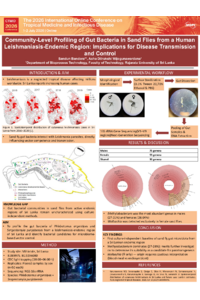
Methods: Sand flies were collected from Mihintale, a confirmed leishmaniasis-endemic region with active human cases, to investigate gut bacterial profiles relevant to human disease transmission. Light traps were placed in peridomestic environments (buffalo cattle sheds) adjacent to human dwellings between 18:00-06:00 hours. Following morphological identification, 50 male and 50 female Phlebotomus argentipes and Sergentomyia punjabensis were surface-sterilized and dissected. Pooled male and female gut samples were subjected to next-generation sequencing of the 16S rRNA gene (V1-V9 regions) to characterize bacterial communities.
Results: Analysis revealed 75 bacterial genera in males and 53 in females across both Phlebotomus argentipes and Sergentomyia punjabensis populations collected from this disease-endemic region. Across both species, Methylobacterium was the most abundant genus in males (27.01%) and females (28.04%). Thirty bacterial genera constituted a core microbiota shared between sexes. Wolbachia was detected exclusively in female sand flies.
Conclusions: This culture-independent profiling provides baseline data on the gut bacterial communities associated with sand fly vectors in a Sri Lankan endemic region. The abundance of Methylobacterium merits further investigation to determine its suitability as a candidate for paratransgenesis. The detection of Wolbachia exclusively in females requires cautious interpretation, as it may reflect acquisition during blood feeding from other hosts rather than a stable endosymbiotic association. Future studies should focus on confirming the origin and heritability of Wolbachia in Phlebotomus argentipes and evaluating the functional role of core microbiota in vector competence to inform the development of microbiome-based intervention strategies.
Keywords
Leishmaniasis
human disease transmission
Phlebotomus argentipes
gut microbiome
vector control
Poster
sciforum-176502 Poster.pdf
Sustaining Lymphatic Filariasis Elimination: A Systematic Review of Post-Intervention and Post-Validation Challenges
Serum-based untargeted metabolomics to investigate possible indicators of asymptomatic Lymphatic Filariasis