Event submissions
Published
This submission belongs to the session S7. NDT in Cultural Heritage Preservation of the event The 1st International Online Conference on Non-Destructive Testing
Published date
26 Jun, 2026
Academic Editor
'%3e%3cpath%20d='M12.6657%2010.9104C12.4185%2010.325%2012.0599%209.79327%2011.6097%209.34482C11.1609%208.89508%2010.6293%208.5365%2010.0442%208.28888C10.0389%208.28626%2010.0337%208.28495%2010.0285%208.28233C10.8446%207.69279%2011.3752%206.73249%2011.3752%205.64904C11.3752%203.8542%209.92103%202.39999%208.1262%202.39999C6.33136%202.39999%204.87715%203.8542%204.87715%205.64904C4.87715%206.73249%205.40774%207.69279%206.22393%208.28364C6.21869%208.28626%206.21345%208.28757%206.20821%208.29019C5.62129%208.5378%205.09463%208.89284%204.64265%209.34613C4.1929%209.79493%203.83432%2010.3266%203.58671%2010.9117C3.34345%2011.4845%203.21226%2012.0987%203.20023%2012.7209C3.19988%2012.7349%203.20233%2012.7488%203.20744%2012.7619C3.21255%2012.7749%203.22022%2012.7867%203.22998%2012.7968C3.23975%2012.8068%203.25142%2012.8147%203.26431%2012.8202C3.2772%2012.8256%203.29105%2012.8284%203.30504%2012.8284H4.09109C4.14874%2012.8284%204.19459%2012.7825%204.1959%2012.7262C4.2221%2011.7148%204.62823%2010.7676%205.34617%2010.0497C6.08899%209.30683%207.0755%208.89808%208.1262%208.89808C9.17689%208.89808%2010.1634%209.30683%2010.9062%2010.0497C11.6242%2010.7676%2012.0303%2011.7148%2012.0565%2012.7262C12.0578%2012.7838%2012.1037%2012.8284%2012.1613%2012.8284H12.9474C12.9613%2012.8284%2012.9752%2012.8256%2012.9881%2012.8202C13.001%2012.8147%2013.0126%2012.8068%2013.0224%2012.7968C13.0322%2012.7867%2013.0398%2012.7749%2013.0449%2012.7619C13.0501%2012.7488%2013.0525%2012.7349%2013.0522%2012.7209C13.0391%2012.0947%2012.9094%2011.4855%2012.6657%2010.9104ZM8.1262%207.9024C7.52486%207.9024%206.9589%207.6679%206.53312%207.24211C6.10733%206.81633%205.87283%206.25037%205.87283%205.64904C5.87283%205.0477%206.10733%204.48174%206.53312%204.05596C6.9589%203.63018%207.52486%203.39567%208.1262%203.39567C8.72753%203.39567%209.29349%203.63018%209.71927%204.05596C10.1451%204.48174%2010.3796%205.0477%2010.3796%205.64904C10.3796%206.25037%2010.1451%206.81633%209.71927%207.24211C9.29349%207.6679%208.72753%207.9024%208.1262%207.9024Z'%20fill='%235D1EE1'/%3e%3c/g%3e%3c/svg%3e) Fabio Tosti
Fabio TostiCitation
Yexin Zhou, Koji Shibazaki, Yoichi Ohyanagi, Akiko Iwata, Interpretable Non-Destructive Discrimination of Japanese Bast Fibers via Micro-Hyperspectral Imaging, in Proceedings of The 1st International Online Conference on Non-Destructive Testing, 1 July–3 July 2026, MDPI: Basel, Switzerland
Share
Email
Facebook
Twitter
LinkedIn
Interpretable Non-Destructive Discrimination of Japanese Bast Fibers via Micro-Hyperspectral Imaging
'%3e%3cpath%20d='M12.6647%2010.9104C12.4176%2010.325%2012.0589%209.7933%2011.6088%209.34485C11.16%208.89511%2010.6283%208.53653%2010.0432%208.28891C10.038%208.28629%2010.0327%208.28498%2010.0275%208.28236C10.8437%207.69282%2011.3743%206.73252%2011.3743%205.64907C11.3743%203.85423%209.92005%202.40002%208.12522%202.40002C6.33038%202.40002%204.87618%203.85423%204.87618%205.64907C4.87618%206.73252%205.40677%207.69282%206.22296%208.28367C6.21772%208.28629%206.21248%208.2876%206.20724%208.29022C5.62031%208.53783%205.09365%208.89287%204.64167%209.34616C4.19192%209.79496%203.83334%2010.3266%203.58573%2010.9117C3.34247%2011.4846%203.21128%2012.0987%203.19925%2012.721C3.1989%2012.735%203.20135%2012.7489%203.20646%2012.7619C3.21157%2012.7749%203.21924%2012.7868%203.22901%2012.7968C3.23877%2012.8068%203.25045%2012.8148%203.26334%2012.8202C3.27623%2012.8256%203.29007%2012.8284%203.30406%2012.8284H4.09012C4.14776%2012.8284%204.19362%2012.7825%204.19493%2012.7262C4.22113%2011.7148%204.62726%2010.7676%205.34519%2010.0497C6.08802%209.30686%207.07452%208.89811%208.12522%208.89811C9.17592%208.89811%2010.1624%209.30686%2010.9052%2010.0497C11.6232%2010.7676%2012.0293%2011.7148%2012.0555%2012.7262C12.0568%2012.7839%2012.1027%2012.8284%2012.1603%2012.8284H12.9464C12.9604%2012.8284%2012.9742%2012.8256%2012.9871%2012.8202C13%2012.8148%2013.0117%2012.8068%2013.0214%2012.7968C13.0312%2012.7868%2013.0389%2012.7749%2013.044%2012.7619C13.0491%2012.7489%2013.0515%2012.735%2013.0512%2012.721C13.0381%2012.0947%2012.9084%2011.4856%2012.6647%2010.9104ZM8.12522%207.90243C7.52388%207.90243%206.95792%207.66793%206.53214%207.24215C6.10636%206.81636%205.87185%206.2504%205.87185%205.64907C5.87185%205.04773%206.10636%204.48177%206.53214%204.05599C6.95792%203.63021%207.52388%203.3957%208.12522%203.3957C8.72655%203.3957%209.29252%203.63021%209.7183%204.05599C10.1441%204.48177%2010.3786%205.04773%2010.3786%205.64907C10.3786%206.2504%2010.1441%206.81636%209.7183%207.24215C9.29252%207.66793%208.72655%207.90243%208.12522%207.90243Z'%20fill='%235D1EE1'/%3e%3c/g%3e%3c/svg%3e)
Yexin Zhou 1
Koji Shibazaki 2
Yoichi Ohyanagi 2
Akiko Iwata 2
1. Life and Culture Department, Seirei Women’s Junior College, Hamamatsu, Japan
2. Faculty of Fine Arts, Aichi University of the Arts, Nagakute, Japan
Abstract
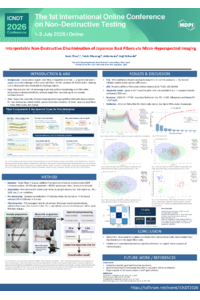
Accurate paper fiber identification is essential for cultural heritage conservation to select appropriate repair materials. However, conventional methods are often destructive, and macroscopic data-driven approaches lack physicochemical interpretability. This study introduces a non-destructive, interpretable approach to discriminate three traditional Japanese bast fibers (Kozo, Mitsumata, Gampi) using micro-hyperspectral imaging (Micro-HSI) combined with chemometric analysis.
Using well-documented, undyed, single-raw-material samples from an authenticated archive, we established baseline spectral characteristics. Reflectance spectra from microscopic regions were collected in the 400–1000 nm range. Data were preprocessed using Savitzky–Golay first derivative filtering and Z-score normalization to mitigate baseline drift and intensity variations.
While principal component analysis (PCA) yielded limited separation due to the fibers' similar cellulose compositions, linear discriminant analysis (LDA) achieved clear classification. LDA highlighted subtle spectral differences, with key discriminative features linked to visible-range baseline variations, lignin-related absorption (400–450 nm), and near-infrared O–H and C–H overtone vibrations (~835 nm).
As this is currently a feasibility study, the model relies on pristine samples. Future work will expand the dataset to include aged, mixed-fiber, and geographically diverse papers, incorporating additional preprocessing methods like standard normal variate (SNV) to enhance robustness. These findings validate Micro-HSI as an effective, non-destructive tool for fiber identification, providing a crucial baseline for the future conservation of historical paper artifacts.
Keywords
non-destructive testing (NDT)
micro-hyperspectral imaging (Micro-HSI)
paper fiber identification
chemometrics
cultural heritage conservation
bast fiber identification
Poster
ICNDT2026_poster_BastFiber_MicroHSI.pdf
High-Resolution GPR Diagnostics for Historical Wall Paintings: A Case Study of Giotto’s Paintings in Florence
Integrating Non-Destructive Testing with HBIM for the Preservation of Timber-Framed Masonry Heritage Structures in Switzerland