Event submissions
Events2026 International Online Conference on Tropical Medicine and Infectious Disease
Published
This submission belongs to the session S3. Neglected Tropical Diseases of the event 2026 International Online Conference on Tropical Medicine and Infectious Disease
Published date
26 Jun, 2026
Academic Editor
'%3e%3cpath%20d='M12.6657%2010.9104C12.4185%2010.325%2012.0599%209.79327%2011.6097%209.34482C11.1609%208.89508%2010.6293%208.5365%2010.0442%208.28888C10.0389%208.28626%2010.0337%208.28495%2010.0285%208.28233C10.8446%207.69279%2011.3752%206.73249%2011.3752%205.64904C11.3752%203.8542%209.92103%202.39999%208.1262%202.39999C6.33136%202.39999%204.87715%203.8542%204.87715%205.64904C4.87715%206.73249%205.40774%207.69279%206.22393%208.28364C6.21869%208.28626%206.21345%208.28757%206.20821%208.29019C5.62129%208.5378%205.09463%208.89284%204.64265%209.34613C4.1929%209.79493%203.83432%2010.3266%203.58671%2010.9117C3.34345%2011.4845%203.21226%2012.0987%203.20023%2012.7209C3.19988%2012.7349%203.20233%2012.7488%203.20744%2012.7619C3.21255%2012.7749%203.22022%2012.7867%203.22998%2012.7968C3.23975%2012.8068%203.25142%2012.8147%203.26431%2012.8202C3.2772%2012.8256%203.29105%2012.8284%203.30504%2012.8284H4.09109C4.14874%2012.8284%204.19459%2012.7825%204.1959%2012.7262C4.2221%2011.7148%204.62823%2010.7676%205.34617%2010.0497C6.08899%209.30683%207.0755%208.89808%208.1262%208.89808C9.17689%208.89808%2010.1634%209.30683%2010.9062%2010.0497C11.6242%2010.7676%2012.0303%2011.7148%2012.0565%2012.7262C12.0578%2012.7838%2012.1037%2012.8284%2012.1613%2012.8284H12.9474C12.9613%2012.8284%2012.9752%2012.8256%2012.9881%2012.8202C13.001%2012.8147%2013.0126%2012.8068%2013.0224%2012.7968C13.0322%2012.7867%2013.0398%2012.7749%2013.0449%2012.7619C13.0501%2012.7488%2013.0525%2012.7349%2013.0522%2012.7209C13.0391%2012.0947%2012.9094%2011.4855%2012.6657%2010.9104ZM8.1262%207.9024C7.52486%207.9024%206.9589%207.6679%206.53312%207.24211C6.10733%206.81633%205.87283%206.25037%205.87283%205.64904C5.87283%205.0477%206.10733%204.48174%206.53312%204.05596C6.9589%203.63018%207.52486%203.39567%208.1262%203.39567C8.72753%203.39567%209.29349%203.63018%209.71927%204.05596C10.1451%204.48174%2010.3796%205.0477%2010.3796%205.64904C10.3796%206.25037%2010.1451%206.81633%209.71927%207.24211C9.29349%207.6679%208.72753%207.9024%208.1262%207.9024Z'%20fill='%235D1EE1'/%3e%3c/g%3e%3c/svg%3e) Archie Clements
Archie ClementsCitation
Tripti Singh, Shivani Sharma, Anchal Singh, Serum-based untargeted metabolomics to investigate possible indicators of asymptomatic Lymphatic Filariasis, in Proceedings of 2026 International Online Conference on Tropical Medicine and Infectious Disease, 1 July–2 July 2026, MDPI: Basel, Switzerland
Share
Email
Facebook
Twitter
LinkedIn
Serum-based untargeted metabolomics to investigate possible indicators of asymptomatic Lymphatic Filariasis
'%3e%3cpath%20d='M12.6647%2010.9104C12.4176%2010.325%2012.0589%209.7933%2011.6088%209.34485C11.16%208.89511%2010.6283%208.53653%2010.0432%208.28891C10.038%208.28629%2010.0327%208.28498%2010.0275%208.28236C10.8437%207.69282%2011.3743%206.73252%2011.3743%205.64907C11.3743%203.85423%209.92005%202.40002%208.12522%202.40002C6.33038%202.40002%204.87618%203.85423%204.87618%205.64907C4.87618%206.73252%205.40677%207.69282%206.22296%208.28367C6.21772%208.28629%206.21248%208.2876%206.20724%208.29022C5.62031%208.53783%205.09365%208.89287%204.64167%209.34616C4.19192%209.79496%203.83334%2010.3266%203.58573%2010.9117C3.34247%2011.4846%203.21128%2012.0987%203.19925%2012.721C3.1989%2012.735%203.20135%2012.7489%203.20646%2012.7619C3.21157%2012.7749%203.21924%2012.7868%203.22901%2012.7968C3.23877%2012.8068%203.25045%2012.8148%203.26334%2012.8202C3.27623%2012.8256%203.29007%2012.8284%203.30406%2012.8284H4.09012C4.14776%2012.8284%204.19362%2012.7825%204.19493%2012.7262C4.22113%2011.7148%204.62726%2010.7676%205.34519%2010.0497C6.08802%209.30686%207.07452%208.89811%208.12522%208.89811C9.17592%208.89811%2010.1624%209.30686%2010.9052%2010.0497C11.6232%2010.7676%2012.0293%2011.7148%2012.0555%2012.7262C12.0568%2012.7839%2012.1027%2012.8284%2012.1603%2012.8284H12.9464C12.9604%2012.8284%2012.9742%2012.8256%2012.9871%2012.8202C13%2012.8148%2013.0117%2012.8068%2013.0214%2012.7968C13.0312%2012.7868%2013.0389%2012.7749%2013.044%2012.7619C13.0491%2012.7489%2013.0515%2012.735%2013.0512%2012.721C13.0381%2012.0947%2012.9084%2011.4856%2012.6647%2010.9104ZM8.12522%207.90243C7.52388%207.90243%206.95792%207.66793%206.53214%207.24215C6.10636%206.81636%205.87185%206.2504%205.87185%205.64907C5.87185%205.04773%206.10636%204.48177%206.53214%204.05599C6.95792%203.63021%207.52388%203.3957%208.12522%203.3957C8.72655%203.3957%209.29252%203.63021%209.7183%204.05599C10.1441%204.48177%2010.3786%205.04773%2010.3786%205.64907C10.3786%206.2504%2010.1441%206.81636%209.7183%207.24215C9.29252%207.66793%208.72655%207.90243%208.12522%207.90243Z'%20fill='%235D1EE1'/%3e%3c/g%3e%3c/svg%3e)
Tripti Singh 1
Shivani Sharma 1
Anchal Singh 1
1. Department of Biochemistry, Institute of Science, Banaras Hindu University, Varanasi, India
Abstract
Abstract
Introduction
Lymphatic filariasis (LF), a devastating tropical disease caused by the parasitic filarial worms Wuchereria bancrofti, Brugia malayi, and Brugia timori, continues to pose a substantial public health challenge in endemic tropical and subtropical regions. After malaria, it is the second most prevalent vector-borne illness. A wide range of clinical manifestations are associated with LF. The clinical symptoms of LF are varied, ranging from asymptomatic or subclinical infections with circulating microfilariae to pronounced pathologies such as lymphedema, elephantiasis, and hydrocele. The diagnosis of asymptomatic LF infections can be challenging since microscopy, serological tests, and antigen detection tests may exhibit decreased sensitivity in certain instances.
Methods
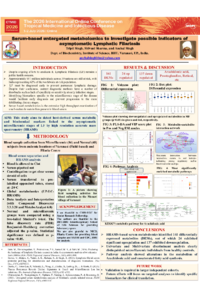
Serum samples were collected from 84 microfilaremic individuals and 48 healthy volunteers residing in the endemic districts of Eastern Uttar Pradesh. The serum samples were processed, and the metabolites were extracted and identified via High-Resolution Accurate Mass Spectrometry (HRAMS)-based metabolomics. Metabolomic data analysis was conducted using the default parameters of "Compound Discoverer 3.3.3.20" software. A two-tailed Student's t-test was employed to assess feature differences between healthy and microfilaremic groups. The p-value was adjusted using the Benjamini–Hochberg correction for false discovery rate (FDR). A p-value of <0.05 was regarded as statistically significant. The "MetaboAnalyst 6.0" platform was utilized for pathway and network analyses.
Results
A total of 161 metabolites were uncovered, with 24 exhibiting significant upregulation and 137 exhibiting significant downregulation. Multivariate and univariate statistical analysis demonstrated significant metabolic differences distinguishing microfilaremic individuals from healthy controls. Additionally, pathway analysis of the metabolites showed changes in the metabolism of arachidonic acid and unsaturated fatty acid synthesis. Network analysis identified metabolites that had significant clinical implications.
Conclusions
The findings indicate an alteration in the host serum metabolome during the microfilaremic stage of lymphatic filariasis, which could function as possible biomarkers for early disease detection, surveillance, and therapeutic intervention.
Keywords
Lymphatic Filariasis
Asymptomatic filariasis
HRAMS
metabolome
serum biomarkers
Poster
sciforum-175494 poster.pdf
Community-Level Profiling of Gut Bacteria in Sand Flies from a Human Leishmaniasis-Endemic Region: Implications for Disease Transmission and Control
Hidden in the Dirt: The Persistent Presence and Environmental Drivers of Soil-Transmitted Helminths in parts of Ogun State, Southwestern Nigeria