Event submissions
Published
This submission belongs to the session S2. Actuarial Science of the event The 1st International Online Conference on Risks
Published date
01 Jul, 2026
Academic Editor
'%3e%3cpath%20d='M12.6657%2010.9104C12.4185%2010.325%2012.0599%209.79327%2011.6097%209.34482C11.1609%208.89508%2010.6293%208.5365%2010.0442%208.28888C10.0389%208.28626%2010.0337%208.28495%2010.0285%208.28233C10.8446%207.69279%2011.3752%206.73249%2011.3752%205.64904C11.3752%203.8542%209.92103%202.39999%208.1262%202.39999C6.33136%202.39999%204.87715%203.8542%204.87715%205.64904C4.87715%206.73249%205.40774%207.69279%206.22393%208.28364C6.21869%208.28626%206.21345%208.28757%206.20821%208.29019C5.62129%208.5378%205.09463%208.89284%204.64265%209.34613C4.1929%209.79493%203.83432%2010.3266%203.58671%2010.9117C3.34345%2011.4845%203.21226%2012.0987%203.20023%2012.7209C3.19988%2012.7349%203.20233%2012.7488%203.20744%2012.7619C3.21255%2012.7749%203.22022%2012.7867%203.22998%2012.7968C3.23975%2012.8068%203.25142%2012.8147%203.26431%2012.8202C3.2772%2012.8256%203.29105%2012.8284%203.30504%2012.8284H4.09109C4.14874%2012.8284%204.19459%2012.7825%204.1959%2012.7262C4.2221%2011.7148%204.62823%2010.7676%205.34617%2010.0497C6.08899%209.30683%207.0755%208.89808%208.1262%208.89808C9.17689%208.89808%2010.1634%209.30683%2010.9062%2010.0497C11.6242%2010.7676%2012.0303%2011.7148%2012.0565%2012.7262C12.0578%2012.7838%2012.1037%2012.8284%2012.1613%2012.8284H12.9474C12.9613%2012.8284%2012.9752%2012.8256%2012.9881%2012.8202C13.001%2012.8147%2013.0126%2012.8068%2013.0224%2012.7968C13.0322%2012.7867%2013.0398%2012.7749%2013.0449%2012.7619C13.0501%2012.7488%2013.0525%2012.7349%2013.0522%2012.7209C13.0391%2012.0947%2012.9094%2011.4855%2012.6657%2010.9104ZM8.1262%207.9024C7.52486%207.9024%206.9589%207.6679%206.53312%207.24211C6.10733%206.81633%205.87283%206.25037%205.87283%205.64904C5.87283%205.0477%206.10733%204.48174%206.53312%204.05596C6.9589%203.63018%207.52486%203.39567%208.1262%203.39567C8.72753%203.39567%209.29349%203.63018%209.71927%204.05596C10.1451%204.48174%2010.3796%205.0477%2010.3796%205.64904C10.3796%206.25037%2010.1451%206.81633%209.71927%207.24211C9.29349%207.6679%208.72753%207.9024%208.1262%207.9024Z'%20fill='%235D1EE1'/%3e%3c/g%3e%3c/svg%3e) Corina Constantinescu
Corina ConstantinescuCitation
Maria Carannante, Alessandro Mazzoccoli, A Stochastic Gordon–Loeb Framework for Outcome-Based Cyber Insurance, in Proceedings of The 1st International Online Conference on Risks, 6 July–7 July 2026, MDPI: Basel, Switzerland
Share
Email
Facebook
Twitter
LinkedIn
A Stochastic Gordon–Loeb Framework for Outcome-Based Cyber Insurance
'%3e%3cpath%20d='M12.6647%2010.9104C12.4176%2010.325%2012.0589%209.7933%2011.6088%209.34485C11.16%208.89511%2010.6283%208.53653%2010.0432%208.28891C10.038%208.28629%2010.0327%208.28498%2010.0275%208.28236C10.8437%207.69282%2011.3743%206.73252%2011.3743%205.64907C11.3743%203.85423%209.92005%202.40002%208.12522%202.40002C6.33038%202.40002%204.87618%203.85423%204.87618%205.64907C4.87618%206.73252%205.40677%207.69282%206.22296%208.28367C6.21772%208.28629%206.21248%208.2876%206.20724%208.29022C5.62031%208.53783%205.09365%208.89287%204.64167%209.34616C4.19192%209.79496%203.83334%2010.3266%203.58573%2010.9117C3.34247%2011.4846%203.21128%2012.0987%203.19925%2012.721C3.1989%2012.735%203.20135%2012.7489%203.20646%2012.7619C3.21157%2012.7749%203.21924%2012.7868%203.22901%2012.7968C3.23877%2012.8068%203.25045%2012.8148%203.26334%2012.8202C3.27623%2012.8256%203.29007%2012.8284%203.30406%2012.8284H4.09012C4.14776%2012.8284%204.19362%2012.7825%204.19493%2012.7262C4.22113%2011.7148%204.62726%2010.7676%205.34519%2010.0497C6.08802%209.30686%207.07452%208.89811%208.12522%208.89811C9.17592%208.89811%2010.1624%209.30686%2010.9052%2010.0497C11.6232%2010.7676%2012.0293%2011.7148%2012.0555%2012.7262C12.0568%2012.7839%2012.1027%2012.8284%2012.1603%2012.8284H12.9464C12.9604%2012.8284%2012.9742%2012.8256%2012.9871%2012.8202C13%2012.8148%2013.0117%2012.8068%2013.0214%2012.7968C13.0312%2012.7868%2013.0389%2012.7749%2013.044%2012.7619C13.0491%2012.7489%2013.0515%2012.735%2013.0512%2012.721C13.0381%2012.0947%2012.9084%2011.4856%2012.6647%2010.9104ZM8.12522%207.90243C7.52388%207.90243%206.95792%207.66793%206.53214%207.24215C6.10636%206.81636%205.87185%206.2504%205.87185%205.64907C5.87185%205.04773%206.10636%204.48177%206.53214%204.05599C6.95792%203.63021%207.52388%203.3957%208.12522%203.3957C8.72655%203.3957%209.29252%203.63021%209.7183%204.05599C10.1441%204.48177%2010.3786%205.04773%2010.3786%205.64907C10.3786%206.2504%2010.1441%206.81636%209.7183%207.24215C9.29252%207.66793%208.72655%207.90243%208.12522%207.90243Z'%20fill='%235D1EE1'/%3e%3c/g%3e%3c/svg%3e)
Maria Carannante 1

Alessandro Mazzoccoli 2
1. Department of Human Science, Link Campus University, via del casale di San Pio V, 00165, Rome, Italy
2. Department of Economics, Roma Tre University, Via Silvio D'Amico 77, 00145, Rome, Italy
Abstract
Introduction
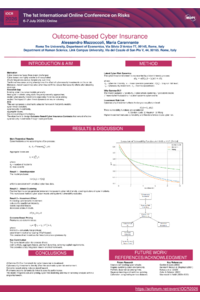
Cyber insurance markets are fertile ground for outcome-based contracts (OBCs), in which premiums depend on observable security performance. While these contracts aim to align incentives between policyholders and insurance companies, they also introduce additional solvency risk due to the stochastic interaction between security investments, loss frequency, and premium variability. Therefore, we propose a stochastic framework to model the trade-off between policyholders' security investments and insurer liability and to assess the solvency implications of performance-related pricing in cyber insurance.
Methods
We extend a stochastic Gordon–Loeb framework with aggregate losses dependent on the stochastic breach probability determined by security investments. The policyholder's investment dynamics are modeled as an exogenous mean-reverting diffusion, which captures operational uncertainty. The insurance company offers a premium adjustment based on expected outcomes, linked to vulnerability over the contractual horizon. The insurance company's profit and loss distribution is derived by combining the frequency of stochastic attacks, their severity, vulnerability dynamics, and performance-related premium variability. This also allows for the effects on capital requirements.
Expected Results
The model reveals a nonlinear relationship between incentive intensity and capital requirements. Performance-based pricing reduces expected losses but increases profit volatility due to premium variability. The net solvency effect depends on the covariance between aggregate losses and vulnerability-based premium adjustments. An optimal incentive intensity emerges that minimizes required capital while preserving risk mitigation benefits.
Conclusions
Outcome-based cyber insurance contracts create a measurable trade-off between security investment incentives and the insurer's solvency risk. The proposed framework enables dynamic performance-based pricing, consistent with risk-sensitive capital valuation, providing a quantitative basis for prudentially sound cyber OBC design.
Keywords
cyber insurance
gordon loeb
stochastic modeling
solvency capital requirement
Poster
Poster_mazzoccoli.pdf
Assessing Spatial Risk Dependence in Temperature Portfolios: A Spatially Continuous Neural Network Framework
The Economics of Piracy: Pricing Maritime Security in Risk Portfolios