Event submissions
Published
This submission belongs to the session S2. Actuarial Science of the event The 1st International Online Conference on Risks
Published date
01 Jul, 2026
Academic Editor
'%3e%3cpath%20d='M12.6657%2010.9104C12.4185%2010.325%2012.0599%209.79327%2011.6097%209.34482C11.1609%208.89508%2010.6293%208.5365%2010.0442%208.28888C10.0389%208.28626%2010.0337%208.28495%2010.0285%208.28233C10.8446%207.69279%2011.3752%206.73249%2011.3752%205.64904C11.3752%203.8542%209.92103%202.39999%208.1262%202.39999C6.33136%202.39999%204.87715%203.8542%204.87715%205.64904C4.87715%206.73249%205.40774%207.69279%206.22393%208.28364C6.21869%208.28626%206.21345%208.28757%206.20821%208.29019C5.62129%208.5378%205.09463%208.89284%204.64265%209.34613C4.1929%209.79493%203.83432%2010.3266%203.58671%2010.9117C3.34345%2011.4845%203.21226%2012.0987%203.20023%2012.7209C3.19988%2012.7349%203.20233%2012.7488%203.20744%2012.7619C3.21255%2012.7749%203.22022%2012.7867%203.22998%2012.7968C3.23975%2012.8068%203.25142%2012.8147%203.26431%2012.8202C3.2772%2012.8256%203.29105%2012.8284%203.30504%2012.8284H4.09109C4.14874%2012.8284%204.19459%2012.7825%204.1959%2012.7262C4.2221%2011.7148%204.62823%2010.7676%205.34617%2010.0497C6.08899%209.30683%207.0755%208.89808%208.1262%208.89808C9.17689%208.89808%2010.1634%209.30683%2010.9062%2010.0497C11.6242%2010.7676%2012.0303%2011.7148%2012.0565%2012.7262C12.0578%2012.7838%2012.1037%2012.8284%2012.1613%2012.8284H12.9474C12.9613%2012.8284%2012.9752%2012.8256%2012.9881%2012.8202C13.001%2012.8147%2013.0126%2012.8068%2013.0224%2012.7968C13.0322%2012.7867%2013.0398%2012.7749%2013.0449%2012.7619C13.0501%2012.7488%2013.0525%2012.7349%2013.0522%2012.7209C13.0391%2012.0947%2012.9094%2011.4855%2012.6657%2010.9104ZM8.1262%207.9024C7.52486%207.9024%206.9589%207.6679%206.53312%207.24211C6.10733%206.81633%205.87283%206.25037%205.87283%205.64904C5.87283%205.0477%206.10733%204.48174%206.53312%204.05596C6.9589%203.63018%207.52486%203.39567%208.1262%203.39567C8.72753%203.39567%209.29349%203.63018%209.71927%204.05596C10.1451%204.48174%2010.3796%205.0477%2010.3796%205.64904C10.3796%206.25037%2010.1451%206.81633%209.71927%207.24211C9.29349%207.6679%208.72753%207.9024%208.1262%207.9024Z'%20fill='%235D1EE1'/%3e%3c/g%3e%3c/svg%3e) Corina Constantinescu
Corina ConstantinescuCitation
Lobna Sayed Ahmed, María Isabel Martínez Torre-Enciso, Oscar Valdemar De la Torre-Torres, A Hybrid Framework to Model Insurance Mortality Rates: Graduation and Ensemble Models, in Proceedings of The 1st International Online Conference on Risks, 6 July–7 July 2026, MDPI: Basel, Switzerland
Share
Email
Facebook
Twitter
LinkedIn
A Hybrid Framework to Model Insurance Mortality Rates: Graduation and Ensemble Models
'%3e%3cpath%20d='M12.6647%2010.9104C12.4176%2010.325%2012.0589%209.7933%2011.6088%209.34485C11.16%208.89511%2010.6283%208.53653%2010.0432%208.28891C10.038%208.28629%2010.0327%208.28498%2010.0275%208.28236C10.8437%207.69282%2011.3743%206.73252%2011.3743%205.64907C11.3743%203.85423%209.92005%202.40002%208.12522%202.40002C6.33038%202.40002%204.87618%203.85423%204.87618%205.64907C4.87618%206.73252%205.40677%207.69282%206.22296%208.28367C6.21772%208.28629%206.21248%208.2876%206.20724%208.29022C5.62031%208.53783%205.09365%208.89287%204.64167%209.34616C4.19192%209.79496%203.83334%2010.3266%203.58573%2010.9117C3.34247%2011.4846%203.21128%2012.0987%203.19925%2012.721C3.1989%2012.735%203.20135%2012.7489%203.20646%2012.7619C3.21157%2012.7749%203.21924%2012.7868%203.22901%2012.7968C3.23877%2012.8068%203.25045%2012.8148%203.26334%2012.8202C3.27623%2012.8256%203.29007%2012.8284%203.30406%2012.8284H4.09012C4.14776%2012.8284%204.19362%2012.7825%204.19493%2012.7262C4.22113%2011.7148%204.62726%2010.7676%205.34519%2010.0497C6.08802%209.30686%207.07452%208.89811%208.12522%208.89811C9.17592%208.89811%2010.1624%209.30686%2010.9052%2010.0497C11.6232%2010.7676%2012.0293%2011.7148%2012.0555%2012.7262C12.0568%2012.7839%2012.1027%2012.8284%2012.1603%2012.8284H12.9464C12.9604%2012.8284%2012.9742%2012.8256%2012.9871%2012.8202C13%2012.8148%2013.0117%2012.8068%2013.0214%2012.7968C13.0312%2012.7868%2013.0389%2012.7749%2013.044%2012.7619C13.0491%2012.7489%2013.0515%2012.735%2013.0512%2012.721C13.0381%2012.0947%2012.9084%2011.4856%2012.6647%2010.9104ZM8.12522%207.90243C7.52388%207.90243%206.95792%207.66793%206.53214%207.24215C6.10636%206.81636%205.87185%206.2504%205.87185%205.64907C5.87185%205.04773%206.10636%204.48177%206.53214%204.05599C6.95792%203.63021%207.52388%203.3957%208.12522%203.3957C8.72655%203.3957%209.29252%203.63021%209.7183%204.05599C10.1441%204.48177%2010.3786%205.04773%2010.3786%205.64907C10.3786%206.2504%2010.1441%206.81636%209.7183%207.24215C9.29252%207.66793%208.72655%207.90243%208.12522%207.90243Z'%20fill='%235D1EE1'/%3e%3c/g%3e%3c/svg%3e)
Lobna Sayed Ahmed 1,2
María Isabel Martínez Torre-Enciso 1

Oscar Valdemar De la Torre-Torres 3
1. Department of Finance and Commercial Research, UDI of Finance, Faculty of Economics and Business, Universidad Autónoma de Madrid (UAM), Madrid, 28049, Spain.
2. Insurance and Actuarial Science Department, Faculty of Commerce, Cairo University, Giza, 12613, Egypt.
3. School of Accounting and Management Sciences, Universidad Michoacana de San Nicolás de Hidalgo (UMSNH), Morelia, 58090, México.
Abstract
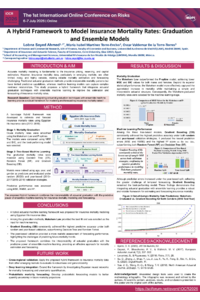
Accurate modeling of mortality rates is crucial for effective risk management. It affects product pricing, reserving, and capital estimation. Modeling mortality experience for insurance portfolios is particularly challenging in emerging markets, where data is often limited and inconsistent.
This research introduces a hybrid modeling framework that integrates actuarial graduation with tree-based machine learning models to enhance the modeling and forecasting of insurance mortality rates.
The proposed framework first applies graduation models, including the Makeham law and P-splines, to smooth crude mortality rates and capture underlying patterns. Tree-based machine learning models, including decision trees, random forests, and gradient boosting, are then utilized with two splitting approaches, random splitting and year-based splitting, to estimate and forecast graduated mortality rates, capturing nonlinear dependencies across age, year, and gender.
The methodology is applied to Egyptian life insurance data covering ages 16 to 60 for the period 2013 to 2019. The empirical results showed that the Makeham model provides a better fit and higher predictive accuracy for graduating mortality rates. Among machine learning models, gradient boosting with both random and year-based splitting achieves the highest predictive accuracy and supports reliable prediction of future mortality rates.
By combining the interpretability of actuarial graduation methods with the predictive capability of machine learning, the proposed framework provides a robust approach for modeling and forecasting insurance mortality rates in life insurance applications.
Keywords
Insurance Mortality Modeling
Mortality Graduation
Makeham Law
P-splines
Ensemble Machine Learning
Gradient Boosting
Poster
Lobna S. Ahmed POSTER IOCR2026.pdf
Life Expectancy as a Driver of Pension Fund Equity Allocation: Evidence from Cross-Country Data
Dynamic Principal Component Analysis for Syndemic Factors in an Extended Lee–Carter Mortality Model