Event submissions
Published
This submission belongs to the session S2. Actuarial Science of the event The 1st International Online Conference on Risks
Published date
01 Jul, 2026
Academic Editor
'%3e%3cpath%20d='M12.6657%2010.9104C12.4185%2010.325%2012.0599%209.79327%2011.6097%209.34482C11.1609%208.89508%2010.6293%208.5365%2010.0442%208.28888C10.0389%208.28626%2010.0337%208.28495%2010.0285%208.28233C10.8446%207.69279%2011.3752%206.73249%2011.3752%205.64904C11.3752%203.8542%209.92103%202.39999%208.1262%202.39999C6.33136%202.39999%204.87715%203.8542%204.87715%205.64904C4.87715%206.73249%205.40774%207.69279%206.22393%208.28364C6.21869%208.28626%206.21345%208.28757%206.20821%208.29019C5.62129%208.5378%205.09463%208.89284%204.64265%209.34613C4.1929%209.79493%203.83432%2010.3266%203.58671%2010.9117C3.34345%2011.4845%203.21226%2012.0987%203.20023%2012.7209C3.19988%2012.7349%203.20233%2012.7488%203.20744%2012.7619C3.21255%2012.7749%203.22022%2012.7867%203.22998%2012.7968C3.23975%2012.8068%203.25142%2012.8147%203.26431%2012.8202C3.2772%2012.8256%203.29105%2012.8284%203.30504%2012.8284H4.09109C4.14874%2012.8284%204.19459%2012.7825%204.1959%2012.7262C4.2221%2011.7148%204.62823%2010.7676%205.34617%2010.0497C6.08899%209.30683%207.0755%208.89808%208.1262%208.89808C9.17689%208.89808%2010.1634%209.30683%2010.9062%2010.0497C11.6242%2010.7676%2012.0303%2011.7148%2012.0565%2012.7262C12.0578%2012.7838%2012.1037%2012.8284%2012.1613%2012.8284H12.9474C12.9613%2012.8284%2012.9752%2012.8256%2012.9881%2012.8202C13.001%2012.8147%2013.0126%2012.8068%2013.0224%2012.7968C13.0322%2012.7867%2013.0398%2012.7749%2013.0449%2012.7619C13.0501%2012.7488%2013.0525%2012.7349%2013.0522%2012.7209C13.0391%2012.0947%2012.9094%2011.4855%2012.6657%2010.9104ZM8.1262%207.9024C7.52486%207.9024%206.9589%207.6679%206.53312%207.24211C6.10733%206.81633%205.87283%206.25037%205.87283%205.64904C5.87283%205.0477%206.10733%204.48174%206.53312%204.05596C6.9589%203.63018%207.52486%203.39567%208.1262%203.39567C8.72753%203.39567%209.29349%203.63018%209.71927%204.05596C10.1451%204.48174%2010.3796%205.0477%2010.3796%205.64904C10.3796%206.25037%2010.1451%206.81633%209.71927%207.24211C9.29349%207.6679%208.72753%207.9024%208.1262%207.9024Z'%20fill='%235D1EE1'/%3e%3c/g%3e%3c/svg%3e) Hailiang Yang
Hailiang YangCitation
Antonio Nazzaro, Paola Festa, Bayesian Neural Networks for Robust Reserve Decisions under Lévy Mortality Shocks, in Proceedings of The 1st International Online Conference on Risks, 6 July–7 July 2026, MDPI: Basel, Switzerland
Share
Email
Facebook
Twitter
LinkedIn
Bayesian Neural Networks for Robust Reserve Decisions under Lévy Mortality Shocks
'%3e%3cpath%20d='M12.6647%2010.9104C12.4176%2010.325%2012.0589%209.7933%2011.6088%209.34485C11.16%208.89511%2010.6283%208.53653%2010.0432%208.28891C10.038%208.28629%2010.0327%208.28498%2010.0275%208.28236C10.8437%207.69282%2011.3743%206.73252%2011.3743%205.64907C11.3743%203.85423%209.92005%202.40002%208.12522%202.40002C6.33038%202.40002%204.87618%203.85423%204.87618%205.64907C4.87618%206.73252%205.40677%207.69282%206.22296%208.28367C6.21772%208.28629%206.21248%208.2876%206.20724%208.29022C5.62031%208.53783%205.09365%208.89287%204.64167%209.34616C4.19192%209.79496%203.83334%2010.3266%203.58573%2010.9117C3.34247%2011.4846%203.21128%2012.0987%203.19925%2012.721C3.1989%2012.735%203.20135%2012.7489%203.20646%2012.7619C3.21157%2012.7749%203.21924%2012.7868%203.22901%2012.7968C3.23877%2012.8068%203.25045%2012.8148%203.26334%2012.8202C3.27623%2012.8256%203.29007%2012.8284%203.30406%2012.8284H4.09012C4.14776%2012.8284%204.19362%2012.7825%204.19493%2012.7262C4.22113%2011.7148%204.62726%2010.7676%205.34519%2010.0497C6.08802%209.30686%207.07452%208.89811%208.12522%208.89811C9.17592%208.89811%2010.1624%209.30686%2010.9052%2010.0497C11.6232%2010.7676%2012.0293%2011.7148%2012.0555%2012.7262C12.0568%2012.7839%2012.1027%2012.8284%2012.1603%2012.8284H12.9464C12.9604%2012.8284%2012.9742%2012.8256%2012.9871%2012.8202C13%2012.8148%2013.0117%2012.8068%2013.0214%2012.7968C13.0312%2012.7868%2013.0389%2012.7749%2013.044%2012.7619C13.0491%2012.7489%2013.0515%2012.735%2013.0512%2012.721C13.0381%2012.0947%2012.9084%2011.4856%2012.6647%2010.9104ZM8.12522%207.90243C7.52388%207.90243%206.95792%207.66793%206.53214%207.24215C6.10636%206.81636%205.87185%206.2504%205.87185%205.64907C5.87185%205.04773%206.10636%204.48177%206.53214%204.05599C6.95792%203.63021%207.52388%203.3957%208.12522%203.3957C8.72655%203.3957%209.29252%203.63021%209.7183%204.05599C10.1441%204.48177%2010.3786%205.04773%2010.3786%205.64907C10.3786%206.2504%2010.1441%206.81636%209.7183%207.24215C9.29252%207.66793%208.72655%207.90243%208.12522%207.90243Z'%20fill='%235D1EE1'/%3e%3c/g%3e%3c/svg%3e)
Antonio Nazzaro 1
Paola Festa 2
1. REPRISE – Register of Expert Peer Reviewers for Italian Scientific Evaluation, Ministry of University and Research (MUR), Rome 00153, Italy
2. Department of Mathematics and Applications "R. Caccioppoli" University of Naples Federico II, Naples 80126, Italy
Abstract
This paper addresses the critical decision-making problem of valuing life insurance reserves under extreme demographic uncertainty, such as pandemics, climate-induced shifts, and economic crises. We introduce a novel framework that integrates Bayesian deep learning with measure-theoretic actuarial science to overcome the limitations of classical models. By modeling financial and demographic risks through product measures (μ ⊗ ν) and incorporating Lévy processes for mortality shocks, our approach captures the complex interaction between stochastic discounting and discontinuous demographic dynamics. The neural architecture, a stochastic multilayer perceptron with Bayesian Bernoulli dropout and Lévy-distributed noise injection (εₗ ∼ Levy(1.7)), ensures Radon-Nikodym compatibility via a measure-preserving neural operator, guaranteeing actuarial interpretability and decision robustness under Solvency II regulatory standards.
We validate the framework empirically using EIOPA mortality data across multiple stress scenarios, including a simulated COVID-19-style pandemic shock with tripled arrival rates. Results demonstrate significant improvements: a 63% reduction in mean absolute error (MAE) and a 77% decrease in Kullback–Leibler (KL) divergence compared to classical models. Under pandemic stress, our model achieves a 64% error reduction, requiring 22% less economic capital under the 99.5% Value-at-Risk (VaR) Solvency II requirement. Additionally, we integrate fairness metrics via Pearl's do-calculus, achieving a fairness score of ε = 0.0031—well below the EIOPA regulatory threshold (<0.005)—with an adjusted average treatment effect (ATE) for gender of -0.0031 ± 0.0004, eliminating demographic bias.
The framework offers a scalable, transparent, and ethically-aware solution for reserve modeling and decision-making in volatile demographic environments, with projected quantum-inspired complexity of O(√N) for large portfolios.
Keywords
Bayesian Neural Networks
Lévy Processes
Actuarial Reserve Valuation
Measure-Theoretic Learning
Solvency II
Mortality Risk Modeling
Causal Fairness
Poster
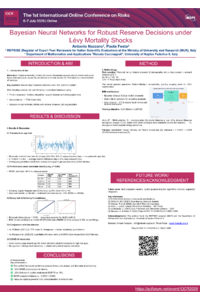
IOCR-Poster-Nazzaro_Festa.pdf
A Two‑Split, Three‑Peak Fourier Extension of the Lee–Carter Mortality Model
Life Insurance Market Development and Economic Growth in Cameroon:
Evidence of a Nonlinear and Feedback Relationship
Evidence of a Nonlinear and Feedback Relationship