Event submissions
Published
This submission belongs to the session S1. Dental Biomaterials of the event The 2nd International Online Conference on Functional Biomaterials
Published date
03 Jul, 2026
Academic Editor
'%3e%3cpath%20d='M12.6657%2010.9104C12.4185%2010.325%2012.0599%209.79327%2011.6097%209.34482C11.1609%208.89508%2010.6293%208.5365%2010.0442%208.28888C10.0389%208.28626%2010.0337%208.28495%2010.0285%208.28233C10.8446%207.69279%2011.3752%206.73249%2011.3752%205.64904C11.3752%203.8542%209.92103%202.39999%208.1262%202.39999C6.33136%202.39999%204.87715%203.8542%204.87715%205.64904C4.87715%206.73249%205.40774%207.69279%206.22393%208.28364C6.21869%208.28626%206.21345%208.28757%206.20821%208.29019C5.62129%208.5378%205.09463%208.89284%204.64265%209.34613C4.1929%209.79493%203.83432%2010.3266%203.58671%2010.9117C3.34345%2011.4845%203.21226%2012.0987%203.20023%2012.7209C3.19988%2012.7349%203.20233%2012.7488%203.20744%2012.7619C3.21255%2012.7749%203.22022%2012.7867%203.22998%2012.7968C3.23975%2012.8068%203.25142%2012.8147%203.26431%2012.8202C3.2772%2012.8256%203.29105%2012.8284%203.30504%2012.8284H4.09109C4.14874%2012.8284%204.19459%2012.7825%204.1959%2012.7262C4.2221%2011.7148%204.62823%2010.7676%205.34617%2010.0497C6.08899%209.30683%207.0755%208.89808%208.1262%208.89808C9.17689%208.89808%2010.1634%209.30683%2010.9062%2010.0497C11.6242%2010.7676%2012.0303%2011.7148%2012.0565%2012.7262C12.0578%2012.7838%2012.1037%2012.8284%2012.1613%2012.8284H12.9474C12.9613%2012.8284%2012.9752%2012.8256%2012.9881%2012.8202C13.001%2012.8147%2013.0126%2012.8068%2013.0224%2012.7968C13.0322%2012.7867%2013.0398%2012.7749%2013.0449%2012.7619C13.0501%2012.7488%2013.0525%2012.7349%2013.0522%2012.7209C13.0391%2012.0947%2012.9094%2011.4855%2012.6657%2010.9104ZM8.1262%207.9024C7.52486%207.9024%206.9589%207.6679%206.53312%207.24211C6.10733%206.81633%205.87283%206.25037%205.87283%205.64904C5.87283%205.0477%206.10733%204.48174%206.53312%204.05596C6.9589%203.63018%207.52486%203.39567%208.1262%203.39567C8.72753%203.39567%209.29349%203.63018%209.71927%204.05596C10.1451%204.48174%2010.3796%205.0477%2010.3796%205.64904C10.3796%206.25037%2010.1451%206.81633%209.71927%207.24211C9.29349%207.6679%208.72753%207.9024%208.1262%207.9024Z'%20fill='%235D1EE1'/%3e%3c/g%3e%3c/svg%3e) Gianrico Spagnuolo
Gianrico SpagnuoloCitation
Pamela Voigt, Michele Formolo Garcia, Marcia Margarete Meier, Plasma-Assisted Bifunctionalization of Glass Fillers to Develop Contact-Active Antibacterial Dental Composites, in Proceedings of The 2nd International Online Conference on Functional Biomaterials, 8 July–10 July 2026, MDPI: Basel, Switzerland
Share
Email
Facebook
Twitter
LinkedIn
Plasma-Assisted Bifunctionalization of Glass Fillers to Develop Contact-Active Antibacterial Dental Composites
'%3e%3cpath%20d='M12.6647%2010.9104C12.4176%2010.325%2012.0589%209.7933%2011.6088%209.34485C11.16%208.89511%2010.6283%208.53653%2010.0432%208.28891C10.038%208.28629%2010.0327%208.28498%2010.0275%208.28236C10.8437%207.69282%2011.3743%206.73252%2011.3743%205.64907C11.3743%203.85423%209.92005%202.40002%208.12522%202.40002C6.33038%202.40002%204.87618%203.85423%204.87618%205.64907C4.87618%206.73252%205.40677%207.69282%206.22296%208.28367C6.21772%208.28629%206.21248%208.2876%206.20724%208.29022C5.62031%208.53783%205.09365%208.89287%204.64167%209.34616C4.19192%209.79496%203.83334%2010.3266%203.58573%2010.9117C3.34247%2011.4846%203.21128%2012.0987%203.19925%2012.721C3.1989%2012.735%203.20135%2012.7489%203.20646%2012.7619C3.21157%2012.7749%203.21924%2012.7868%203.22901%2012.7968C3.23877%2012.8068%203.25045%2012.8148%203.26334%2012.8202C3.27623%2012.8256%203.29007%2012.8284%203.30406%2012.8284H4.09012C4.14776%2012.8284%204.19362%2012.7825%204.19493%2012.7262C4.22113%2011.7148%204.62726%2010.7676%205.34519%2010.0497C6.08802%209.30686%207.07452%208.89811%208.12522%208.89811C9.17592%208.89811%2010.1624%209.30686%2010.9052%2010.0497C11.6232%2010.7676%2012.0293%2011.7148%2012.0555%2012.7262C12.0568%2012.7839%2012.1027%2012.8284%2012.1603%2012.8284H12.9464C12.9604%2012.8284%2012.9742%2012.8256%2012.9871%2012.8202C13%2012.8148%2013.0117%2012.8068%2013.0214%2012.7968C13.0312%2012.7868%2013.0389%2012.7749%2013.044%2012.7619C13.0491%2012.7489%2013.0515%2012.735%2013.0512%2012.721C13.0381%2012.0947%2012.9084%2011.4856%2012.6647%2010.9104ZM8.12522%207.90243C7.52388%207.90243%206.95792%207.66793%206.53214%207.24215C6.10636%206.81636%205.87185%206.2504%205.87185%205.64907C5.87185%205.04773%206.10636%204.48177%206.53214%204.05599C6.95792%203.63021%207.52388%203.3957%208.12522%203.3957C8.72655%203.3957%209.29252%203.63021%209.7183%204.05599C10.1441%204.48177%2010.3786%205.04773%2010.3786%205.64907C10.3786%206.2504%2010.1441%206.81636%209.7183%207.24215C9.29252%207.66793%208.72655%207.90243%208.12522%207.90243Z'%20fill='%235D1EE1'/%3e%3c/g%3e%3c/svg%3e)
Pamela Voigt 1
Michele Formolo Garcia 2
Marcia Margarete Meier 1
1. Department of Chemistry, Santa Catarina State University (UDESC), College of Technological Science (CCT), Joinville, 89219-710, SC, Brazil.
2. Department of Chemical Engineering, University of the Joinville Region (UNIVILLE), Joinville, 89219-710, SC, Brazil
Abstract
Quaternary ammonium silanes (QASi) are well-known antimicrobial agents due to their broad-spectrum biocidal activity and biocompatibility, making them attractive for biomedical and dental composite applications. The silanol groups of QASi can be covalently bonded to inorganic surface fillers, enabling the design of contact-active antibacterial interfaces. Nonetheless, silanes such as dimethyloctadecyl[3-(trimethoxysilyl)propyl]ammonium chloride (QASi-18) cannot form covalent bonds with polymers like methacrylic resin, used in dental materials, compromising mechanical properties. In this study, barium–aluminum silicate glass particle fillers were bifunctionalized to generate antibacterial surfaces, using QASi-18 and 3-methacryloxypropyltrimethoxysilane (MPS) as a coupling agent, to mediate a covalent bond between the filler particles and the methacrylic resin. The glass particle modification was performed through plasma-assisted surface activation, where nonthermal plasma parameters were adjusted to reduce the thermal degradation of the substances deposited on the filler particles. The bifunctionalized particles were characterized by FTIR, XPS, TG, particle size distribution and zeta potential measurements. Zeta potential exhibited a shift toward positive surface charge, indicating the presence of quaternary ammonium groups on the particle surface. Microbiological assays demonstrated antimicrobial activity against Escherichia coli, Streptococcus salivarius, and Candida albicans. After incorporation into resin composites based on bisphenol A-glycidyl methacrylate (Bis-GMA) and triethylene glycol dimethacrylate (TEGDMA), antimicrobial efficacy decreased but remained high, consistent with a contact-dependent mechanism governed by the accessibility of functionalized particles at the composite surface. The plasma parameters were adequate to preserve methacrylate groups, as observed by the FTIR spectrum contributing to composite reinforcement. Overall, these findings highlight plasma-assisted silane bifunctionalization as a promising strategy to engineer antibacterial biomaterials and surfaces.
Keywords
QASi
MPS
nonthermal plasma
bifunctionalization
dental composite
Poster
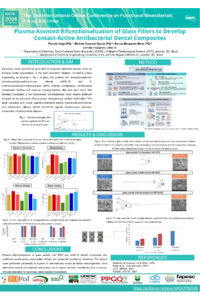
IOCBF 2026 - Poster Pamela-revM.pdf
A Dual-Action Hydrogel System for Endodontic Repair and Infection Control
In Vitro Validation of Calcium Phosphate-Loaded Microgels as In Vitro Niche Model for Dental Applications