Event submissions
Published
This submission belongs to the session S1. Dental Biomaterials of the event The 2nd International Online Conference on Functional Biomaterials
Published date
03 Jul, 2026
Academic Editor
'%3e%3cpath%20d='M12.6657%2010.9104C12.4185%2010.325%2012.0599%209.79327%2011.6097%209.34482C11.1609%208.89508%2010.6293%208.5365%2010.0442%208.28888C10.0389%208.28626%2010.0337%208.28495%2010.0285%208.28233C10.8446%207.69279%2011.3752%206.73249%2011.3752%205.64904C11.3752%203.8542%209.92103%202.39999%208.1262%202.39999C6.33136%202.39999%204.87715%203.8542%204.87715%205.64904C4.87715%206.73249%205.40774%207.69279%206.22393%208.28364C6.21869%208.28626%206.21345%208.28757%206.20821%208.29019C5.62129%208.5378%205.09463%208.89284%204.64265%209.34613C4.1929%209.79493%203.83432%2010.3266%203.58671%2010.9117C3.34345%2011.4845%203.21226%2012.0987%203.20023%2012.7209C3.19988%2012.7349%203.20233%2012.7488%203.20744%2012.7619C3.21255%2012.7749%203.22022%2012.7867%203.22998%2012.7968C3.23975%2012.8068%203.25142%2012.8147%203.26431%2012.8202C3.2772%2012.8256%203.29105%2012.8284%203.30504%2012.8284H4.09109C4.14874%2012.8284%204.19459%2012.7825%204.1959%2012.7262C4.2221%2011.7148%204.62823%2010.7676%205.34617%2010.0497C6.08899%209.30683%207.0755%208.89808%208.1262%208.89808C9.17689%208.89808%2010.1634%209.30683%2010.9062%2010.0497C11.6242%2010.7676%2012.0303%2011.7148%2012.0565%2012.7262C12.0578%2012.7838%2012.1037%2012.8284%2012.1613%2012.8284H12.9474C12.9613%2012.8284%2012.9752%2012.8256%2012.9881%2012.8202C13.001%2012.8147%2013.0126%2012.8068%2013.0224%2012.7968C13.0322%2012.7867%2013.0398%2012.7749%2013.0449%2012.7619C13.0501%2012.7488%2013.0525%2012.7349%2013.0522%2012.7209C13.0391%2012.0947%2012.9094%2011.4855%2012.6657%2010.9104ZM8.1262%207.9024C7.52486%207.9024%206.9589%207.6679%206.53312%207.24211C6.10733%206.81633%205.87283%206.25037%205.87283%205.64904C5.87283%205.0477%206.10733%204.48174%206.53312%204.05596C6.9589%203.63018%207.52486%203.39567%208.1262%203.39567C8.72753%203.39567%209.29349%203.63018%209.71927%204.05596C10.1451%204.48174%2010.3796%205.0477%2010.3796%205.64904C10.3796%206.25037%2010.1451%206.81633%209.71927%207.24211C9.29349%207.6679%208.72753%207.9024%208.1262%207.9024Z'%20fill='%235D1EE1'/%3e%3c/g%3e%3c/svg%3e) Gianrico Spagnuolo
Gianrico SpagnuoloCitation
Md Sofiqul Islam, Vivek Padmanabhan, Lana Yassin Almaghribi, Nansi Fadi Wahbeh, Smriti Aryal A C, Muhammed Mustahsen Rahman, Bonding Performance, Mass Stability, and Mechanical Properties of Self-adhesive Resin Composites and Conventional Dental Composites: A Comparative Laboratory Evaluation, in Proceedings of The 2nd International Online Conference on Functional Biomaterials, 8 July–10 July 2026, MDPI: Basel, Switzerland
Share
Email
Facebook
Twitter
LinkedIn
Bonding Performance, Mass Stability, and Mechanical Properties of Self-adhesive Resin Composites and Conventional Dental Composites: A Comparative Laboratory Evaluation

Md Sofiqul Islam 1
'%3e%3cpath%20d='M12.6647%2010.9104C12.4176%2010.325%2012.0589%209.7933%2011.6088%209.34485C11.16%208.89511%2010.6283%208.53653%2010.0432%208.28891C10.038%208.28629%2010.0327%208.28498%2010.0275%208.28236C10.8437%207.69282%2011.3743%206.73252%2011.3743%205.64907C11.3743%203.85423%209.92005%202.40002%208.12522%202.40002C6.33038%202.40002%204.87618%203.85423%204.87618%205.64907C4.87618%206.73252%205.40677%207.69282%206.22296%208.28367C6.21772%208.28629%206.21248%208.2876%206.20724%208.29022C5.62031%208.53783%205.09365%208.89287%204.64167%209.34616C4.19192%209.79496%203.83334%2010.3266%203.58573%2010.9117C3.34247%2011.4846%203.21128%2012.0987%203.19925%2012.721C3.1989%2012.735%203.20135%2012.7489%203.20646%2012.7619C3.21157%2012.7749%203.21924%2012.7868%203.22901%2012.7968C3.23877%2012.8068%203.25045%2012.8148%203.26334%2012.8202C3.27623%2012.8256%203.29007%2012.8284%203.30406%2012.8284H4.09012C4.14776%2012.8284%204.19362%2012.7825%204.19493%2012.7262C4.22113%2011.7148%204.62726%2010.7676%205.34519%2010.0497C6.08802%209.30686%207.07452%208.89811%208.12522%208.89811C9.17592%208.89811%2010.1624%209.30686%2010.9052%2010.0497C11.6232%2010.7676%2012.0293%2011.7148%2012.0555%2012.7262C12.0568%2012.7839%2012.1027%2012.8284%2012.1603%2012.8284H12.9464C12.9604%2012.8284%2012.9742%2012.8256%2012.9871%2012.8202C13%2012.8148%2013.0117%2012.8068%2013.0214%2012.7968C13.0312%2012.7868%2013.0389%2012.7749%2013.044%2012.7619C13.0491%2012.7489%2013.0515%2012.735%2013.0512%2012.721C13.0381%2012.0947%2012.9084%2011.4856%2012.6647%2010.9104ZM8.12522%207.90243C7.52388%207.90243%206.95792%207.66793%206.53214%207.24215C6.10636%206.81636%205.87185%206.2504%205.87185%205.64907C5.87185%205.04773%206.10636%204.48177%206.53214%204.05599C6.95792%203.63021%207.52388%203.3957%208.12522%203.3957C8.72655%203.3957%209.29252%203.63021%209.7183%204.05599C10.1441%204.48177%2010.3786%205.04773%2010.3786%205.64907C10.3786%206.2504%2010.1441%206.81636%209.7183%207.24215C9.29252%207.66793%208.72655%207.90243%208.12522%207.90243Z'%20fill='%235D1EE1'/%3e%3c/g%3e%3c/svg%3e)
Vivek Padmanabhan 2
Lana Yassin Almaghribi 1
Nansi Fadi Wahbeh 1
Smriti Aryal A C 3
Muhammed Mustahsen Rahman 4
1. Department of Operative Dentistry, RAK College of Dental Sciences, RAK Medical and Health Sciences University, P.O Box: 12973, Ras Al-Khaimah, United Arab Emirates
2. Department of Pediatric Dentistry, RAK College of Dental Sciences, RAK Medical and Health Sciences University, P.O Box: 12973, Ras Al-Khaimah, United Arab Emirates
3. Department of Oral and Craniofacial Health Sciences, College of Dental Medicine, University of Sharjah, P.O Box: 27272 Sharjah, United Arab Emirates
4. Department of Periodontology, RAK College of Dental Sciences, RAK Medical and Health Sciences University, P.O Box: 12973, Ras Al-Khaimah, United Arab Emirates
Abstract
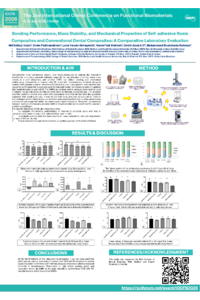
Introduction: Self-adhesive resin composite (SARC) is gaining popularity due to its simplified clinical steps. The objectives of this study were to evaluate the bonding performance, mass stability and mechanical properties of three SARCs and to compare them with two conventional resin composites (RCs) using a universal adhesive system (UAS).
Materials and Methods: A total of 80 enamel blocks, 5 mm x 5 mm, were prepared and embedded in an acrylic mold. The surface of enamel was polished using 600-grit carbide paper to create a smear layer. After acid etching, a 2mmX2mm cylinder-shaped restoration was made either with one of three SARC materials or with two types of RC using UAS. The shear bond strength test was performed after 24 h of water incubation and after 1 year of artificial aging. The mass stability of the hexagonal-shaped SARC and conventional RC was evaluated using water sorption and solubility tests. The mechanical properties, including Vickers hardness, elastic modulus and creep, were evaluated after 24 h of water incubation and after 1 year of artificial aging.
Results: Both material type and aging showed a significant effect on bonding performance, mass stability and mechanical properties of SARC and conventional RC (p<0.05). The shear bond strength of SARC was comparable to that of conventional RC+ UAS. Conventional RC showed less water sorption and solubility compared to SARC. The Vickers hardness, elastic modulus and creep properties of some SARC were inferior compared to those of conventional RC both at 24 h and at 1 year.
Conclusion: The bonding performance of SARC can substitute for that of conventional RC+ UAS; however, inferior mass stability and mechanical properties limit its use in routine dental restorative procedures.
Keywords
Self-Adhesive Resin Composite
Universal adhesive system
Resin composite
Shear bond strength
Water sorption
Solubility
Vickers hardness
Elastic modulus
Creep.
Poster
fee3c30bdee5dbcec586ef347b928b92.pdf
Microstructurally Refined Ti-6Al-7Nb via High-Pressure Sliding Modulates Osteoblast Adhesion and Proliferation
Metrological assessment of the trueness of prosthetic metal frameworks manufactured through digital techniques.