Event submissions
Published
This submission belongs to the session S2. Bone Biomaterials of the event The 2nd International Online Conference on Functional Biomaterials
Published date
03 Jul, 2026
Academic Editor
'%3e%3cpath%20d='M12.6657%2010.9104C12.4185%2010.325%2012.0599%209.79327%2011.6097%209.34482C11.1609%208.89508%2010.6293%208.5365%2010.0442%208.28888C10.0389%208.28626%2010.0337%208.28495%2010.0285%208.28233C10.8446%207.69279%2011.3752%206.73249%2011.3752%205.64904C11.3752%203.8542%209.92103%202.39999%208.1262%202.39999C6.33136%202.39999%204.87715%203.8542%204.87715%205.64904C4.87715%206.73249%205.40774%207.69279%206.22393%208.28364C6.21869%208.28626%206.21345%208.28757%206.20821%208.29019C5.62129%208.5378%205.09463%208.89284%204.64265%209.34613C4.1929%209.79493%203.83432%2010.3266%203.58671%2010.9117C3.34345%2011.4845%203.21226%2012.0987%203.20023%2012.7209C3.19988%2012.7349%203.20233%2012.7488%203.20744%2012.7619C3.21255%2012.7749%203.22022%2012.7867%203.22998%2012.7968C3.23975%2012.8068%203.25142%2012.8147%203.26431%2012.8202C3.2772%2012.8256%203.29105%2012.8284%203.30504%2012.8284H4.09109C4.14874%2012.8284%204.19459%2012.7825%204.1959%2012.7262C4.2221%2011.7148%204.62823%2010.7676%205.34617%2010.0497C6.08899%209.30683%207.0755%208.89808%208.1262%208.89808C9.17689%208.89808%2010.1634%209.30683%2010.9062%2010.0497C11.6242%2010.7676%2012.0303%2011.7148%2012.0565%2012.7262C12.0578%2012.7838%2012.1037%2012.8284%2012.1613%2012.8284H12.9474C12.9613%2012.8284%2012.9752%2012.8256%2012.9881%2012.8202C13.001%2012.8147%2013.0126%2012.8068%2013.0224%2012.7968C13.0322%2012.7867%2013.0398%2012.7749%2013.0449%2012.7619C13.0501%2012.7488%2013.0525%2012.7349%2013.0522%2012.7209C13.0391%2012.0947%2012.9094%2011.4855%2012.6657%2010.9104ZM8.1262%207.9024C7.52486%207.9024%206.9589%207.6679%206.53312%207.24211C6.10733%206.81633%205.87283%206.25037%205.87283%205.64904C5.87283%205.0477%206.10733%204.48174%206.53312%204.05596C6.9589%203.63018%207.52486%203.39567%208.1262%203.39567C8.72753%203.39567%209.29349%203.63018%209.71927%204.05596C10.1451%204.48174%2010.3796%205.0477%2010.3796%205.64904C10.3796%206.25037%2010.1451%206.81633%209.71927%207.24211C9.29349%207.6679%208.72753%207.9024%208.1262%207.9024Z'%20fill='%235D1EE1'/%3e%3c/g%3e%3c/svg%3e) Elisa Boanini
Elisa BoaniniCitation
Adnan Abdulkarim Alsaei, Ayah Adel Binrajab, Ahmad Naim Zarwi, Fatema Nader Rahimi, G. Roshan Deen, Bioprinting of Imaging-Derived Bone Geometries: Toward Patient-Specific Alginate Hydrogel Femur Phantoms for Mechanical and Functional Testing, in Proceedings of The 2nd International Online Conference on Functional Biomaterials, 8 July–10 July 2026, MDPI: Basel, Switzerland
Share
Email
Facebook
Twitter
LinkedIn
Bioprinting of Imaging-Derived Bone Geometries: Toward Patient-Specific Alginate Hydrogel Femur Phantoms for Mechanical and Functional Testing
'%3e%3cpath%20d='M12.6647%2010.9104C12.4176%2010.325%2012.0589%209.7933%2011.6088%209.34485C11.16%208.89511%2010.6283%208.53653%2010.0432%208.28891C10.038%208.28629%2010.0327%208.28498%2010.0275%208.28236C10.8437%207.69282%2011.3743%206.73252%2011.3743%205.64907C11.3743%203.85423%209.92005%202.40002%208.12522%202.40002C6.33038%202.40002%204.87618%203.85423%204.87618%205.64907C4.87618%206.73252%205.40677%207.69282%206.22296%208.28367C6.21772%208.28629%206.21248%208.2876%206.20724%208.29022C5.62031%208.53783%205.09365%208.89287%204.64167%209.34616C4.19192%209.79496%203.83334%2010.3266%203.58573%2010.9117C3.34247%2011.4846%203.21128%2012.0987%203.19925%2012.721C3.1989%2012.735%203.20135%2012.7489%203.20646%2012.7619C3.21157%2012.7749%203.21924%2012.7868%203.22901%2012.7968C3.23877%2012.8068%203.25045%2012.8148%203.26334%2012.8202C3.27623%2012.8256%203.29007%2012.8284%203.30406%2012.8284H4.09012C4.14776%2012.8284%204.19362%2012.7825%204.19493%2012.7262C4.22113%2011.7148%204.62726%2010.7676%205.34519%2010.0497C6.08802%209.30686%207.07452%208.89811%208.12522%208.89811C9.17592%208.89811%2010.1624%209.30686%2010.9052%2010.0497C11.6232%2010.7676%2012.0293%2011.7148%2012.0555%2012.7262C12.0568%2012.7839%2012.1027%2012.8284%2012.1603%2012.8284H12.9464C12.9604%2012.8284%2012.9742%2012.8256%2012.9871%2012.8202C13%2012.8148%2013.0117%2012.8068%2013.0214%2012.7968C13.0312%2012.7868%2013.0389%2012.7749%2013.044%2012.7619C13.0491%2012.7489%2013.0515%2012.735%2013.0512%2012.721C13.0381%2012.0947%2012.9084%2011.4856%2012.6647%2010.9104ZM8.12522%207.90243C7.52388%207.90243%206.95792%207.66793%206.53214%207.24215C6.10636%206.81636%205.87185%206.2504%205.87185%205.64907C5.87185%205.04773%206.10636%204.48177%206.53214%204.05599C6.95792%203.63021%207.52388%203.3957%208.12522%203.3957C8.72655%203.3957%209.29252%203.63021%209.7183%204.05599C10.1441%204.48177%2010.3786%205.04773%2010.3786%205.64907C10.3786%206.2504%2010.1441%206.81636%209.7183%207.24215C9.29252%207.66793%208.72655%207.90243%208.12522%207.90243Z'%20fill='%235D1EE1'/%3e%3c/g%3e%3c/svg%3e)
Adnan Abdulkarim Alsaei 1
Ayah Adel Binrajab 1
Ahmad Naim Zarwi 1
Fatema Nader Rahimi 1

G. Roshan Deen 1
1. School of Medicine, Royal College of Surgeons in Ireland (RCSI) – Medical University of Bahrain, Busaiteen, Kingdom of Bahrain
Abstract
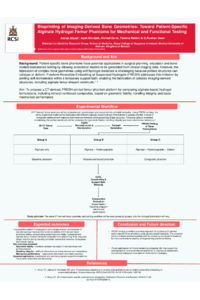
Background: Patient-specific anatomical bone phantoms are increasingly needed for preclinical testing, surgical planning, education, and the development of bone-associated biomaterials. Conventional fabrication methods often struggle to reproduce complex anatomy while maintaining soft-material print fidelity. Freeform Reversible Embedding of Suspended Hydrogels (FRESH) enables high-resolution printing of soft biomaterials within a support bath, making it well-suited for constructing imaging-derived biological geometries.
Objective: This work highlights the use of FRESH printing to fabricate femur-like structures from 3D CT imaging data and discusses the functional relevance of shape-accurate, mechanically resilient hydrogel constructs as handling and workflow platforms.
Methods: A workflow is outlined in which a human femur geometry is reconstructed from 3D CT imaging, scaled as needed, converted to printable toolpaths, and fabricated via FRESH printing using sodium alginate hydrogel inks (typical 1.5–3% w/v) followed by calcium ion crosslinking in CaCl₂ (typical 50–200 mM) to form stable constructs. Following removal from the support bath, prints are assessed for geometric fidelity against the digital model, handling integrity, and basic mechanical performance using uniaxial tensile strain testing as a functional readout.
Results: Imaging-derived femur constructs produced via FRESH printing can closely replicate the intended geometry and remain robust during handling. Mechanical feasibility is supported by tensile testing demonstrating high strain tolerance (up to ~40%) with elastic recovery, indicating a stable hydrogel network suitable for repeated manipulation and functional evaluation. These constructs are intended to reproduce patient-specific geometry rather than native femur composition or load-bearing mechanical properties.
Conclusion: FRESH printing offers a practical route to generate anatomically accurate, mechanically resilient alginate hydrogel femur phantoms from clinical imaging data. Such constructs can serve as versatile platforms for bone-related biomaterials research, including comparative testing of printable inks, optimisation of reinforcement strategies, and integration with mineral phases or composite fillers to progressively approximate bone-relevant mechanics where needed.
Keywords
FRESH
CT
Bio-printing
Biomaterials
Alginate
Hydrogels
Poster
Poster - Bioprinting .pdf
Polyetheretherketone as an alternative to titanium alloys in the additive manufacturing of orthopedic implants
Engineering Injectable and Self-Setting Bone Grafts with In Situ Hierarchical Pores via Polyphosphate Coacervate and Gelatin–MgP Core–Shell Porogens