Event submissions
Published
This submission belongs to the session S2. Bone Biomaterials of the event The 2nd International Online Conference on Functional Biomaterials
Published date
03 Jul, 2026
Academic Editor
'%3e%3cpath%20d='M12.6657%2010.9104C12.4185%2010.325%2012.0599%209.79327%2011.6097%209.34482C11.1609%208.89508%2010.6293%208.5365%2010.0442%208.28888C10.0389%208.28626%2010.0337%208.28495%2010.0285%208.28233C10.8446%207.69279%2011.3752%206.73249%2011.3752%205.64904C11.3752%203.8542%209.92103%202.39999%208.1262%202.39999C6.33136%202.39999%204.87715%203.8542%204.87715%205.64904C4.87715%206.73249%205.40774%207.69279%206.22393%208.28364C6.21869%208.28626%206.21345%208.28757%206.20821%208.29019C5.62129%208.5378%205.09463%208.89284%204.64265%209.34613C4.1929%209.79493%203.83432%2010.3266%203.58671%2010.9117C3.34345%2011.4845%203.21226%2012.0987%203.20023%2012.7209C3.19988%2012.7349%203.20233%2012.7488%203.20744%2012.7619C3.21255%2012.7749%203.22022%2012.7867%203.22998%2012.7968C3.23975%2012.8068%203.25142%2012.8147%203.26431%2012.8202C3.2772%2012.8256%203.29105%2012.8284%203.30504%2012.8284H4.09109C4.14874%2012.8284%204.19459%2012.7825%204.1959%2012.7262C4.2221%2011.7148%204.62823%2010.7676%205.34617%2010.0497C6.08899%209.30683%207.0755%208.89808%208.1262%208.89808C9.17689%208.89808%2010.1634%209.30683%2010.9062%2010.0497C11.6242%2010.7676%2012.0303%2011.7148%2012.0565%2012.7262C12.0578%2012.7838%2012.1037%2012.8284%2012.1613%2012.8284H12.9474C12.9613%2012.8284%2012.9752%2012.8256%2012.9881%2012.8202C13.001%2012.8147%2013.0126%2012.8068%2013.0224%2012.7968C13.0322%2012.7867%2013.0398%2012.7749%2013.0449%2012.7619C13.0501%2012.7488%2013.0525%2012.7349%2013.0522%2012.7209C13.0391%2012.0947%2012.9094%2011.4855%2012.6657%2010.9104ZM8.1262%207.9024C7.52486%207.9024%206.9589%207.6679%206.53312%207.24211C6.10733%206.81633%205.87283%206.25037%205.87283%205.64904C5.87283%205.0477%206.10733%204.48174%206.53312%204.05596C6.9589%203.63018%207.52486%203.39567%208.1262%203.39567C8.72753%203.39567%209.29349%203.63018%209.71927%204.05596C10.1451%204.48174%2010.3796%205.0477%2010.3796%205.64904C10.3796%206.25037%2010.1451%206.81633%209.71927%207.24211C9.29349%207.6679%208.72753%207.9024%208.1262%207.9024Z'%20fill='%235D1EE1'/%3e%3c/g%3e%3c/svg%3e) Elisa Boanini
Elisa BoaniniCitation
Zhangling Nie, feng chen, Engineering Injectable and Self-Setting Bone Grafts with In Situ Hierarchical Pores via Polyphosphate Coacervate and Gelatin–MgP Core–Shell Porogens, in Proceedings of The 2nd International Online Conference on Functional Biomaterials, 8 July–10 July 2026, MDPI: Basel, Switzerland
Share
Email
Facebook
Twitter
LinkedIn
Engineering Injectable and Self-Setting Bone Grafts with In Situ Hierarchical Pores via Polyphosphate Coacervate and Gelatin–MgP Core–Shell Porogens
'%3e%3cpath%20d='M12.6647%2010.9104C12.4176%2010.325%2012.0589%209.7933%2011.6088%209.34485C11.16%208.89511%2010.6283%208.53653%2010.0432%208.28891C10.038%208.28629%2010.0327%208.28498%2010.0275%208.28236C10.8437%207.69282%2011.3743%206.73252%2011.3743%205.64907C11.3743%203.85423%209.92005%202.40002%208.12522%202.40002C6.33038%202.40002%204.87618%203.85423%204.87618%205.64907C4.87618%206.73252%205.40677%207.69282%206.22296%208.28367C6.21772%208.28629%206.21248%208.2876%206.20724%208.29022C5.62031%208.53783%205.09365%208.89287%204.64167%209.34616C4.19192%209.79496%203.83334%2010.3266%203.58573%2010.9117C3.34247%2011.4846%203.21128%2012.0987%203.19925%2012.721C3.1989%2012.735%203.20135%2012.7489%203.20646%2012.7619C3.21157%2012.7749%203.21924%2012.7868%203.22901%2012.7968C3.23877%2012.8068%203.25045%2012.8148%203.26334%2012.8202C3.27623%2012.8256%203.29007%2012.8284%203.30406%2012.8284H4.09012C4.14776%2012.8284%204.19362%2012.7825%204.19493%2012.7262C4.22113%2011.7148%204.62726%2010.7676%205.34519%2010.0497C6.08802%209.30686%207.07452%208.89811%208.12522%208.89811C9.17592%208.89811%2010.1624%209.30686%2010.9052%2010.0497C11.6232%2010.7676%2012.0293%2011.7148%2012.0555%2012.7262C12.0568%2012.7839%2012.1027%2012.8284%2012.1603%2012.8284H12.9464C12.9604%2012.8284%2012.9742%2012.8256%2012.9871%2012.8202C13%2012.8148%2013.0117%2012.8068%2013.0214%2012.7968C13.0312%2012.7868%2013.0389%2012.7749%2013.044%2012.7619C13.0491%2012.7489%2013.0515%2012.735%2013.0512%2012.721C13.0381%2012.0947%2012.9084%2011.4856%2012.6647%2010.9104ZM8.12522%207.90243C7.52388%207.90243%206.95792%207.66793%206.53214%207.24215C6.10636%206.81636%205.87185%206.2504%205.87185%205.64907C5.87185%205.04773%206.10636%204.48177%206.53214%204.05599C6.95792%203.63021%207.52388%203.3957%208.12522%203.3957C8.72655%203.3957%209.29252%203.63021%209.7183%204.05599C10.1441%204.48177%2010.3786%205.04773%2010.3786%205.64907C10.3786%206.2504%2010.1441%206.81636%209.7183%207.24215C9.29252%207.66793%208.72655%207.90243%208.12522%207.90243Z'%20fill='%235D1EE1'/%3e%3c/g%3e%3c/svg%3e)
Zhangling Nie 1

feng chen 1
1. Shanghai Key Laboratory of Craniomaxillofacial Development and Diseases, Shanghai Stomatological Hospital & School of Stomatology, Fudan University, Shanghai 201102, China
Abstract
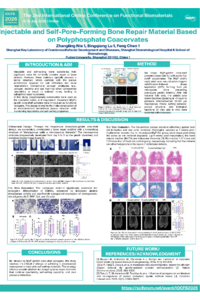
Background: Injectable and self-setting bone substitutes hold significant value for minimally invasive repair of bone defects. However, these materials typically possess a dense structure, which conflicts with the porous architecture required for cell infiltration and bone regeneration. Conventional porogen strategies (e.g., porogen leaching and gas foaming) often compromise injectability or result in isolated pores, leading to suboptimal repair outcomes.
Methods: Using calcium polyphosphate (Ca-polyP) coacervate as the injectable matrix, we introduced MgP–gelatin core–shell powders (MgP:gelatin = 5:1) as functional porogens. The core–shell structure comprises a gelatin core coated with an alkaline MgP shell. Upon mixing with the acidic Ca-polyP coacervate, the MgP shell triggers an acid-base neutralization reaction that initiates self-setting and activates the setting-induced liquid–solid phase separation (SIPS) mechanism, generating abundant micropores (1–10 μm). Concurrently, the MgP shell serves as a physical barrier to delay water penetration into the gelatin core, ensuring undisturbed SIPS. After complete setting, gradual dissolution of the gelatin core results in the formation of interconnected macropores (40–60 μm), with optimal porosity achieved at day 5. The setting behavior, pore architecture, and biological functions were systematically evaluated.
Results: Through the MgP–gelatin core–shell design, we successfully fabricated bone repair scaffolds with a hierarchical "microporous wall + macroporous channel" structure. In vitro, the composite significantly promoted BMSC osteogenic differentiation, as evidenced by markedly elevated expressions of iBSP, OCN, and osterix. In vivo, the hierarchical porosity effectively guided host-cell infiltration and new bone formation; at 8 weeks post-implantation, bone volume fraction (BV/TV) and trabecular thickness (Tb.Th) were 1.37-fold and 1.23-fold higher than those of the blank control group, respectively, indicating enhanced repair of rat femoral defects.
Conclusion: By introducing MgP–gelatin core–shell porogens, this study resolves the critical challenge of achieving interconnected macropores in injectable self-setting materials. This strategy offers a versatile platform for designing bone repair materials that combine injectability, self-setting capability, and ideal porous architecture.
Keywords
Polyphosphate coacervate
Injectable biomaterials
Self-setting
Hierarchical porosity
Bone tissue engineering
Core-shell structure
Poster
iocfb壁报.pdf
Bioprinting of Imaging-Derived Bone Geometries: Toward Patient-Specific Alginate Hydrogel Femur Phantoms for Mechanical and Functional Testing
Bioactive and magnetic apatitic bone cement for bone regeneration