Event submissions
Published
This submission belongs to the session S2. Bone Biomaterials of the event The 2nd International Online Conference on Functional Biomaterials
Published date
03 Jul, 2026
Academic Editor
'%3e%3cpath%20d='M12.6657%2010.9104C12.4185%2010.325%2012.0599%209.79327%2011.6097%209.34482C11.1609%208.89508%2010.6293%208.5365%2010.0442%208.28888C10.0389%208.28626%2010.0337%208.28495%2010.0285%208.28233C10.8446%207.69279%2011.3752%206.73249%2011.3752%205.64904C11.3752%203.8542%209.92103%202.39999%208.1262%202.39999C6.33136%202.39999%204.87715%203.8542%204.87715%205.64904C4.87715%206.73249%205.40774%207.69279%206.22393%208.28364C6.21869%208.28626%206.21345%208.28757%206.20821%208.29019C5.62129%208.5378%205.09463%208.89284%204.64265%209.34613C4.1929%209.79493%203.83432%2010.3266%203.58671%2010.9117C3.34345%2011.4845%203.21226%2012.0987%203.20023%2012.7209C3.19988%2012.7349%203.20233%2012.7488%203.20744%2012.7619C3.21255%2012.7749%203.22022%2012.7867%203.22998%2012.7968C3.23975%2012.8068%203.25142%2012.8147%203.26431%2012.8202C3.2772%2012.8256%203.29105%2012.8284%203.30504%2012.8284H4.09109C4.14874%2012.8284%204.19459%2012.7825%204.1959%2012.7262C4.2221%2011.7148%204.62823%2010.7676%205.34617%2010.0497C6.08899%209.30683%207.0755%208.89808%208.1262%208.89808C9.17689%208.89808%2010.1634%209.30683%2010.9062%2010.0497C11.6242%2010.7676%2012.0303%2011.7148%2012.0565%2012.7262C12.0578%2012.7838%2012.1037%2012.8284%2012.1613%2012.8284H12.9474C12.9613%2012.8284%2012.9752%2012.8256%2012.9881%2012.8202C13.001%2012.8147%2013.0126%2012.8068%2013.0224%2012.7968C13.0322%2012.7867%2013.0398%2012.7749%2013.0449%2012.7619C13.0501%2012.7488%2013.0525%2012.7349%2013.0522%2012.7209C13.0391%2012.0947%2012.9094%2011.4855%2012.6657%2010.9104ZM8.1262%207.9024C7.52486%207.9024%206.9589%207.6679%206.53312%207.24211C6.10733%206.81633%205.87283%206.25037%205.87283%205.64904C5.87283%205.0477%206.10733%204.48174%206.53312%204.05596C6.9589%203.63018%207.52486%203.39567%208.1262%203.39567C8.72753%203.39567%209.29349%203.63018%209.71927%204.05596C10.1451%204.48174%2010.3796%205.0477%2010.3796%205.64904C10.3796%206.25037%2010.1451%206.81633%209.71927%207.24211C9.29349%207.6679%208.72753%207.9024%208.1262%207.9024Z'%20fill='%235D1EE1'/%3e%3c/g%3e%3c/svg%3e) Elisa Boanini
Elisa BoaniniCitation
Marta Tavoni, Anna Tampieri, Hina Inam, Elisa Restivo, Livia Visai, Simone Sprio, Bioactive and magnetic apatitic bone cement for bone regeneration, in Proceedings of The 2nd International Online Conference on Functional Biomaterials, 8 July–10 July 2026, MDPI: Basel, Switzerland
Share
Email
Facebook
Twitter
LinkedIn
Bioactive and magnetic apatitic bone cement for bone regeneration
'%3e%3cpath%20d='M12.6647%2010.9104C12.4176%2010.325%2012.0589%209.7933%2011.6088%209.34485C11.16%208.89511%2010.6283%208.53653%2010.0432%208.28891C10.038%208.28629%2010.0327%208.28498%2010.0275%208.28236C10.8437%207.69282%2011.3743%206.73252%2011.3743%205.64907C11.3743%203.85423%209.92005%202.40002%208.12522%202.40002C6.33038%202.40002%204.87618%203.85423%204.87618%205.64907C4.87618%206.73252%205.40677%207.69282%206.22296%208.28367C6.21772%208.28629%206.21248%208.2876%206.20724%208.29022C5.62031%208.53783%205.09365%208.89287%204.64167%209.34616C4.19192%209.79496%203.83334%2010.3266%203.58573%2010.9117C3.34247%2011.4846%203.21128%2012.0987%203.19925%2012.721C3.1989%2012.735%203.20135%2012.7489%203.20646%2012.7619C3.21157%2012.7749%203.21924%2012.7868%203.22901%2012.7968C3.23877%2012.8068%203.25045%2012.8148%203.26334%2012.8202C3.27623%2012.8256%203.29007%2012.8284%203.30406%2012.8284H4.09012C4.14776%2012.8284%204.19362%2012.7825%204.19493%2012.7262C4.22113%2011.7148%204.62726%2010.7676%205.34519%2010.0497C6.08802%209.30686%207.07452%208.89811%208.12522%208.89811C9.17592%208.89811%2010.1624%209.30686%2010.9052%2010.0497C11.6232%2010.7676%2012.0293%2011.7148%2012.0555%2012.7262C12.0568%2012.7839%2012.1027%2012.8284%2012.1603%2012.8284H12.9464C12.9604%2012.8284%2012.9742%2012.8256%2012.9871%2012.8202C13%2012.8148%2013.0117%2012.8068%2013.0214%2012.7968C13.0312%2012.7868%2013.0389%2012.7749%2013.044%2012.7619C13.0491%2012.7489%2013.0515%2012.735%2013.0512%2012.721C13.0381%2012.0947%2012.9084%2011.4856%2012.6647%2010.9104ZM8.12522%207.90243C7.52388%207.90243%206.95792%207.66793%206.53214%207.24215C6.10636%206.81636%205.87185%206.2504%205.87185%205.64907C5.87185%205.04773%206.10636%204.48177%206.53214%204.05599C6.95792%203.63021%207.52388%203.3957%208.12522%203.3957C8.72655%203.3957%209.29252%203.63021%209.7183%204.05599C10.1441%204.48177%2010.3786%205.04773%2010.3786%205.64907C10.3786%206.2504%2010.1441%206.81636%209.7183%207.24215C9.29252%207.66793%208.72655%207.90243%208.12522%207.90243Z'%20fill='%235D1EE1'/%3e%3c/g%3e%3c/svg%3e)
Marta Tavoni 1
Anna Tampieri 1
Hina Inam 1
Elisa Restivo 2
Livia Visai 2,3,4
Simone Sprio 1
1. Institute of Science, Technology and Sustainability for Ceramics, National Research Council, 48018 Faenza, Italy
2. Molecular Medicine Department (DMM), Center for Health Technologies (CHT), UdR INSTM, University of Pavia, Pavia, Italy
3. UOR6 Nanotechnology Laboratory, Department of Prevention and Rehabilitation in Occupational Medicine and Specialty Medicine, Istituti Clinici Scientifici Maugeri IRCCS, Pavia, Italy
4. Interuniversity Center for the Promotion of the 3Rs Principles in Teaching and Research (Centro 3R), Operative Unit (OU) of University of Pavia, Pavia, Italy
Abstract
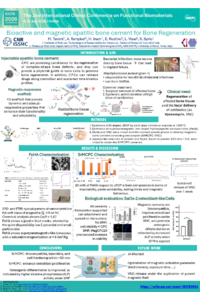
Introduction. Bone regeneration in compromised physiological conditions requires biomaterials able to combine bioactivity and mechanical performance, and support the physiological bone healing processes by eliciting an appropriate cellular response. Apatitic bone cements (CPCs) are injectable biomaterials that self‑harden in vivo into biomimetic hydroxyapatite, offering an attractive option for minimally invasive surgery. In this study, Fe‑doped hydroxyapatite (FeHA) was incorporated into CPCs to develop magneto‑responsive bone cements capable of enhancing regenerative outcomes through remote activation. The aim was to design and optimise a bioactive apatitic cement able to modulate biological activity on demand.
Methods. FeHA nanoparticles were synthesised by a neutralisation method and combined with α‑tricalcium phosphate, previously obtained by solid‑state reaction at 1400 °C, followed by rapid quenching, to produce magnetic CPCs. The influence of FeHA content, liquid‑to‑powder ratio, and additives on injectability, cohesion, and setting behaviour was investigated. The resulting cements were characterised in terms of phase composition, ion release, and surface morphology. Cytocompatibility, cell morphology, and osteogenic differentiation were evaluated in vitro, with and without exposure to static magnetic fields (SMFs). Tetracycline, a broad-spectrum antibiotic, was used as a model drug to evaluate the ability of magnetic-CPC to release therapeutic agents.
Results. Optimised magnetic CPCs containing 20% FeHA exhibited suitable rheological properties, reliable self‑hardening, and stable magnetic behaviour. Tetracycline‑loaded magnetic CPCs showed sustained release over 7 days, governed by interactions with the apatitic matrix. In vitro, magnetic activation significantly enhanced cell proliferation and osteogenic markers compared with non‑activated controls, demonstrating the synergistic contribution of FeHA magnetisation and CPC bioactivity.
Conclusions. The magnetic bone cement developed in this work represents a promising injectable biomaterial for bone regeneration. Its ability to self‑harden, support osteogenic processes, and be externally activated to modulate cellular behaviour highlights its potential for personalised, on‑demand therapeutic strategies, particularly in patients with impaired regenerative capacity.
Keywords
Magnetic Bone Cement
Fe-doped hydroxyapatite
bone regeneration
Poster
Tavoni_Poster_id_sciforum-179368.pdf
Engineering Injectable and Self-Setting Bone Grafts with In Situ Hierarchical Pores via Polyphosphate Coacervate and Gelatin–MgP Core–Shell Porogens
Tailoring MAO Coatings on Pure Magnesium via Electrical Parameters in a Multi-Component Electrolyte