Event submissions
Published
This submission belongs to the session S2. Bone Biomaterials of the event The 2nd International Online Conference on Functional Biomaterials
Published date
03 Jul, 2026
Academic Editor
'%3e%3cpath%20d='M12.6657%2010.9104C12.4185%2010.325%2012.0599%209.79327%2011.6097%209.34482C11.1609%208.89508%2010.6293%208.5365%2010.0442%208.28888C10.0389%208.28626%2010.0337%208.28495%2010.0285%208.28233C10.8446%207.69279%2011.3752%206.73249%2011.3752%205.64904C11.3752%203.8542%209.92103%202.39999%208.1262%202.39999C6.33136%202.39999%204.87715%203.8542%204.87715%205.64904C4.87715%206.73249%205.40774%207.69279%206.22393%208.28364C6.21869%208.28626%206.21345%208.28757%206.20821%208.29019C5.62129%208.5378%205.09463%208.89284%204.64265%209.34613C4.1929%209.79493%203.83432%2010.3266%203.58671%2010.9117C3.34345%2011.4845%203.21226%2012.0987%203.20023%2012.7209C3.19988%2012.7349%203.20233%2012.7488%203.20744%2012.7619C3.21255%2012.7749%203.22022%2012.7867%203.22998%2012.7968C3.23975%2012.8068%203.25142%2012.8147%203.26431%2012.8202C3.2772%2012.8256%203.29105%2012.8284%203.30504%2012.8284H4.09109C4.14874%2012.8284%204.19459%2012.7825%204.1959%2012.7262C4.2221%2011.7148%204.62823%2010.7676%205.34617%2010.0497C6.08899%209.30683%207.0755%208.89808%208.1262%208.89808C9.17689%208.89808%2010.1634%209.30683%2010.9062%2010.0497C11.6242%2010.7676%2012.0303%2011.7148%2012.0565%2012.7262C12.0578%2012.7838%2012.1037%2012.8284%2012.1613%2012.8284H12.9474C12.9613%2012.8284%2012.9752%2012.8256%2012.9881%2012.8202C13.001%2012.8147%2013.0126%2012.8068%2013.0224%2012.7968C13.0322%2012.7867%2013.0398%2012.7749%2013.0449%2012.7619C13.0501%2012.7488%2013.0525%2012.7349%2013.0522%2012.7209C13.0391%2012.0947%2012.9094%2011.4855%2012.6657%2010.9104ZM8.1262%207.9024C7.52486%207.9024%206.9589%207.6679%206.53312%207.24211C6.10733%206.81633%205.87283%206.25037%205.87283%205.64904C5.87283%205.0477%206.10733%204.48174%206.53312%204.05596C6.9589%203.63018%207.52486%203.39567%208.1262%203.39567C8.72753%203.39567%209.29349%203.63018%209.71927%204.05596C10.1451%204.48174%2010.3796%205.0477%2010.3796%205.64904C10.3796%206.25037%2010.1451%206.81633%209.71927%207.24211C9.29349%207.6679%208.72753%207.9024%208.1262%207.9024Z'%20fill='%235D1EE1'/%3e%3c/g%3e%3c/svg%3e) Elisa Boanini
Elisa BoaniniCitation
Indra Mooij, Iulian Apachitei, Amir Zadpoor, Lidy Fratila-Apachitei, Mapping the Influence of Unduloid Fields on Cytoskeletal and Nuclear Adaptation of hMSCs, in Proceedings of The 2nd International Online Conference on Functional Biomaterials, 8 July–10 July 2026, MDPI: Basel, Switzerland
Share
Email
Facebook
Twitter
LinkedIn
Mapping the Influence of Unduloid Fields on Cytoskeletal and Nuclear Adaptation of hMSCs
'%3e%3cpath%20d='M12.6647%2010.9104C12.4176%2010.325%2012.0589%209.7933%2011.6088%209.34485C11.16%208.89511%2010.6283%208.53653%2010.0432%208.28891C10.038%208.28629%2010.0327%208.28498%2010.0275%208.28236C10.8437%207.69282%2011.3743%206.73252%2011.3743%205.64907C11.3743%203.85423%209.92005%202.40002%208.12522%202.40002C6.33038%202.40002%204.87618%203.85423%204.87618%205.64907C4.87618%206.73252%205.40677%207.69282%206.22296%208.28367C6.21772%208.28629%206.21248%208.2876%206.20724%208.29022C5.62031%208.53783%205.09365%208.89287%204.64167%209.34616C4.19192%209.79496%203.83334%2010.3266%203.58573%2010.9117C3.34247%2011.4846%203.21128%2012.0987%203.19925%2012.721C3.1989%2012.735%203.20135%2012.7489%203.20646%2012.7619C3.21157%2012.7749%203.21924%2012.7868%203.22901%2012.7968C3.23877%2012.8068%203.25045%2012.8148%203.26334%2012.8202C3.27623%2012.8256%203.29007%2012.8284%203.30406%2012.8284H4.09012C4.14776%2012.8284%204.19362%2012.7825%204.19493%2012.7262C4.22113%2011.7148%204.62726%2010.7676%205.34519%2010.0497C6.08802%209.30686%207.07452%208.89811%208.12522%208.89811C9.17592%208.89811%2010.1624%209.30686%2010.9052%2010.0497C11.6232%2010.7676%2012.0293%2011.7148%2012.0555%2012.7262C12.0568%2012.7839%2012.1027%2012.8284%2012.1603%2012.8284H12.9464C12.9604%2012.8284%2012.9742%2012.8256%2012.9871%2012.8202C13%2012.8148%2013.0117%2012.8068%2013.0214%2012.7968C13.0312%2012.7868%2013.0389%2012.7749%2013.044%2012.7619C13.0491%2012.7489%2013.0515%2012.735%2013.0512%2012.721C13.0381%2012.0947%2012.9084%2011.4856%2012.6647%2010.9104ZM8.12522%207.90243C7.52388%207.90243%206.95792%207.66793%206.53214%207.24215C6.10636%206.81636%205.87185%206.2504%205.87185%205.64907C5.87185%205.04773%206.10636%204.48177%206.53214%204.05599C6.95792%203.63021%207.52388%203.3957%208.12522%203.3957C8.72655%203.3957%209.29252%203.63021%209.7183%204.05599C10.1441%204.48177%2010.3786%205.04773%2010.3786%205.64907C10.3786%206.2504%2010.1441%206.81636%209.7183%207.24215C9.29252%207.66793%208.72655%207.90243%208.12522%207.90243Z'%20fill='%235D1EE1'/%3e%3c/g%3e%3c/svg%3e)
Indra Mooij 1

Iulian Apachitei 1

Amir Zadpoor 1

Lidy Fratila-Apachitei 1
1. Department of Biomechanical Engineering, Faculty of Mechanical Engineering, Delft University of Technology, Delft, The Netherlands
Abstract
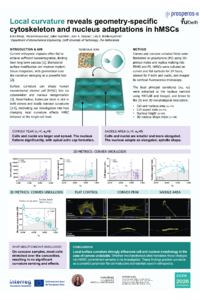
Introduction: Biomaterial surface geometry acts as a powerful cell-instructive cue at the biomaterial–tissue interface by reshaping cytoskeletal and nuclear architecture [1,2]. Uncovering how specific curvatures regulate these responses is essential for guiding the fate of human mesenchymal stromal cells (hMSCs). Here, we investigate concave and convex unduloid fields defined by two radii of curvatures (r₁ = 135 µm, r₂ = 45 µm) and their corresponding local principal curvatures to gain insight into curvature-dependent adaptation at the single-cell level.
Methods: Curvature fields were fabricated on polystyrene (PS) substrates using molds fabricated by micro-digital light printing, followed by replica molding into polydimethylsiloxane and final imprinting onto PS. hMSCs were cultured on curved and flat PS substrates for 24 hours, stained for F-actin and nuclei, and imaged by confocal fluorescence microscopy. The local principal curvatures (κ₁, κ₂) were extracted at the nuclear centroid, enabling direct correlation of curvature with cellular behavior. Cell area, elongation, actin organization, nuclear deformation, and cell/nuclear orientation relative to the underlying geometry were analyzed in FIJI.
Results: hMSCs exhibited curvature-dependent adaptation. Locally convex regions (κ₁ > 0, κ₂ > 0) promoted isotropic spreading with prominent stress fibres, nuclear flattening, and apical actin cap formation. In contrast, cells in local concavities (κ₂ < 0) displayed reduced cell area, increased elongation and more rounded nuclei. In saddle areas (κ₁ > 0, κ₂ < 0), hMSCs aligned diagonally relative to the principal curvature directions, indicating curvature-dependent orientation. Cells on flat controls showed comparable spreading to cells on convex areas, but less pronounced actin cap formation. These findings suggest that varying local curvatures influence hMSC adaptation, potentially affecting subsequent cellular function and collective behavior.
Conclusions: Quantitative mapping of hMSC responses to local principal curvatures reveals curvature-specific adaptations that are highly relevant for biomaterial-induced cell modulation, such as osteoimmunomodulation.
1: Callens, S.J.P. et al. (2020). Biomaterials 232, 119739
2: Xiao, L. et al. (2023). J. Mater. Chem. B 11, 2550–2567
Keywords
surface geometry
surface curvature
human mesenchymal stromal cells
cell mechanics
Poster
Poster IOCFB IM TU Delft.pdf
Engineering Trb3-Targeted Exosome Mimetics to Promote Bone Regeneration in Osteoporosis
Compositional Control of Strontium-Substituted Hydroxyapatite Governs Bioactivity and Mechanical Response in Electrospun PCL/Gel Scaffolds