Event submissions
Published
This submission belongs to the session S4. Biomaterials for Tissue Engineering and Regenerative Medicine of the event The 2nd International Online Conference on Functional Biomaterials
Published date
03 Jul, 2026
Academic Editor
'%3e%3cpath%20d='M12.6657%2010.9104C12.4185%2010.325%2012.0599%209.79327%2011.6097%209.34482C11.1609%208.89508%2010.6293%208.5365%2010.0442%208.28888C10.0389%208.28626%2010.0337%208.28495%2010.0285%208.28233C10.8446%207.69279%2011.3752%206.73249%2011.3752%205.64904C11.3752%203.8542%209.92103%202.39999%208.1262%202.39999C6.33136%202.39999%204.87715%203.8542%204.87715%205.64904C4.87715%206.73249%205.40774%207.69279%206.22393%208.28364C6.21869%208.28626%206.21345%208.28757%206.20821%208.29019C5.62129%208.5378%205.09463%208.89284%204.64265%209.34613C4.1929%209.79493%203.83432%2010.3266%203.58671%2010.9117C3.34345%2011.4845%203.21226%2012.0987%203.20023%2012.7209C3.19988%2012.7349%203.20233%2012.7488%203.20744%2012.7619C3.21255%2012.7749%203.22022%2012.7867%203.22998%2012.7968C3.23975%2012.8068%203.25142%2012.8147%203.26431%2012.8202C3.2772%2012.8256%203.29105%2012.8284%203.30504%2012.8284H4.09109C4.14874%2012.8284%204.19459%2012.7825%204.1959%2012.7262C4.2221%2011.7148%204.62823%2010.7676%205.34617%2010.0497C6.08899%209.30683%207.0755%208.89808%208.1262%208.89808C9.17689%208.89808%2010.1634%209.30683%2010.9062%2010.0497C11.6242%2010.7676%2012.0303%2011.7148%2012.0565%2012.7262C12.0578%2012.7838%2012.1037%2012.8284%2012.1613%2012.8284H12.9474C12.9613%2012.8284%2012.9752%2012.8256%2012.9881%2012.8202C13.001%2012.8147%2013.0126%2012.8068%2013.0224%2012.7968C13.0322%2012.7867%2013.0398%2012.7749%2013.0449%2012.7619C13.0501%2012.7488%2013.0525%2012.7349%2013.0522%2012.7209C13.0391%2012.0947%2012.9094%2011.4855%2012.6657%2010.9104ZM8.1262%207.9024C7.52486%207.9024%206.9589%207.6679%206.53312%207.24211C6.10733%206.81633%205.87283%206.25037%205.87283%205.64904C5.87283%205.0477%206.10733%204.48174%206.53312%204.05596C6.9589%203.63018%207.52486%203.39567%208.1262%203.39567C8.72753%203.39567%209.29349%203.63018%209.71927%204.05596C10.1451%204.48174%2010.3796%205.0477%2010.3796%205.64904C10.3796%206.25037%2010.1451%206.81633%209.71927%207.24211C9.29349%207.6679%208.72753%207.9024%208.1262%207.9024Z'%20fill='%235D1EE1'/%3e%3c/g%3e%3c/svg%3e) Piergiorgio Gentile
Piergiorgio GentileCitation
Kirill Kucheryaev, Kirill Gapeev, Ekaterina Chikanova, Dmitry Shtansky, Polylactide/Nanohydroxyapatite Composite Films: Physicochemical Properties and Biocompatibility for Regenerative Medicine Applications, in Proceedings of The 2nd International Online Conference on Functional Biomaterials, 8 July–10 July 2026, MDPI: Basel, Switzerland
Share
Email
Facebook
Twitter
LinkedIn
Polylactide/Nanohydroxyapatite Composite Films: Physicochemical Properties and Biocompatibility for Regenerative Medicine Applications
'%3e%3cpath%20d='M12.6647%2010.9104C12.4176%2010.325%2012.0589%209.7933%2011.6088%209.34485C11.16%208.89511%2010.6283%208.53653%2010.0432%208.28891C10.038%208.28629%2010.0327%208.28498%2010.0275%208.28236C10.8437%207.69282%2011.3743%206.73252%2011.3743%205.64907C11.3743%203.85423%209.92005%202.40002%208.12522%202.40002C6.33038%202.40002%204.87618%203.85423%204.87618%205.64907C4.87618%206.73252%205.40677%207.69282%206.22296%208.28367C6.21772%208.28629%206.21248%208.2876%206.20724%208.29022C5.62031%208.53783%205.09365%208.89287%204.64167%209.34616C4.19192%209.79496%203.83334%2010.3266%203.58573%2010.9117C3.34247%2011.4846%203.21128%2012.0987%203.19925%2012.721C3.1989%2012.735%203.20135%2012.7489%203.20646%2012.7619C3.21157%2012.7749%203.21924%2012.7868%203.22901%2012.7968C3.23877%2012.8068%203.25045%2012.8148%203.26334%2012.8202C3.27623%2012.8256%203.29007%2012.8284%203.30406%2012.8284H4.09012C4.14776%2012.8284%204.19362%2012.7825%204.19493%2012.7262C4.22113%2011.7148%204.62726%2010.7676%205.34519%2010.0497C6.08802%209.30686%207.07452%208.89811%208.12522%208.89811C9.17592%208.89811%2010.1624%209.30686%2010.9052%2010.0497C11.6232%2010.7676%2012.0293%2011.7148%2012.0555%2012.7262C12.0568%2012.7839%2012.1027%2012.8284%2012.1603%2012.8284H12.9464C12.9604%2012.8284%2012.9742%2012.8256%2012.9871%2012.8202C13%2012.8148%2013.0117%2012.8068%2013.0214%2012.7968C13.0312%2012.7868%2013.0389%2012.7749%2013.044%2012.7619C13.0491%2012.7489%2013.0515%2012.735%2013.0512%2012.721C13.0381%2012.0947%2012.9084%2011.4856%2012.6647%2010.9104ZM8.12522%207.90243C7.52388%207.90243%206.95792%207.66793%206.53214%207.24215C6.10636%206.81636%205.87185%206.2504%205.87185%205.64907C5.87185%205.04773%206.10636%204.48177%206.53214%204.05599C6.95792%203.63021%207.52388%203.3957%208.12522%203.3957C8.72655%203.3957%209.29252%203.63021%209.7183%204.05599C10.1441%204.48177%2010.3786%205.04773%2010.3786%205.64907C10.3786%206.2504%2010.1441%206.81636%209.7183%207.24215C9.29252%207.66793%208.72655%207.90243%208.12522%207.90243Z'%20fill='%235D1EE1'/%3e%3c/g%3e%3c/svg%3e)
Kirill Kucheryaev 1
Kirill Gapeev 1
Ekaterina Chikanova 1
Dmitry Shtansky 1
1. University of Science and Technology MISIS, Leninsky prospect 4, Moscow 119049, Russia
Abstract
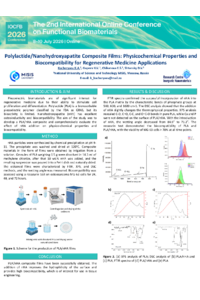
Introduction: Piezoelectric biomaterials are of significant interest for regenerative medicine due to their ability to stimulate cell proliferation and differentiation. Polylactide (PLA) is a bioresorbablepiezoelectric polymer classified by the FDA as GRAS, but its bioactivity is limited. Nanohydroxyapatite(nHA) has excellent osteoinductivity and biocompatibility. The aim of the study was to develop a PLA/nHA composite and comprehensively evaluate the effect of nHA addition on physico-chemical properties and biocompatibility.
Methods: nHA particles were synthesized by chemical precipitation at pH 9-11. The precipitate was washed and dried at 120°C. Composite materials in the form of films were obtained by irrigation from a solution. Granules of PLA weighing 0.5 g were dissolved in 14.3 ml of methylene chloride, 10 wt.% nHA was added, and the resulting suspension was poured into a Petri dish and naturally dried. The obtained films were characterized by FTIR, XPS, and DSC methods, and the wetting angle was measured. Biocompatibility was assessed using a resazurin test on osteosarcoma MG-63 cells for 24, 48, and 72 hours.
Results: FTIR spectra confirmed the successful incorporation of nHA into the PLA matrix by the characteristic bands of phosphate groups at 560, 600, and 1020 cm-1. The DSC analysis showed that the addition of nHA slightly changes the thermophysical properties. XPS analysis revealed C-O, C=O, C-C, and O=C-O bonds in pure PLA, while Ca and P were not detected on the surface of PLA/nHA. With the introduction of nHA, the wetting angle decreased from 84.9° to 71.2°. The rezazurin test demonstrated the biocompatibility of PLA and PLA/nHA, with the viability of MG-63 cells > 70% at all time points.
Conclusions: PLA/nHA composite films have been successfully obtained. The addition of nHA improves the hydrophilicity of the surface and provides high biocompatibility, which is of interest for use in tissue engineering.
Keywords
Polylactic acid
biodegradable polymers
hydroxyapatite
tissue engineering
regenerative medicine.
Poster
Poster.pdf
Mechanistic Study of Ion-Exchange Strategy for Regulating Multi-Metal Homeostasis to Ameliorate Mitochondrial Dysfunction in Radiation-Induced Oral Mucositis
From Spontaneous Differentiation to Functional Synaptic Networks: Neurogenic Modulation of SH‑SY5Y Cells by Semiconductive P3HT Interfaces