Event submissions
Published
This submission belongs to the session S4. Biomaterials for Tissue Engineering and Regenerative Medicine of the event The 2nd International Online Conference on Functional Biomaterials
Published date
03 Jul, 2026
Academic Editor
'%3e%3cpath%20d='M12.6657%2010.9104C12.4185%2010.325%2012.0599%209.79327%2011.6097%209.34482C11.1609%208.89508%2010.6293%208.5365%2010.0442%208.28888C10.0389%208.28626%2010.0337%208.28495%2010.0285%208.28233C10.8446%207.69279%2011.3752%206.73249%2011.3752%205.64904C11.3752%203.8542%209.92103%202.39999%208.1262%202.39999C6.33136%202.39999%204.87715%203.8542%204.87715%205.64904C4.87715%206.73249%205.40774%207.69279%206.22393%208.28364C6.21869%208.28626%206.21345%208.28757%206.20821%208.29019C5.62129%208.5378%205.09463%208.89284%204.64265%209.34613C4.1929%209.79493%203.83432%2010.3266%203.58671%2010.9117C3.34345%2011.4845%203.21226%2012.0987%203.20023%2012.7209C3.19988%2012.7349%203.20233%2012.7488%203.20744%2012.7619C3.21255%2012.7749%203.22022%2012.7867%203.22998%2012.7968C3.23975%2012.8068%203.25142%2012.8147%203.26431%2012.8202C3.2772%2012.8256%203.29105%2012.8284%203.30504%2012.8284H4.09109C4.14874%2012.8284%204.19459%2012.7825%204.1959%2012.7262C4.2221%2011.7148%204.62823%2010.7676%205.34617%2010.0497C6.08899%209.30683%207.0755%208.89808%208.1262%208.89808C9.17689%208.89808%2010.1634%209.30683%2010.9062%2010.0497C11.6242%2010.7676%2012.0303%2011.7148%2012.0565%2012.7262C12.0578%2012.7838%2012.1037%2012.8284%2012.1613%2012.8284H12.9474C12.9613%2012.8284%2012.9752%2012.8256%2012.9881%2012.8202C13.001%2012.8147%2013.0126%2012.8068%2013.0224%2012.7968C13.0322%2012.7867%2013.0398%2012.7749%2013.0449%2012.7619C13.0501%2012.7488%2013.0525%2012.7349%2013.0522%2012.7209C13.0391%2012.0947%2012.9094%2011.4855%2012.6657%2010.9104ZM8.1262%207.9024C7.52486%207.9024%206.9589%207.6679%206.53312%207.24211C6.10733%206.81633%205.87283%206.25037%205.87283%205.64904C5.87283%205.0477%206.10733%204.48174%206.53312%204.05596C6.9589%203.63018%207.52486%203.39567%208.1262%203.39567C8.72753%203.39567%209.29349%203.63018%209.71927%204.05596C10.1451%204.48174%2010.3796%205.0477%2010.3796%205.64904C10.3796%206.25037%2010.1451%206.81633%209.71927%207.24211C9.29349%207.6679%208.72753%207.9024%208.1262%207.9024Z'%20fill='%235D1EE1'/%3e%3c/g%3e%3c/svg%3e) Piergiorgio Gentile
Piergiorgio GentileCitation
Karen J. Juarez-Navarro, Franciso M. Sánchez-Arévalo, Marco A. Alvarez-Perez, Hybrid 3D-Printed/Electrospun Honeycomb PCL Scaffolds Improve Mechanical Stability and Promote Osteoblast Colonization, in Proceedings of The 2nd International Online Conference on Functional Biomaterials, 8 July–10 July 2026, MDPI: Basel, Switzerland
Share
Email
Facebook
Twitter
LinkedIn
Hybrid 3D-Printed/Electrospun Honeycomb PCL Scaffolds Improve Mechanical Stability and Promote Osteoblast Colonization
Hybrid 3D-Printed/Electrospun Honeycomb PCL Scaffolds Improve Mechanical Stability and Promote Osteoblast Colonization
'%3e%3cpath%20d='M12.6647%2010.9104C12.4176%2010.325%2012.0589%209.7933%2011.6088%209.34485C11.16%208.89511%2010.6283%208.53653%2010.0432%208.28891C10.038%208.28629%2010.0327%208.28498%2010.0275%208.28236C10.8437%207.69282%2011.3743%206.73252%2011.3743%205.64907C11.3743%203.85423%209.92005%202.40002%208.12522%202.40002C6.33038%202.40002%204.87618%203.85423%204.87618%205.64907C4.87618%206.73252%205.40677%207.69282%206.22296%208.28367C6.21772%208.28629%206.21248%208.2876%206.20724%208.29022C5.62031%208.53783%205.09365%208.89287%204.64167%209.34616C4.19192%209.79496%203.83334%2010.3266%203.58573%2010.9117C3.34247%2011.4846%203.21128%2012.0987%203.19925%2012.721C3.1989%2012.735%203.20135%2012.7489%203.20646%2012.7619C3.21157%2012.7749%203.21924%2012.7868%203.22901%2012.7968C3.23877%2012.8068%203.25045%2012.8148%203.26334%2012.8202C3.27623%2012.8256%203.29007%2012.8284%203.30406%2012.8284H4.09012C4.14776%2012.8284%204.19362%2012.7825%204.19493%2012.7262C4.22113%2011.7148%204.62726%2010.7676%205.34519%2010.0497C6.08802%209.30686%207.07452%208.89811%208.12522%208.89811C9.17592%208.89811%2010.1624%209.30686%2010.9052%2010.0497C11.6232%2010.7676%2012.0293%2011.7148%2012.0555%2012.7262C12.0568%2012.7839%2012.1027%2012.8284%2012.1603%2012.8284H12.9464C12.9604%2012.8284%2012.9742%2012.8256%2012.9871%2012.8202C13%2012.8148%2013.0117%2012.8068%2013.0214%2012.7968C13.0312%2012.7868%2013.0389%2012.7749%2013.044%2012.7619C13.0491%2012.7489%2013.0515%2012.735%2013.0512%2012.721C13.0381%2012.0947%2012.9084%2011.4856%2012.6647%2010.9104ZM8.12522%207.90243C7.52388%207.90243%206.95792%207.66793%206.53214%207.24215C6.10636%206.81636%205.87185%206.2504%205.87185%205.64907C5.87185%205.04773%206.10636%204.48177%206.53214%204.05599C6.95792%203.63021%207.52388%203.3957%208.12522%203.3957C8.72655%203.3957%209.29252%203.63021%209.7183%204.05599C10.1441%204.48177%2010.3786%205.04773%2010.3786%205.64907C10.3786%206.2504%2010.1441%206.81636%209.7183%207.24215C9.29252%207.66793%208.72655%207.90243%208.12522%207.90243Z'%20fill='%235D1EE1'/%3e%3c/g%3e%3c/svg%3e)
Karen J. Juarez-Navarro 1,2
Franciso M. Sánchez-Arévalo 2
Marco A. Alvarez-Perez 3
1. Graduate Program in Biological Sciences, Faculty of Sciences, National Autonomous University of Mexico (UNAM), Ciudad Universitaria, Mexico City, C.P. 04510, Mexico
2. Institute of Materials Research, National Autonomous University of Mexico (UNAM), Ciudad Universitaria, Mexico City, C.P. 04510, Mexico
3. Tissue Bioengineering Laboratory, Division of Graduate Studies and Research, Faculty of Dentistry, National Autonomous University of Mexico (UNAM), Ciudad Universitaria, Mexico City, C.P. 04510, Mexico
Abstract
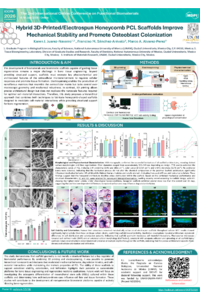
Introduction: The fabrication of biomimetic scaffolds that simultaneously provide structural support and microenvironmental cues remains a central challenge in bone tissue engineering. Electrospinning enables the production of nanofibrous matrices that resemble the extracellular matrix but lacks control over macroscopic geometry and mechanical robustness. In contrast, 3D printing allows precise architectural design but does not replicate the nanoscale features required for optimal cell–material interactions. This study proposes a hierarchical strategy that integrates both techniques to generate honeycomb-shaped biologically functional scaffolds.
Methods:
Poly(ε-caprolactone) scaffolds with hexagonal geometry were fabricated by combining 3D-printed collectors with electrospinning deposition. The resulting constructs were characterized by Fourier-transform infrared spectroscopy to confirm chemical integrity, scanning electron microscopy to evaluate fiber distribution and scaffold architecture, and mechanical testing to determine tensile properties. Swelling behavior and enzymatic degradation were assessed to analyze physicochemical stability. In vitro biological performance was evaluated using MTT assays of human fetal osteoblasts and fluorescence microscopy to determine cell viability, proliferation, and scaffold colonization.
Results:
This fabrication approach produced scaffolds with hierarchical organization, integrating defined hexagonal macroporosity with nanofibrous surfaces. Structural design influenced mechanical response and fluid interaction, yielding improved stability compared to randomly deposited meshes. In vitro assays demonstrated sustained and enhanced cell viability and progressive colonization along the hexagonal architecture.
Conclusions:
The integration of 3D printing and electrospinning enabled the fabrication of hierarchical PCL scaffolds that combine controlled macroscopic architecture with biomimetic nanofibrous features. The hexagonal design influenced mechanical behavior, physicochemical stability, and cellular response, promoting scaffold colonization while maintaining structural integrity. This dual-fabrication strategy addresses the individual limitations of each technique and represents a promising approach for the development of structurally guided platforms for bone tissue engineering applications.
Keywords
Electrospinning
3D Printing
Honeycomb
Bone Tissue Engineering Scaffolds
Osteoblasts
Poly(ε-caprolactone)
Poster
sciforum-175102.pdf
Evaluation of a Biomimetic and Electroactive 3D Bioprinted Cardiac Patch: From Bioink Optimization to Functional Regeneration in a Perfusion System
Characterization of Cellular and Molecular Responses to Platelet-Rich Plasma (PRP) from Elderly Patients with Acute Inflammatory Conditions in Cell Culture