Event submissions
Published
This submission belongs to the session S5. Biomaterials for Drug Delivery and Therapy of the event The 2nd International Online Conference on Functional Biomaterials
Published date
03 Jul, 2026
Academic Editor
'%3e%3cpath%20d='M12.6657%2010.9104C12.4185%2010.325%2012.0599%209.79327%2011.6097%209.34482C11.1609%208.89508%2010.6293%208.5365%2010.0442%208.28888C10.0389%208.28626%2010.0337%208.28495%2010.0285%208.28233C10.8446%207.69279%2011.3752%206.73249%2011.3752%205.64904C11.3752%203.8542%209.92103%202.39999%208.1262%202.39999C6.33136%202.39999%204.87715%203.8542%204.87715%205.64904C4.87715%206.73249%205.40774%207.69279%206.22393%208.28364C6.21869%208.28626%206.21345%208.28757%206.20821%208.29019C5.62129%208.5378%205.09463%208.89284%204.64265%209.34613C4.1929%209.79493%203.83432%2010.3266%203.58671%2010.9117C3.34345%2011.4845%203.21226%2012.0987%203.20023%2012.7209C3.19988%2012.7349%203.20233%2012.7488%203.20744%2012.7619C3.21255%2012.7749%203.22022%2012.7867%203.22998%2012.7968C3.23975%2012.8068%203.25142%2012.8147%203.26431%2012.8202C3.2772%2012.8256%203.29105%2012.8284%203.30504%2012.8284H4.09109C4.14874%2012.8284%204.19459%2012.7825%204.1959%2012.7262C4.2221%2011.7148%204.62823%2010.7676%205.34617%2010.0497C6.08899%209.30683%207.0755%208.89808%208.1262%208.89808C9.17689%208.89808%2010.1634%209.30683%2010.9062%2010.0497C11.6242%2010.7676%2012.0303%2011.7148%2012.0565%2012.7262C12.0578%2012.7838%2012.1037%2012.8284%2012.1613%2012.8284H12.9474C12.9613%2012.8284%2012.9752%2012.8256%2012.9881%2012.8202C13.001%2012.8147%2013.0126%2012.8068%2013.0224%2012.7968C13.0322%2012.7867%2013.0398%2012.7749%2013.0449%2012.7619C13.0501%2012.7488%2013.0525%2012.7349%2013.0522%2012.7209C13.0391%2012.0947%2012.9094%2011.4855%2012.6657%2010.9104ZM8.1262%207.9024C7.52486%207.9024%206.9589%207.6679%206.53312%207.24211C6.10733%206.81633%205.87283%206.25037%205.87283%205.64904C5.87283%205.0477%206.10733%204.48174%206.53312%204.05596C6.9589%203.63018%207.52486%203.39567%208.1262%203.39567C8.72753%203.39567%209.29349%203.63018%209.71927%204.05596C10.1451%204.48174%2010.3796%205.0477%2010.3796%205.64904C10.3796%206.25037%2010.1451%206.81633%209.71927%207.24211C9.29349%207.6679%208.72753%207.9024%208.1262%207.9024Z'%20fill='%235D1EE1'/%3e%3c/g%3e%3c/svg%3e) Filippo Rossi
Filippo RossiCitation
Berna Ateş, Özgül Gök Özatay, Şahin Şenay, Cardiomyocyte-Loaded Polymeric Microsphere Design For Treatment Of Cardiac Regeneration After Myocardial Ischemia And in vitro Evaluation, in Proceedings of The 2nd International Online Conference on Functional Biomaterials, 8 July–10 July 2026, MDPI: Basel, Switzerland
Share
Email
Facebook
Twitter
LinkedIn
Cardiomyocyte-Loaded Polymeric Microsphere Design For Treatment Of Cardiac Regeneration After Myocardial Ischemia And in vitro Evaluation
'%3e%3cpath%20d='M12.6647%2010.9104C12.4176%2010.325%2012.0589%209.7933%2011.6088%209.34485C11.16%208.89511%2010.6283%208.53653%2010.0432%208.28891C10.038%208.28629%2010.0327%208.28498%2010.0275%208.28236C10.8437%207.69282%2011.3743%206.73252%2011.3743%205.64907C11.3743%203.85423%209.92005%202.40002%208.12522%202.40002C6.33038%202.40002%204.87618%203.85423%204.87618%205.64907C4.87618%206.73252%205.40677%207.69282%206.22296%208.28367C6.21772%208.28629%206.21248%208.2876%206.20724%208.29022C5.62031%208.53783%205.09365%208.89287%204.64167%209.34616C4.19192%209.79496%203.83334%2010.3266%203.58573%2010.9117C3.34247%2011.4846%203.21128%2012.0987%203.19925%2012.721C3.1989%2012.735%203.20135%2012.7489%203.20646%2012.7619C3.21157%2012.7749%203.21924%2012.7868%203.22901%2012.7968C3.23877%2012.8068%203.25045%2012.8148%203.26334%2012.8202C3.27623%2012.8256%203.29007%2012.8284%203.30406%2012.8284H4.09012C4.14776%2012.8284%204.19362%2012.7825%204.19493%2012.7262C4.22113%2011.7148%204.62726%2010.7676%205.34519%2010.0497C6.08802%209.30686%207.07452%208.89811%208.12522%208.89811C9.17592%208.89811%2010.1624%209.30686%2010.9052%2010.0497C11.6232%2010.7676%2012.0293%2011.7148%2012.0555%2012.7262C12.0568%2012.7839%2012.1027%2012.8284%2012.1603%2012.8284H12.9464C12.9604%2012.8284%2012.9742%2012.8256%2012.9871%2012.8202C13%2012.8148%2013.0117%2012.8068%2013.0214%2012.7968C13.0312%2012.7868%2013.0389%2012.7749%2013.044%2012.7619C13.0491%2012.7489%2013.0515%2012.735%2013.0512%2012.721C13.0381%2012.0947%2012.9084%2011.4856%2012.6647%2010.9104ZM8.12522%207.90243C7.52388%207.90243%206.95792%207.66793%206.53214%207.24215C6.10636%206.81636%205.87185%206.2504%205.87185%205.64907C5.87185%205.04773%206.10636%204.48177%206.53214%204.05599C6.95792%203.63021%207.52388%203.3957%208.12522%203.3957C8.72655%203.3957%209.29252%203.63021%209.7183%204.05599C10.1441%204.48177%2010.3786%205.04773%2010.3786%205.64907C10.3786%206.2504%2010.1441%206.81636%209.7183%207.24215C9.29252%207.66793%208.72655%207.90243%208.12522%207.90243Z'%20fill='%235D1EE1'/%3e%3c/g%3e%3c/svg%3e)
Berna Ateş 1
Özgül Gök Özatay 1
Şahin Şenay 2
1. Acibadem Mehmet Ali Aydinlar University , Institute of Biomedical Engineering , 34638, İstanbul, Türkiye
2. Acibadem Mehmet Ali Aydinlar University ,Medical Faculty , 34638, İstanbul, Türkiye
Abstract
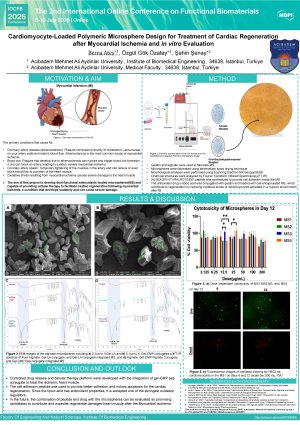
Cardiovascular disease (CVD) is the leading cause of mortality and disability worldwide, with 17.9 million annual deaths, including myocardial infarction caused by atherosclerosis [1]. Atherosclerosis is a complicated cardiovascular disease caused by multiple factors, including aging, inflammation, coronary artery blockage, oxidative stress, and plaque rupture, which causes myocardial ischemia (MI) and damages the heart muscle [2]. Current clinical strategies face limitations such as a lack of regeneration of damaged muscle and residual heart failure progression (e.g., pharmacological treatments and reperfusion therapies), leading to death [3]. Targeted drug delivery systems, including nanomedicine, nanoparticles and microsphere therapies, are being investigated to improve cardiomyocyte renewal. In this study, we designed a cardiomyocyte-loaded Gelatin-Alginate (GA) microsphere conjugated with LA (lipoic acid) and CMP (WLSEAGPVVTVRALRGTGSW) peptide to treat damaged heart tissue by using the electrostatic spray drying technique. We determined the chemical groups and morphological analyses of the microsphere using FT-IR, 1H NMR, and EDS-SEM. Dose-dependent cytotoxicity of drug and peptide conjugation on cell-loaded microspheres was obtained on days 4, 8, and 12 of incubation using the CCK-8 assay and live-dead assay. The cytotoxicity results showed the cell viability increased from 72% to 100% on day 12, indicating that drug and peptide conjugation increased cell regeneration. Thus, this treatment method may be part of a promising next-generation cellular therapy in the future.
Keywords
Cellular therapies
antioxidant drugs,polymeric microspheres,drug- polymer conjugate,peptide synthesis
biomaterials
Drug delivery
Poster
MDPI_2nd International Online Biomaterials Conference_.pdf
Bioactivity-Guided Assembly of Fucoidan from Turbinaria decurrens for Enhanced Anticancer Performance
Dual-Loaded Curcumin and Phenformin Copolymer Micelles for Targeted Colorectal Cancer Therapy via Mitochondrial Stress and Metabolic Modulation