Event submissions
Published
This submission belongs to the session S5. Biomaterials for Drug Delivery and Therapy of the event The 2nd International Online Conference on Functional Biomaterials
Published date
03 Jul, 2026
Academic Editor
'%3e%3cpath%20d='M12.6657%2010.9104C12.4185%2010.325%2012.0599%209.79327%2011.6097%209.34482C11.1609%208.89508%2010.6293%208.5365%2010.0442%208.28888C10.0389%208.28626%2010.0337%208.28495%2010.0285%208.28233C10.8446%207.69279%2011.3752%206.73249%2011.3752%205.64904C11.3752%203.8542%209.92103%202.39999%208.1262%202.39999C6.33136%202.39999%204.87715%203.8542%204.87715%205.64904C4.87715%206.73249%205.40774%207.69279%206.22393%208.28364C6.21869%208.28626%206.21345%208.28757%206.20821%208.29019C5.62129%208.5378%205.09463%208.89284%204.64265%209.34613C4.1929%209.79493%203.83432%2010.3266%203.58671%2010.9117C3.34345%2011.4845%203.21226%2012.0987%203.20023%2012.7209C3.19988%2012.7349%203.20233%2012.7488%203.20744%2012.7619C3.21255%2012.7749%203.22022%2012.7867%203.22998%2012.7968C3.23975%2012.8068%203.25142%2012.8147%203.26431%2012.8202C3.2772%2012.8256%203.29105%2012.8284%203.30504%2012.8284H4.09109C4.14874%2012.8284%204.19459%2012.7825%204.1959%2012.7262C4.2221%2011.7148%204.62823%2010.7676%205.34617%2010.0497C6.08899%209.30683%207.0755%208.89808%208.1262%208.89808C9.17689%208.89808%2010.1634%209.30683%2010.9062%2010.0497C11.6242%2010.7676%2012.0303%2011.7148%2012.0565%2012.7262C12.0578%2012.7838%2012.1037%2012.8284%2012.1613%2012.8284H12.9474C12.9613%2012.8284%2012.9752%2012.8256%2012.9881%2012.8202C13.001%2012.8147%2013.0126%2012.8068%2013.0224%2012.7968C13.0322%2012.7867%2013.0398%2012.7749%2013.0449%2012.7619C13.0501%2012.7488%2013.0525%2012.7349%2013.0522%2012.7209C13.0391%2012.0947%2012.9094%2011.4855%2012.6657%2010.9104ZM8.1262%207.9024C7.52486%207.9024%206.9589%207.6679%206.53312%207.24211C6.10733%206.81633%205.87283%206.25037%205.87283%205.64904C5.87283%205.0477%206.10733%204.48174%206.53312%204.05596C6.9589%203.63018%207.52486%203.39567%208.1262%203.39567C8.72753%203.39567%209.29349%203.63018%209.71927%204.05596C10.1451%204.48174%2010.3796%205.0477%2010.3796%205.64904C10.3796%206.25037%2010.1451%206.81633%209.71927%207.24211C9.29349%207.6679%208.72753%207.9024%208.1262%207.9024Z'%20fill='%235D1EE1'/%3e%3c/g%3e%3c/svg%3e) Filippo Rossi
Filippo RossiCitation
Christelle Pihen, Antonio Montes, Supercritical-Assisted Design of SiO₂–TiO₂ Functionalized PLGA Scaffolds for Controlled Drug Delivery Applications, in Proceedings of The 2nd International Online Conference on Functional Biomaterials, 8 July–10 July 2026, MDPI: Basel, Switzerland
Share
Email
Facebook
Twitter
LinkedIn
Supercritical-Assisted Design of SiO₂–TiO₂ Functionalized PLGA Scaffolds for Controlled Drug Delivery Applications
'%3e%3cpath%20d='M12.6647%2010.9104C12.4176%2010.325%2012.0589%209.7933%2011.6088%209.34485C11.16%208.89511%2010.6283%208.53653%2010.0432%208.28891C10.038%208.28629%2010.0327%208.28498%2010.0275%208.28236C10.8437%207.69282%2011.3743%206.73252%2011.3743%205.64907C11.3743%203.85423%209.92005%202.40002%208.12522%202.40002C6.33038%202.40002%204.87618%203.85423%204.87618%205.64907C4.87618%206.73252%205.40677%207.69282%206.22296%208.28367C6.21772%208.28629%206.21248%208.2876%206.20724%208.29022C5.62031%208.53783%205.09365%208.89287%204.64167%209.34616C4.19192%209.79496%203.83334%2010.3266%203.58573%2010.9117C3.34247%2011.4846%203.21128%2012.0987%203.19925%2012.721C3.1989%2012.735%203.20135%2012.7489%203.20646%2012.7619C3.21157%2012.7749%203.21924%2012.7868%203.22901%2012.7968C3.23877%2012.8068%203.25045%2012.8148%203.26334%2012.8202C3.27623%2012.8256%203.29007%2012.8284%203.30406%2012.8284H4.09012C4.14776%2012.8284%204.19362%2012.7825%204.19493%2012.7262C4.22113%2011.7148%204.62726%2010.7676%205.34519%2010.0497C6.08802%209.30686%207.07452%208.89811%208.12522%208.89811C9.17592%208.89811%2010.1624%209.30686%2010.9052%2010.0497C11.6232%2010.7676%2012.0293%2011.7148%2012.0555%2012.7262C12.0568%2012.7839%2012.1027%2012.8284%2012.1603%2012.8284H12.9464C12.9604%2012.8284%2012.9742%2012.8256%2012.9871%2012.8202C13%2012.8148%2013.0117%2012.8068%2013.0214%2012.7968C13.0312%2012.7868%2013.0389%2012.7749%2013.044%2012.7619C13.0491%2012.7489%2013.0515%2012.735%2013.0512%2012.721C13.0381%2012.0947%2012.9084%2011.4856%2012.6647%2010.9104ZM8.12522%207.90243C7.52388%207.90243%206.95792%207.66793%206.53214%207.24215C6.10636%206.81636%205.87185%206.2504%205.87185%205.64907C5.87185%205.04773%206.10636%204.48177%206.53214%204.05599C6.95792%203.63021%207.52388%203.3957%208.12522%203.3957C8.72655%203.3957%209.29252%203.63021%209.7183%204.05599C10.1441%204.48177%2010.3786%205.04773%2010.3786%205.64907C10.3786%206.2504%2010.1441%206.81636%209.7183%207.24215C9.29252%207.66793%208.72655%207.90243%208.12522%207.90243Z'%20fill='%235D1EE1'/%3e%3c/g%3e%3c/svg%3e)
Christelle Pihen 1

Antonio Montes 1
1. Department of Chemical Engineering and Food Technology, Faculty of Sciences, International Excellence Agrifood Campus (CeiA3), University of Cadiz, Campus Universitario Río San Pedro, 11510, Puerto Real (Cadiz), Spain.
Abstract
The development of multifunctional biomaterials with finely controlled structural and functional characteristics remains a major challenge in drug delivery and tissue engineering. In this study, SiO₂–TiO₂ composite particles were synthesized via the Supercritical Anti-Solvent (SAS) process and subsequently incorporated into poly(lactic‑co‑glycolic acid) (PLGA) matrices through supercritical CO₂-assisted foaming. A systematic investigation of key operational parameters, including pressure (90–150 bar), temperature (40–65 °C), and solution flow rate (4–8 mL/min), was carried out to determine their influence on particle formation, composition, and scaffold architecture. SEM–EDX analyses confirmed successful co‑precipitation and formation of SiO₂–TiO₂ hybrid particles under specific processing conditions, and revealed significant variations in particle size distribution and structural organization as functions of the operating parameters. The findings highlight a complex interplay between thermodynamic and mass‑transfer phenomena governing particle precipitation and deposition. Distinct transitions in particle morphology and spatial distribution within the reactor were observed for specific parameter combinations. In parallel, the supercritical foaming of PLGA produced porous scaffolds with markedly different architectures, ranging from uniform pore networks to heterogeneous structures exhibiting localized defects. The structural features obtained suggest a notable correlation between processing conditions and the potential performance of the resulting systems in controlled‑release applications. Overall, this work underscores the versatility of supercritical fluid technologies for fabricating advanced composite biomaterials. The capacity to tailor microstructure through precise control of processing parameters opens new opportunities for designing next‑generation scaffolds with customized properties for biomedical applications.
Keywords
Supercritical Anti-Solvent
SiO₂–TiO₂ composite
Scaffolds
Poster
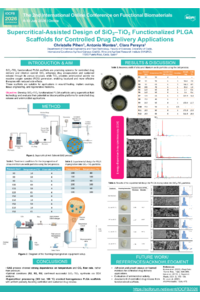
Pihen C.-Poster-Supercritical-Assisted Design of SiO₂–TiO₂ Functionalized PLGA Scaffolds for Controlled Drug Delivery Applications .pdf
Prodigiosin-loaded microvesicles as a novel anticancer drug
Microstructural and Mechanical Characterization of PVA-Based Drug Delivery Films Containing Menthol: Correlation Between SEM Morphology and Texture Analysis Across Three Manufacturing Methods