Event submissions
Published
This submission belongs to the session S5. Biomaterials for Drug Delivery and Therapy of the event The 2nd International Online Conference on Functional Biomaterials
Published date
03 Jul, 2026
Academic Editor
'%3e%3cpath%20d='M12.6657%2010.9104C12.4185%2010.325%2012.0599%209.79327%2011.6097%209.34482C11.1609%208.89508%2010.6293%208.5365%2010.0442%208.28888C10.0389%208.28626%2010.0337%208.28495%2010.0285%208.28233C10.8446%207.69279%2011.3752%206.73249%2011.3752%205.64904C11.3752%203.8542%209.92103%202.39999%208.1262%202.39999C6.33136%202.39999%204.87715%203.8542%204.87715%205.64904C4.87715%206.73249%205.40774%207.69279%206.22393%208.28364C6.21869%208.28626%206.21345%208.28757%206.20821%208.29019C5.62129%208.5378%205.09463%208.89284%204.64265%209.34613C4.1929%209.79493%203.83432%2010.3266%203.58671%2010.9117C3.34345%2011.4845%203.21226%2012.0987%203.20023%2012.7209C3.19988%2012.7349%203.20233%2012.7488%203.20744%2012.7619C3.21255%2012.7749%203.22022%2012.7867%203.22998%2012.7968C3.23975%2012.8068%203.25142%2012.8147%203.26431%2012.8202C3.2772%2012.8256%203.29105%2012.8284%203.30504%2012.8284H4.09109C4.14874%2012.8284%204.19459%2012.7825%204.1959%2012.7262C4.2221%2011.7148%204.62823%2010.7676%205.34617%2010.0497C6.08899%209.30683%207.0755%208.89808%208.1262%208.89808C9.17689%208.89808%2010.1634%209.30683%2010.9062%2010.0497C11.6242%2010.7676%2012.0303%2011.7148%2012.0565%2012.7262C12.0578%2012.7838%2012.1037%2012.8284%2012.1613%2012.8284H12.9474C12.9613%2012.8284%2012.9752%2012.8256%2012.9881%2012.8202C13.001%2012.8147%2013.0126%2012.8068%2013.0224%2012.7968C13.0322%2012.7867%2013.0398%2012.7749%2013.0449%2012.7619C13.0501%2012.7488%2013.0525%2012.7349%2013.0522%2012.7209C13.0391%2012.0947%2012.9094%2011.4855%2012.6657%2010.9104ZM8.1262%207.9024C7.52486%207.9024%206.9589%207.6679%206.53312%207.24211C6.10733%206.81633%205.87283%206.25037%205.87283%205.64904C5.87283%205.0477%206.10733%204.48174%206.53312%204.05596C6.9589%203.63018%207.52486%203.39567%208.1262%203.39567C8.72753%203.39567%209.29349%203.63018%209.71927%204.05596C10.1451%204.48174%2010.3796%205.0477%2010.3796%205.64904C10.3796%206.25037%2010.1451%206.81633%209.71927%207.24211C9.29349%207.6679%208.72753%207.9024%208.1262%207.9024Z'%20fill='%235D1EE1'/%3e%3c/g%3e%3c/svg%3e) Filippo Rossi
Filippo RossiCitation
Roberta Rovelli, Eunhyung Kim, Teresa Macchi, Heungsoo Shin, Serena Danti, Dual-Ion Crosslinked Alginate Hydrogels for Combined Antioxidant and Anti-Inflammatory Delivery in Colon-Targeted Therapy, in Proceedings of The 2nd International Online Conference on Functional Biomaterials, 8 July–10 July 2026, MDPI: Basel, Switzerland
Share
Email
Facebook
Twitter
LinkedIn
Dual-Ion Crosslinked Alginate Hydrogels for Combined Antioxidant and Anti-Inflammatory Delivery in Colon-Targeted Therapy
'%3e%3cpath%20d='M12.6647%2010.9104C12.4176%2010.325%2012.0589%209.7933%2011.6088%209.34485C11.16%208.89511%2010.6283%208.53653%2010.0432%208.28891C10.038%208.28629%2010.0327%208.28498%2010.0275%208.28236C10.8437%207.69282%2011.3743%206.73252%2011.3743%205.64907C11.3743%203.85423%209.92005%202.40002%208.12522%202.40002C6.33038%202.40002%204.87618%203.85423%204.87618%205.64907C4.87618%206.73252%205.40677%207.69282%206.22296%208.28367C6.21772%208.28629%206.21248%208.2876%206.20724%208.29022C5.62031%208.53783%205.09365%208.89287%204.64167%209.34616C4.19192%209.79496%203.83334%2010.3266%203.58573%2010.9117C3.34247%2011.4846%203.21128%2012.0987%203.19925%2012.721C3.1989%2012.735%203.20135%2012.7489%203.20646%2012.7619C3.21157%2012.7749%203.21924%2012.7868%203.22901%2012.7968C3.23877%2012.8068%203.25045%2012.8148%203.26334%2012.8202C3.27623%2012.8256%203.29007%2012.8284%203.30406%2012.8284H4.09012C4.14776%2012.8284%204.19362%2012.7825%204.19493%2012.7262C4.22113%2011.7148%204.62726%2010.7676%205.34519%2010.0497C6.08802%209.30686%207.07452%208.89811%208.12522%208.89811C9.17592%208.89811%2010.1624%209.30686%2010.9052%2010.0497C11.6232%2010.7676%2012.0293%2011.7148%2012.0555%2012.7262C12.0568%2012.7839%2012.1027%2012.8284%2012.1603%2012.8284H12.9464C12.9604%2012.8284%2012.9742%2012.8256%2012.9871%2012.8202C13%2012.8148%2013.0117%2012.8068%2013.0214%2012.7968C13.0312%2012.7868%2013.0389%2012.7749%2013.044%2012.7619C13.0491%2012.7489%2013.0515%2012.735%2013.0512%2012.721C13.0381%2012.0947%2012.9084%2011.4856%2012.6647%2010.9104ZM8.12522%207.90243C7.52388%207.90243%206.95792%207.66793%206.53214%207.24215C6.10636%206.81636%205.87185%206.2504%205.87185%205.64907C5.87185%205.04773%206.10636%204.48177%206.53214%204.05599C6.95792%203.63021%207.52388%203.3957%208.12522%203.3957C8.72655%203.3957%209.29252%203.63021%209.7183%204.05599C10.1441%204.48177%2010.3786%205.04773%2010.3786%205.64907C10.3786%206.2504%2010.1441%206.81636%209.7183%207.24215C9.29252%207.66793%208.72655%207.90243%208.12522%207.90243Z'%20fill='%235D1EE1'/%3e%3c/g%3e%3c/svg%3e)
Roberta Rovelli 1
Eunhyung Kim 2
Teresa Macchi 3
Heungsoo Shin 2

Serena Danti 4
1. Doctoral School in Life Sciences, University of Siena, 53100 Siena, Italy
2. Department of Bioengineering, Hanyang University, 222 Wangsimni-ro, Seongdong-gu, Seoul 04763, Republic of Korea
3. Department of Translational Research and New Technologies in Medicine and Surgery, University of Pisa, 56126 Pisa, Italy
4. Department of Civil and Industrial Engineering, University of Pisa, 56122 Pisa, Italy
Abstract
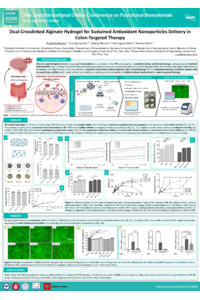
Chronic psychological stress disrupts gut homeostasis via activation of the hypothalamic–pituitary–adrenal (HPA) axis, leading to oxidative stress, epithelial damage, and persistent intestinal inflammation. Targeted strategies capable of simultaneously modulating oxidative stress and inflammatory responses are therefore highly desirable for colon-related disorders.
Here, we developed a dual-ion crosslinked sodium alginate (SA) hydrogel for the sustained release of antioxidant mineral-tannic acid nanoparticles (mTNs) under colon-mimicking conditions.
Mannuronic-rich, low molecular weight SA (50-80 kDa; M/G ratio 1.56) was selected to ensure homogeneous nanoparticle incorporation. A controlled pre-gelation step with Ca²⁺ and Zn²⁺ ions was introduced to promote uniform crosslinking and enhance network stability, with Zn²⁺ additionally contributing to epithelial repair and redox regulation.
Composite hydrogels containing 2, 3, and 4 % (w/v) SA and 1 % (w/v) mTNs were prepared and characterized in terms of encapsulation efficiency, mechanical properties, swelling, degradation, and release kinetics in simulated colon fluid. Anti-inflammatory activity was evaluated in LPS-stimulated macrophages by quantifying TNF-α gene expression, while cytocompatibility was assessed in Caco-2 cells.
Encapsulation efficiencies exceeded 80%, and dual ion crosslinking provided tunable mechanical properties comparable to native colon tissue. The composite hydrogels exhibited sustained nanoparticles release over 72 h, while preserving antioxidant activity. Notably, mTN-loaded hydrogels significantly reduced TNF-α expression compared to SA-only controls, confirming an anti-inflammatory effect, with excellent cytocompatibility observed in Caco-2 cells.
Overall, this dual-crosslinked hydrogel platform represents a promising strategy for controlled antioxidant delivery and modulation of stress-related colon inflammation, supporting its potential for colon-targeted therapy.
Keywords
Sodium alginate hydrogels
antioxidant nanoparticles
colon-targeted delivery
Poster
Poster_IOCFB_2026_RobertaRovelli.pdf
Effect of pore size on physical properties of self-agglomerated and ultrasonicated lyogels
Optimization of Rutin- and Quercetin-Loaded Chitosan Nanoparticles for Enhanced Anti-Inflammatory Delivery