Event submissions
Published
This submission belongs to the session S5. Biomaterials for Drug Delivery and Therapy of the event The 2nd International Online Conference on Functional Biomaterials
Published date
03 Jul, 2026
Academic Editor
'%3e%3cpath%20d='M12.6657%2010.9104C12.4185%2010.325%2012.0599%209.79327%2011.6097%209.34482C11.1609%208.89508%2010.6293%208.5365%2010.0442%208.28888C10.0389%208.28626%2010.0337%208.28495%2010.0285%208.28233C10.8446%207.69279%2011.3752%206.73249%2011.3752%205.64904C11.3752%203.8542%209.92103%202.39999%208.1262%202.39999C6.33136%202.39999%204.87715%203.8542%204.87715%205.64904C4.87715%206.73249%205.40774%207.69279%206.22393%208.28364C6.21869%208.28626%206.21345%208.28757%206.20821%208.29019C5.62129%208.5378%205.09463%208.89284%204.64265%209.34613C4.1929%209.79493%203.83432%2010.3266%203.58671%2010.9117C3.34345%2011.4845%203.21226%2012.0987%203.20023%2012.7209C3.19988%2012.7349%203.20233%2012.7488%203.20744%2012.7619C3.21255%2012.7749%203.22022%2012.7867%203.22998%2012.7968C3.23975%2012.8068%203.25142%2012.8147%203.26431%2012.8202C3.2772%2012.8256%203.29105%2012.8284%203.30504%2012.8284H4.09109C4.14874%2012.8284%204.19459%2012.7825%204.1959%2012.7262C4.2221%2011.7148%204.62823%2010.7676%205.34617%2010.0497C6.08899%209.30683%207.0755%208.89808%208.1262%208.89808C9.17689%208.89808%2010.1634%209.30683%2010.9062%2010.0497C11.6242%2010.7676%2012.0303%2011.7148%2012.0565%2012.7262C12.0578%2012.7838%2012.1037%2012.8284%2012.1613%2012.8284H12.9474C12.9613%2012.8284%2012.9752%2012.8256%2012.9881%2012.8202C13.001%2012.8147%2013.0126%2012.8068%2013.0224%2012.7968C13.0322%2012.7867%2013.0398%2012.7749%2013.0449%2012.7619C13.0501%2012.7488%2013.0525%2012.7349%2013.0522%2012.7209C13.0391%2012.0947%2012.9094%2011.4855%2012.6657%2010.9104ZM8.1262%207.9024C7.52486%207.9024%206.9589%207.6679%206.53312%207.24211C6.10733%206.81633%205.87283%206.25037%205.87283%205.64904C5.87283%205.0477%206.10733%204.48174%206.53312%204.05596C6.9589%203.63018%207.52486%203.39567%208.1262%203.39567C8.72753%203.39567%209.29349%203.63018%209.71927%204.05596C10.1451%204.48174%2010.3796%205.0477%2010.3796%205.64904C10.3796%206.25037%2010.1451%206.81633%209.71927%207.24211C9.29349%207.6679%208.72753%207.9024%208.1262%207.9024Z'%20fill='%235D1EE1'/%3e%3c/g%3e%3c/svg%3e) Filippo Rossi
Filippo RossiCitation
Eleni Manolakaki, Niki Karipidou, Maria Vasiliki Kechagia, Georgios Arvanitidis, Antonios Mandalidis, Apostolos Argyros, Nikolaos Michailidis, Amalia Aggeli, Multifunctional Collagen Corneal Shields Enabling Sustained Drug Delivery and Regeneration for Ocular Surface Therapy, in Proceedings of The 2nd International Online Conference on Functional Biomaterials, 8 July–10 July 2026, MDPI: Basel, Switzerland
Share
Email
Facebook
Twitter
LinkedIn
Multifunctional Collagen Corneal Shields Enabling Sustained Drug Delivery and Regeneration for Ocular Surface Therapy
'%3e%3cpath%20d='M12.6647%2010.9104C12.4176%2010.325%2012.0589%209.7933%2011.6088%209.34485C11.16%208.89511%2010.6283%208.53653%2010.0432%208.28891C10.038%208.28629%2010.0327%208.28498%2010.0275%208.28236C10.8437%207.69282%2011.3743%206.73252%2011.3743%205.64907C11.3743%203.85423%209.92005%202.40002%208.12522%202.40002C6.33038%202.40002%204.87618%203.85423%204.87618%205.64907C4.87618%206.73252%205.40677%207.69282%206.22296%208.28367C6.21772%208.28629%206.21248%208.2876%206.20724%208.29022C5.62031%208.53783%205.09365%208.89287%204.64167%209.34616C4.19192%209.79496%203.83334%2010.3266%203.58573%2010.9117C3.34247%2011.4846%203.21128%2012.0987%203.19925%2012.721C3.1989%2012.735%203.20135%2012.7489%203.20646%2012.7619C3.21157%2012.7749%203.21924%2012.7868%203.22901%2012.7968C3.23877%2012.8068%203.25045%2012.8148%203.26334%2012.8202C3.27623%2012.8256%203.29007%2012.8284%203.30406%2012.8284H4.09012C4.14776%2012.8284%204.19362%2012.7825%204.19493%2012.7262C4.22113%2011.7148%204.62726%2010.7676%205.34519%2010.0497C6.08802%209.30686%207.07452%208.89811%208.12522%208.89811C9.17592%208.89811%2010.1624%209.30686%2010.9052%2010.0497C11.6232%2010.7676%2012.0293%2011.7148%2012.0555%2012.7262C12.0568%2012.7839%2012.1027%2012.8284%2012.1603%2012.8284H12.9464C12.9604%2012.8284%2012.9742%2012.8256%2012.9871%2012.8202C13%2012.8148%2013.0117%2012.8068%2013.0214%2012.7968C13.0312%2012.7868%2013.0389%2012.7749%2013.044%2012.7619C13.0491%2012.7489%2013.0515%2012.735%2013.0512%2012.721C13.0381%2012.0947%2012.9084%2011.4856%2012.6647%2010.9104ZM8.12522%207.90243C7.52388%207.90243%206.95792%207.66793%206.53214%207.24215C6.10636%206.81636%205.87185%206.2504%205.87185%205.64907C5.87185%205.04773%206.10636%204.48177%206.53214%204.05599C6.95792%203.63021%207.52388%203.3957%208.12522%203.3957C8.72655%203.3957%209.29252%203.63021%209.7183%204.05599C10.1441%204.48177%2010.3786%205.04773%2010.3786%205.64907C10.3786%206.2504%2010.1441%206.81636%209.7183%207.24215C9.29252%207.66793%208.72655%207.90243%208.12522%207.90243Z'%20fill='%235D1EE1'/%3e%3c/g%3e%3c/svg%3e)
Eleni Manolakaki 1
Niki Karipidou 1,2
Maria Vasiliki Kechagia 1
Georgios Arvanitidis 1
Antonios Mandalidis 1
Apostolos Argyros 2,3

Nikolaos Michailidis 2,4
Amalia Aggeli 1,2
1. Department of Chemical Engineering, Faculty of Engineering, Aristotle University of Thessaloniki, 54124 Thessaloniki, Greece
2. Centre for Research & Development of Advanced Materials (CERDAM), Center for Interdisciplinary Research and Innovation, Balkan Center, 57001 Thessaloniki, Greece
3. Physical Metallurgy Laboratory, Mechanical Engineering Department, Faculty of Engineering, Aristotle University of Thessaloniki, 54124 Thessaloniki, Greece
4. Department of Mechanical Engineering, Faculty of Engineering, Aristotle University of Thessaloniki, 54124 Thessaloniki, Greece
Abstract
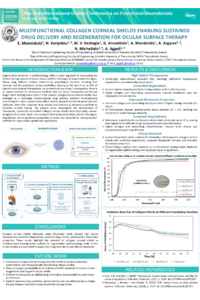
Regenerative medicine in ophthalmology offers a novel approach to overcoming the limited healing capacity of ocular tissues and the challenges of conventional therapies. Ocular drug delivery remains hindered by physiological barriers, including tear turnover and the protective corneal epithelium, resulting in the loss of up to 95% of topically administered therapeutics through conventional eye drops. In this context, collagen-based corneal shields have emerged as a promising multifunctional drug delivery platform biomimetically resembling the native corneal extracellular matrix, capable of providing mechanical protection, hydration, and sustained therapeutic release while supporting tissue healing. The present study investigated the development and physicochemical characterization of therapeutic chemically crosslinked collagen corneal shields using custom-designed 3D-printed molds. This methodology enabled control of shield geometry and surface quality, indispensable for maintaining optical performance. Optical analysis confirmed high transparency, with visible transmittance values between 92% and 98%, exceeding ISO standards for ophthalmic biomaterials. Dissolution studies showed controlled biodegradation, with in vitro dissolution rates between 5% and 25%, expected to increase under in vivo enzymatic conditions. Rheological evaluations showed that collagen concentration and crosslinking density affect viscoelastic properties and mechanical integrity. The shields also effectively incorporated water-soluble drugs, enabling prolonged diffusion, while tobramycin-loaded shields demonstrated sustained antimicrobial activity over 72 hours, validating successful drug loading and controlled release. Overall, the results affirm that collagen corneal shields fabricated using 3D-printed molds achieve a combination of controlled biodegradation, sustained drug delivery, and high optical clarity. These attributes underscore their viability as multifunctional scaffolds for next-generation regenerative ophthalmic therapies.
Keywords
collagen corneal shields
sustained drug delivery
biodegradable biomaterials
ocular surface therapy
Poster
Eleni Manolakaki_Poster Presentation_IOCFB2026.pdf
Effect of Gelation Route on Pore Architecture, Swelling, and Degradation of Silk Fibroin Lyogels
Linking Neuroproteomics to Predictive Brain Drug Delivery: A Physicochemically-Informed Modeling Framework for Silver Nanocarriers in Alzheimer’s and Parkinson’s Disease