Event submissions
Published
This submission belongs to the session S5. Biomaterials for Drug Delivery and Therapy of the event The 2nd International Online Conference on Functional Biomaterials
Published date
03 Jul, 2026
Academic Editor
'%3e%3cpath%20d='M12.6657%2010.9104C12.4185%2010.325%2012.0599%209.79327%2011.6097%209.34482C11.1609%208.89508%2010.6293%208.5365%2010.0442%208.28888C10.0389%208.28626%2010.0337%208.28495%2010.0285%208.28233C10.8446%207.69279%2011.3752%206.73249%2011.3752%205.64904C11.3752%203.8542%209.92103%202.39999%208.1262%202.39999C6.33136%202.39999%204.87715%203.8542%204.87715%205.64904C4.87715%206.73249%205.40774%207.69279%206.22393%208.28364C6.21869%208.28626%206.21345%208.28757%206.20821%208.29019C5.62129%208.5378%205.09463%208.89284%204.64265%209.34613C4.1929%209.79493%203.83432%2010.3266%203.58671%2010.9117C3.34345%2011.4845%203.21226%2012.0987%203.20023%2012.7209C3.19988%2012.7349%203.20233%2012.7488%203.20744%2012.7619C3.21255%2012.7749%203.22022%2012.7867%203.22998%2012.7968C3.23975%2012.8068%203.25142%2012.8147%203.26431%2012.8202C3.2772%2012.8256%203.29105%2012.8284%203.30504%2012.8284H4.09109C4.14874%2012.8284%204.19459%2012.7825%204.1959%2012.7262C4.2221%2011.7148%204.62823%2010.7676%205.34617%2010.0497C6.08899%209.30683%207.0755%208.89808%208.1262%208.89808C9.17689%208.89808%2010.1634%209.30683%2010.9062%2010.0497C11.6242%2010.7676%2012.0303%2011.7148%2012.0565%2012.7262C12.0578%2012.7838%2012.1037%2012.8284%2012.1613%2012.8284H12.9474C12.9613%2012.8284%2012.9752%2012.8256%2012.9881%2012.8202C13.001%2012.8147%2013.0126%2012.8068%2013.0224%2012.7968C13.0322%2012.7867%2013.0398%2012.7749%2013.0449%2012.7619C13.0501%2012.7488%2013.0525%2012.7349%2013.0522%2012.7209C13.0391%2012.0947%2012.9094%2011.4855%2012.6657%2010.9104ZM8.1262%207.9024C7.52486%207.9024%206.9589%207.6679%206.53312%207.24211C6.10733%206.81633%205.87283%206.25037%205.87283%205.64904C5.87283%205.0477%206.10733%204.48174%206.53312%204.05596C6.9589%203.63018%207.52486%203.39567%208.1262%203.39567C8.72753%203.39567%209.29349%203.63018%209.71927%204.05596C10.1451%204.48174%2010.3796%205.0477%2010.3796%205.64904C10.3796%206.25037%2010.1451%206.81633%209.71927%207.24211C9.29349%207.6679%208.72753%207.9024%208.1262%207.9024Z'%20fill='%235D1EE1'/%3e%3c/g%3e%3c/svg%3e) Filippo Rossi
Filippo RossiCitation
Jason Alexander Brianton, Anton Bonartsev, Vera Voinova, Marina Kochevalina, Andrei Dudun, Daria Vasina, Biodegradable PHB–Alginate Composite Matrix for Controlled Endolysin Release, in Proceedings of The 2nd International Online Conference on Functional Biomaterials, 8 July–10 July 2026, MDPI: Basel, Switzerland
Share
Email
Facebook
Twitter
LinkedIn
Biodegradable PHB–Alginate Composite Matrix for Controlled Endolysin Release
'%3e%3cpath%20d='M12.6647%2010.9104C12.4176%2010.325%2012.0589%209.7933%2011.6088%209.34485C11.16%208.89511%2010.6283%208.53653%2010.0432%208.28891C10.038%208.28629%2010.0327%208.28498%2010.0275%208.28236C10.8437%207.69282%2011.3743%206.73252%2011.3743%205.64907C11.3743%203.85423%209.92005%202.40002%208.12522%202.40002C6.33038%202.40002%204.87618%203.85423%204.87618%205.64907C4.87618%206.73252%205.40677%207.69282%206.22296%208.28367C6.21772%208.28629%206.21248%208.2876%206.20724%208.29022C5.62031%208.53783%205.09365%208.89287%204.64167%209.34616C4.19192%209.79496%203.83334%2010.3266%203.58573%2010.9117C3.34247%2011.4846%203.21128%2012.0987%203.19925%2012.721C3.1989%2012.735%203.20135%2012.7489%203.20646%2012.7619C3.21157%2012.7749%203.21924%2012.7868%203.22901%2012.7968C3.23877%2012.8068%203.25045%2012.8148%203.26334%2012.8202C3.27623%2012.8256%203.29007%2012.8284%203.30406%2012.8284H4.09012C4.14776%2012.8284%204.19362%2012.7825%204.19493%2012.7262C4.22113%2011.7148%204.62726%2010.7676%205.34519%2010.0497C6.08802%209.30686%207.07452%208.89811%208.12522%208.89811C9.17592%208.89811%2010.1624%209.30686%2010.9052%2010.0497C11.6232%2010.7676%2012.0293%2011.7148%2012.0555%2012.7262C12.0568%2012.7839%2012.1027%2012.8284%2012.1603%2012.8284H12.9464C12.9604%2012.8284%2012.9742%2012.8256%2012.9871%2012.8202C13%2012.8148%2013.0117%2012.8068%2013.0214%2012.7968C13.0312%2012.7868%2013.0389%2012.7749%2013.044%2012.7619C13.0491%2012.7489%2013.0515%2012.735%2013.0512%2012.721C13.0381%2012.0947%2012.9084%2011.4856%2012.6647%2010.9104ZM8.12522%207.90243C7.52388%207.90243%206.95792%207.66793%206.53214%207.24215C6.10636%206.81636%205.87185%206.2504%205.87185%205.64907C5.87185%205.04773%206.10636%204.48177%206.53214%204.05599C6.95792%203.63021%207.52388%203.3957%208.12522%203.3957C8.72655%203.3957%209.29252%203.63021%209.7183%204.05599C10.1441%204.48177%2010.3786%205.04773%2010.3786%205.64907C10.3786%206.2504%2010.1441%206.81636%209.7183%207.24215C9.29252%207.66793%208.72655%207.90243%208.12522%207.90243Z'%20fill='%235D1EE1'/%3e%3c/g%3e%3c/svg%3e)
Jason Alexander Brianton 1
Anton Bonartsev 1
Vera Voinova 1

Marina Kochevalina 1
Andrei Dudun 2
Daria Vasina 3
1. Faculty of Biology, Department of Bioengineering, Lomonosov Moscow State University, Moscow 119234, Russia
2. Research Center of Biotechnology of the Russian Academy of Sciences, Leninsky Ave, 33, Bld. 2, 119071 Moscow, Russia
3. N.F. Gamaleya National Research Centre for Epidemiology and Microbiology, Ministry of Health of the Russian Federation, 123098 Moscow, Russia
Abstract
Introduction
Infection control and efficient local delivery of antimicrobial proteins remain key challenges for advanced wound dressings. This work presents a fully biodegradable composite wound dressing that combines an electrospun poly(3-hydroxybutyrate) (PHB) fibrous mat with a Ca²⁺-crosslinked alginate hydrogel layer acting as a reservoir for therapeutic proteins (endolysins).
Methods
The composite was fabricated in three stages. First, a porous PHB fibrous mat was produced by electrospinning PHB from 6–8% (w/v) solutions in a hexafluoroisopropanol/chloroform system, with parameters adjusted to obtain fibers of 1–4 µm in diameter. Second, a 2% (w/v) aqueous sodium alginate solution was prepared and the protein was introduced at room temperature. Third, the electrospun PHB mat was placed into the alginate solution prior to gel formation, so that during subsequent crosslinking it became fully submerged/embedded within the gel layer; gelation was achieved by Ca²⁺ diffusion crosslinking through a dialysis membrane (5% CaCl₂, 20 min). Morphology was evaluated by scanning electron microscopy, mechanical properties by tensile testing, and protein content by the Bradford assay (595 nm; BSA calibration). Encapsulation efficiency was calculated as the ratio of experimentally loaded to theoretically introduced protein.
Results
The approach yields a porous, mechanically supportive PHB scaffold fully integrated within a biocompatible alginate hydrogel coating, enabling homogeneous protein distribution in a biodegradable composite structure.
Conclusions
The proposed fully biodegradable PHB/alginate composite dressing provides a mechanically robust, porous framework embedded within a protein-loaded hydrogel layer, offering a promising platform for local delivery of endolysins and other therapeutic proteins in wound care.
Keywords
poly(3-hydroxybutyrate) (PHB)
alginate
electrospinning
biodegradable wound dressing
endolysins
controlled release.
Poster
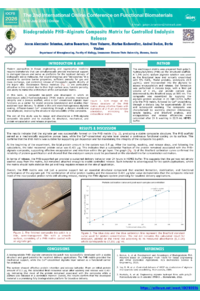
Biodegradable PHB–Alginate Composite Matrix for Controlled Endolysin Release (Poster).pdf
Can Biobased Ionic Liquids act as Cryoprotectants?
Functional performance and biocompatibility of PEDOT:GABA neurotransmitter-loaded coatings