Event submissions
Published
This submission belongs to the session S5. Biomaterials for Drug Delivery and Therapy of the event The 2nd International Online Conference on Functional Biomaterials
Published date
03 Jul, 2026
Academic Editor
'%3e%3cpath%20d='M12.6657%2010.9104C12.4185%2010.325%2012.0599%209.79327%2011.6097%209.34482C11.1609%208.89508%2010.6293%208.5365%2010.0442%208.28888C10.0389%208.28626%2010.0337%208.28495%2010.0285%208.28233C10.8446%207.69279%2011.3752%206.73249%2011.3752%205.64904C11.3752%203.8542%209.92103%202.39999%208.1262%202.39999C6.33136%202.39999%204.87715%203.8542%204.87715%205.64904C4.87715%206.73249%205.40774%207.69279%206.22393%208.28364C6.21869%208.28626%206.21345%208.28757%206.20821%208.29019C5.62129%208.5378%205.09463%208.89284%204.64265%209.34613C4.1929%209.79493%203.83432%2010.3266%203.58671%2010.9117C3.34345%2011.4845%203.21226%2012.0987%203.20023%2012.7209C3.19988%2012.7349%203.20233%2012.7488%203.20744%2012.7619C3.21255%2012.7749%203.22022%2012.7867%203.22998%2012.7968C3.23975%2012.8068%203.25142%2012.8147%203.26431%2012.8202C3.2772%2012.8256%203.29105%2012.8284%203.30504%2012.8284H4.09109C4.14874%2012.8284%204.19459%2012.7825%204.1959%2012.7262C4.2221%2011.7148%204.62823%2010.7676%205.34617%2010.0497C6.08899%209.30683%207.0755%208.89808%208.1262%208.89808C9.17689%208.89808%2010.1634%209.30683%2010.9062%2010.0497C11.6242%2010.7676%2012.0303%2011.7148%2012.0565%2012.7262C12.0578%2012.7838%2012.1037%2012.8284%2012.1613%2012.8284H12.9474C12.9613%2012.8284%2012.9752%2012.8256%2012.9881%2012.8202C13.001%2012.8147%2013.0126%2012.8068%2013.0224%2012.7968C13.0322%2012.7867%2013.0398%2012.7749%2013.0449%2012.7619C13.0501%2012.7488%2013.0525%2012.7349%2013.0522%2012.7209C13.0391%2012.0947%2012.9094%2011.4855%2012.6657%2010.9104ZM8.1262%207.9024C7.52486%207.9024%206.9589%207.6679%206.53312%207.24211C6.10733%206.81633%205.87283%206.25037%205.87283%205.64904C5.87283%205.0477%206.10733%204.48174%206.53312%204.05596C6.9589%203.63018%207.52486%203.39567%208.1262%203.39567C8.72753%203.39567%209.29349%203.63018%209.71927%204.05596C10.1451%204.48174%2010.3796%205.0477%2010.3796%205.64904C10.3796%206.25037%2010.1451%206.81633%209.71927%207.24211C9.29349%207.6679%208.72753%207.9024%208.1262%207.9024Z'%20fill='%235D1EE1'/%3e%3c/g%3e%3c/svg%3e) Filippo Rossi
Filippo RossiCitation
Alicja Tomasiak, Szymon Smołka, Katarzyna Krukiewicz, Functional performance and biocompatibility of PEDOT:GABA neurotransmitter-loaded coatings, in Proceedings of The 2nd International Online Conference on Functional Biomaterials, 8 July–10 July 2026, MDPI: Basel, Switzerland
Share
Email
Facebook
Twitter
LinkedIn
Functional performance and biocompatibility of PEDOT:GABA neurotransmitter-loaded coatings

Alicja Tomasiak 1
'%3e%3cpath%20d='M12.6647%2010.9104C12.4176%2010.325%2012.0589%209.7933%2011.6088%209.34485C11.16%208.89511%2010.6283%208.53653%2010.0432%208.28891C10.038%208.28629%2010.0327%208.28498%2010.0275%208.28236C10.8437%207.69282%2011.3743%206.73252%2011.3743%205.64907C11.3743%203.85423%209.92005%202.40002%208.12522%202.40002C6.33038%202.40002%204.87618%203.85423%204.87618%205.64907C4.87618%206.73252%205.40677%207.69282%206.22296%208.28367C6.21772%208.28629%206.21248%208.2876%206.20724%208.29022C5.62031%208.53783%205.09365%208.89287%204.64167%209.34616C4.19192%209.79496%203.83334%2010.3266%203.58573%2010.9117C3.34247%2011.4846%203.21128%2012.0987%203.19925%2012.721C3.1989%2012.735%203.20135%2012.7489%203.20646%2012.7619C3.21157%2012.7749%203.21924%2012.7868%203.22901%2012.7968C3.23877%2012.8068%203.25045%2012.8148%203.26334%2012.8202C3.27623%2012.8256%203.29007%2012.8284%203.30406%2012.8284H4.09012C4.14776%2012.8284%204.19362%2012.7825%204.19493%2012.7262C4.22113%2011.7148%204.62726%2010.7676%205.34519%2010.0497C6.08802%209.30686%207.07452%208.89811%208.12522%208.89811C9.17592%208.89811%2010.1624%209.30686%2010.9052%2010.0497C11.6232%2010.7676%2012.0293%2011.7148%2012.0555%2012.7262C12.0568%2012.7839%2012.1027%2012.8284%2012.1603%2012.8284H12.9464C12.9604%2012.8284%2012.9742%2012.8256%2012.9871%2012.8202C13%2012.8148%2013.0117%2012.8068%2013.0214%2012.7968C13.0312%2012.7868%2013.0389%2012.7749%2013.044%2012.7619C13.0491%2012.7489%2013.0515%2012.735%2013.0512%2012.721C13.0381%2012.0947%2012.9084%2011.4856%2012.6647%2010.9104ZM8.12522%207.90243C7.52388%207.90243%206.95792%207.66793%206.53214%207.24215C6.10636%206.81636%205.87185%206.2504%205.87185%205.64907C5.87185%205.04773%206.10636%204.48177%206.53214%204.05599C6.95792%203.63021%207.52388%203.3957%208.12522%203.3957C8.72655%203.3957%209.29252%203.63021%209.7183%204.05599C10.1441%204.48177%2010.3786%205.04773%2010.3786%205.64907C10.3786%206.2504%2010.1441%206.81636%209.7183%207.24215C9.29252%207.66793%208.72655%207.90243%208.12522%207.90243Z'%20fill='%235D1EE1'/%3e%3c/g%3e%3c/svg%3e)
Szymon Smołka 2,3,4
Katarzyna Krukiewicz 3,4
1. Department of Physical Chemistry and Technology of Polymers, Faculty of Chemistry, Silesian University of Technology, Strzody 9, Gliwice 44-100, Poland
2. Joint Doctoral School, Silesian University of Technology, Gliwice, Poland
3. Centre for Organic and Nanohybrid Electronics, Silesian University of Technology, Gliwice, Poland
4. Department of Physical Chemistry and Technology of Polymers, Faculty of Chemistry, Silesian University of Technology, Konarskiego 22b st., 44-100, Gliwice, Poland
Abstract
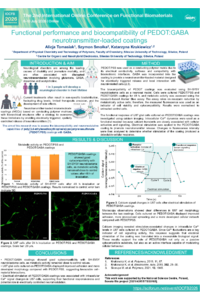
Neurological disorders are among the leading causes of disability and premature mortality in Europe and are frequently associated with impaired neurotransmission involving glutamate, γ-aminobutyric acid (GABA), dopamine, or acetylcholine (1). Current therapeutic strategies rely predominantly on systemic drug administration, which often results in non-specific distribution, limited targeting precision, and adverse side effects (2). Conducting polymer microelectrode coatings capable of incorporating and releasing neurotransmitters offer an alternative strategy for localised neuromodulation. Such biointerfaces aim to replicate aspects of synaptic regulation while reducing systemic exposure (3,4).
This study investigated poly(3,4-ethylenedioxythiophene) (PEDOT) coatings incorporating GABA as electrically responsive neural interfaces designed to combine biocompatibility with electrically controlled neurotransmitter release. PEDOT:GABA coatings were fabricated via electrochemical deposition onto electrode substrates (5). Cytocompatibility was evaluated in vitro using resazurin-based metabolic assays and morphological assessment of SH-SY5Y neuroblastoma and U87 glioblastoma cultures. The ability of the coatings to modulate cellular signalling was assessed by fluorescence calcium imaging to quantify intracellular Ca²⁺ transients following electrically triggered GABA release.
Cells cultured on PEDOT:GABA coatings displayed a moderate reduction in metabolic activity compared with PEDOT controls, while preserving normal morphology and viability. No morphological features indicative of cytotoxicity were observed. Calcium imaging of U87 cultures revealed reproducible, stimulus-dependent intracellular Ca²⁺ fluctuations following electrical stimulation, confirming their capacity to modulate cellular signalling pathways. Calcium transients were detected only upon electrical stimulation and were absent under non-stimulated conditions.
PEDOT:GABA coatings demonstrate a combination of cytocompatibility and electrically controllable bioactivity at the neural interface. While slightly modulating cellular metabolic activity, the coatings do not induce cytotoxic effects and retain the capacity to evoke receptor-mediated calcium signalling. Collectively, these results support the potential of neurotransmitter-loaded conducting polymers as multifunctional biomaterials for spatially and temporally controlled drug delivery and localised neuromodulation.
The Authors would like to thank the National Science Centre, Poland [Sonata Bis 2021/42/E/ST5/00165].
Keywords
Neural interfaces
conducting polymers
PEDOT:GABA
cytocompatibility
intracellular Ca²⁺ signalling
in vitro cultures
Poster
A.Tomasiak IOCFB2026.pdf
Biodegradable PHB–Alginate Composite Matrix for Controlled Endolysin Release
Layered Double Hydroxide-Engineered Oxidized Hyaluronic Acid/Gelatin/Carboxymethyl Chitosan Injectable Hydrogel Incorporating Salvianolic Acid B and Dexamethasone for Cartilage Regeneration