Event submissions
Published
This submission belongs to the session S5. Biomaterials for Drug Delivery and Therapy of the event The 2nd International Online Conference on Functional Biomaterials
Published date
03 Jul, 2026
Academic Editor
'%3e%3cpath%20d='M12.6657%2010.9104C12.4185%2010.325%2012.0599%209.79327%2011.6097%209.34482C11.1609%208.89508%2010.6293%208.5365%2010.0442%208.28888C10.0389%208.28626%2010.0337%208.28495%2010.0285%208.28233C10.8446%207.69279%2011.3752%206.73249%2011.3752%205.64904C11.3752%203.8542%209.92103%202.39999%208.1262%202.39999C6.33136%202.39999%204.87715%203.8542%204.87715%205.64904C4.87715%206.73249%205.40774%207.69279%206.22393%208.28364C6.21869%208.28626%206.21345%208.28757%206.20821%208.29019C5.62129%208.5378%205.09463%208.89284%204.64265%209.34613C4.1929%209.79493%203.83432%2010.3266%203.58671%2010.9117C3.34345%2011.4845%203.21226%2012.0987%203.20023%2012.7209C3.19988%2012.7349%203.20233%2012.7488%203.20744%2012.7619C3.21255%2012.7749%203.22022%2012.7867%203.22998%2012.7968C3.23975%2012.8068%203.25142%2012.8147%203.26431%2012.8202C3.2772%2012.8256%203.29105%2012.8284%203.30504%2012.8284H4.09109C4.14874%2012.8284%204.19459%2012.7825%204.1959%2012.7262C4.2221%2011.7148%204.62823%2010.7676%205.34617%2010.0497C6.08899%209.30683%207.0755%208.89808%208.1262%208.89808C9.17689%208.89808%2010.1634%209.30683%2010.9062%2010.0497C11.6242%2010.7676%2012.0303%2011.7148%2012.0565%2012.7262C12.0578%2012.7838%2012.1037%2012.8284%2012.1613%2012.8284H12.9474C12.9613%2012.8284%2012.9752%2012.8256%2012.9881%2012.8202C13.001%2012.8147%2013.0126%2012.8068%2013.0224%2012.7968C13.0322%2012.7867%2013.0398%2012.7749%2013.0449%2012.7619C13.0501%2012.7488%2013.0525%2012.7349%2013.0522%2012.7209C13.0391%2012.0947%2012.9094%2011.4855%2012.6657%2010.9104ZM8.1262%207.9024C7.52486%207.9024%206.9589%207.6679%206.53312%207.24211C6.10733%206.81633%205.87283%206.25037%205.87283%205.64904C5.87283%205.0477%206.10733%204.48174%206.53312%204.05596C6.9589%203.63018%207.52486%203.39567%208.1262%203.39567C8.72753%203.39567%209.29349%203.63018%209.71927%204.05596C10.1451%204.48174%2010.3796%205.0477%2010.3796%205.64904C10.3796%206.25037%2010.1451%206.81633%209.71927%207.24211C9.29349%207.6679%208.72753%207.9024%208.1262%207.9024Z'%20fill='%235D1EE1'/%3e%3c/g%3e%3c/svg%3e) Filippo Rossi
Filippo RossiCitation
Zhao Wang, Jingjing Sun, Ruilong Sheng, Doxorubicin-loaded Cholesterol-Glycopolymer Nanomicelles with Autophagy Activator Rapamycin for Synergistic Glioblastoma Cell Inhibition, in Proceedings of The 2nd International Online Conference on Functional Biomaterials, 8 July–10 July 2026, MDPI: Basel, Switzerland
Share
Email
Facebook
Twitter
LinkedIn
Doxorubicin-loaded Cholesterol-Glycopolymer Nanomicelles with Autophagy Activator Rapamycin for Synergistic Glioblastoma Cell Inhibition
'%3e%3cpath%20d='M12.6647%2010.9104C12.4176%2010.325%2012.0589%209.7933%2011.6088%209.34485C11.16%208.89511%2010.6283%208.53653%2010.0432%208.28891C10.038%208.28629%2010.0327%208.28498%2010.0275%208.28236C10.8437%207.69282%2011.3743%206.73252%2011.3743%205.64907C11.3743%203.85423%209.92005%202.40002%208.12522%202.40002C6.33038%202.40002%204.87618%203.85423%204.87618%205.64907C4.87618%206.73252%205.40677%207.69282%206.22296%208.28367C6.21772%208.28629%206.21248%208.2876%206.20724%208.29022C5.62031%208.53783%205.09365%208.89287%204.64167%209.34616C4.19192%209.79496%203.83334%2010.3266%203.58573%2010.9117C3.34247%2011.4846%203.21128%2012.0987%203.19925%2012.721C3.1989%2012.735%203.20135%2012.7489%203.20646%2012.7619C3.21157%2012.7749%203.21924%2012.7868%203.22901%2012.7968C3.23877%2012.8068%203.25045%2012.8148%203.26334%2012.8202C3.27623%2012.8256%203.29007%2012.8284%203.30406%2012.8284H4.09012C4.14776%2012.8284%204.19362%2012.7825%204.19493%2012.7262C4.22113%2011.7148%204.62726%2010.7676%205.34519%2010.0497C6.08802%209.30686%207.07452%208.89811%208.12522%208.89811C9.17592%208.89811%2010.1624%209.30686%2010.9052%2010.0497C11.6232%2010.7676%2012.0293%2011.7148%2012.0555%2012.7262C12.0568%2012.7839%2012.1027%2012.8284%2012.1603%2012.8284H12.9464C12.9604%2012.8284%2012.9742%2012.8256%2012.9871%2012.8202C13%2012.8148%2013.0117%2012.8068%2013.0214%2012.7968C13.0312%2012.7868%2013.0389%2012.7749%2013.044%2012.7619C13.0491%2012.7489%2013.0515%2012.735%2013.0512%2012.721C13.0381%2012.0947%2012.9084%2011.4856%2012.6647%2010.9104ZM8.12522%207.90243C7.52388%207.90243%206.95792%207.66793%206.53214%207.24215C6.10636%206.81636%205.87185%206.2504%205.87185%205.64907C5.87185%205.04773%206.10636%204.48177%206.53214%204.05599C6.95792%203.63021%207.52388%203.3957%208.12522%203.3957C8.72655%203.3957%209.29252%203.63021%209.7183%204.05599C10.1441%204.48177%2010.3786%205.04773%2010.3786%205.64907C10.3786%206.2504%2010.1441%206.81636%209.7183%207.24215C9.29252%207.66793%208.72655%207.90243%208.12522%207.90243Z'%20fill='%235D1EE1'/%3e%3c/g%3e%3c/svg%3e)
Zhao Wang 1
Jingjing Sun 2
Ruilong Sheng 3
1. School of Material Engineering, Jinling Institute of Technology, Nanjing 211169, China
2. Department of Pharmaceutical Sciences, University of Nebraska Medical Center, Omaha, NE 68198, USA
3. CQM Centro de Química da Madeira, Universidade da Madeira, Campus da Penteada, 9000 390 Funchal, Portugal
Abstract
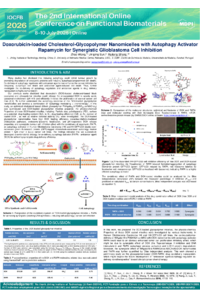
In a recent work, we developed a pH-responsive diblock glycopolymer (PMAgala18-b-P(MAA24-co-MAChol6) for the controllable delivery of doxorubicin (DOX); the glycopolymer nanomicelles have high DOX loading efficiency, caveolae-/clathrin-mediated endocytosis pathways, endosome-lysosome localization, and pH-responsive DOX release properties in the Human Glioblastoma Carcinoma (H4) cell line. Herein, we prepared the DOX-loaded glycopolymer micelles. The physico-chemical properties of these DOX-loaded micelles, including particle size, polydispersity (PDI), surface zeta potential, drug loading content (DLC, wt.%), drug loading efficiency (DLE, wt.%), number of loaded DOX , and relative colloidal stability (%), were investigated. In the cell biological study, we utilized the H4 and H4-GFP-LC3 cell lines (stably over-expresses green fluorescent protein (GFP)-tagged microtubule-associated autophagy marker protein 1 light chain 3 (LC3)) as model cell lines. The co-incubation/co-delivery of MAgala18-b-P(MAA24-co-MAChol6)/DOX nanomicelles with autophagy activator rapamycin (RAPA) could lead to an obviously enhanced tumor cell proliferation inhibitory effect, which might be due to thesynergistic effect of DOX (the Topoisomerase II inhibition and DNA intercalation) and RAPA (autophagy process activation and LC3-II protein degradation). The synergistic effect of MAgala18-b-P(MAA24-co-MAChol6)/DOX nanomicelles and RAPA was further quantified by Bliss independence analysis. This work showed a preliminary study on the glycopolymer-based (DOX-RAPA) drug co-delivery nanosystem, which might inspire the future development of “anticancer agent-autophagy regulator co-delivery nanotherapeutics” toward clinical cancer chemotherapy.
Keywords
Glycopolymer
doxorubicin
rapamycin
topoisomeraseII
autophagy
synergistic effect.
Poster
2th IOCFB Poster 2026_WZ_RS.pdf
Macroheterocycle-Functionalized Bentonite Nanohybrids for Antimicrobial Biomaterial Coatings
Validation of clinical CT-based volumetric analysis using Ti implants for in vivo monitoring of Mg-based orthopaedic devices