Event submissions
Published
This submission belongs to the session S6. Biomaterials and Implantable Devices for Healthcare of the event The 2nd International Online Conference on Functional Biomaterials
Published date
03 Jul, 2026
Academic Editor
'%3e%3cpath%20d='M12.6657%2010.9104C12.4185%2010.325%2012.0599%209.79327%2011.6097%209.34482C11.1609%208.89508%2010.6293%208.5365%2010.0442%208.28888C10.0389%208.28626%2010.0337%208.28495%2010.0285%208.28233C10.8446%207.69279%2011.3752%206.73249%2011.3752%205.64904C11.3752%203.8542%209.92103%202.39999%208.1262%202.39999C6.33136%202.39999%204.87715%203.8542%204.87715%205.64904C4.87715%206.73249%205.40774%207.69279%206.22393%208.28364C6.21869%208.28626%206.21345%208.28757%206.20821%208.29019C5.62129%208.5378%205.09463%208.89284%204.64265%209.34613C4.1929%209.79493%203.83432%2010.3266%203.58671%2010.9117C3.34345%2011.4845%203.21226%2012.0987%203.20023%2012.7209C3.19988%2012.7349%203.20233%2012.7488%203.20744%2012.7619C3.21255%2012.7749%203.22022%2012.7867%203.22998%2012.7968C3.23975%2012.8068%203.25142%2012.8147%203.26431%2012.8202C3.2772%2012.8256%203.29105%2012.8284%203.30504%2012.8284H4.09109C4.14874%2012.8284%204.19459%2012.7825%204.1959%2012.7262C4.2221%2011.7148%204.62823%2010.7676%205.34617%2010.0497C6.08899%209.30683%207.0755%208.89808%208.1262%208.89808C9.17689%208.89808%2010.1634%209.30683%2010.9062%2010.0497C11.6242%2010.7676%2012.0303%2011.7148%2012.0565%2012.7262C12.0578%2012.7838%2012.1037%2012.8284%2012.1613%2012.8284H12.9474C12.9613%2012.8284%2012.9752%2012.8256%2012.9881%2012.8202C13.001%2012.8147%2013.0126%2012.8068%2013.0224%2012.7968C13.0322%2012.7867%2013.0398%2012.7749%2013.0449%2012.7619C13.0501%2012.7488%2013.0525%2012.7349%2013.0522%2012.7209C13.0391%2012.0947%2012.9094%2011.4855%2012.6657%2010.9104ZM8.1262%207.9024C7.52486%207.9024%206.9589%207.6679%206.53312%207.24211C6.10733%206.81633%205.87283%206.25037%205.87283%205.64904C5.87283%205.0477%206.10733%204.48174%206.53312%204.05596C6.9589%203.63018%207.52486%203.39567%208.1262%203.39567C8.72753%203.39567%209.29349%203.63018%209.71927%204.05596C10.1451%204.48174%2010.3796%205.0477%2010.3796%205.64904C10.3796%206.25037%2010.1451%206.81633%209.71927%207.24211C9.29349%207.6679%208.72753%207.9024%208.1262%207.9024Z'%20fill='%235D1EE1'/%3e%3c/g%3e%3c/svg%3e) Meital Zilberman
Meital ZilbermanCitation
Szymon Smołka, Katarzyna Krukiewicz, Multifunctional Bioactive Coatings for Metallic Veterinary Implants, in Proceedings of The 2nd International Online Conference on Functional Biomaterials, 8 July–10 July 2026, MDPI: Basel, Switzerland
Share
Email
Facebook
Twitter
LinkedIn
Multifunctional Bioactive Coatings for Metallic Veterinary Implants
'%3e%3cpath%20d='M12.6647%2010.9104C12.4176%2010.325%2012.0589%209.7933%2011.6088%209.34485C11.16%208.89511%2010.6283%208.53653%2010.0432%208.28891C10.038%208.28629%2010.0327%208.28498%2010.0275%208.28236C10.8437%207.69282%2011.3743%206.73252%2011.3743%205.64907C11.3743%203.85423%209.92005%202.40002%208.12522%202.40002C6.33038%202.40002%204.87618%203.85423%204.87618%205.64907C4.87618%206.73252%205.40677%207.69282%206.22296%208.28367C6.21772%208.28629%206.21248%208.2876%206.20724%208.29022C5.62031%208.53783%205.09365%208.89287%204.64167%209.34616C4.19192%209.79496%203.83334%2010.3266%203.58573%2010.9117C3.34247%2011.4846%203.21128%2012.0987%203.19925%2012.721C3.1989%2012.735%203.20135%2012.7489%203.20646%2012.7619C3.21157%2012.7749%203.21924%2012.7868%203.22901%2012.7968C3.23877%2012.8068%203.25045%2012.8148%203.26334%2012.8202C3.27623%2012.8256%203.29007%2012.8284%203.30406%2012.8284H4.09012C4.14776%2012.8284%204.19362%2012.7825%204.19493%2012.7262C4.22113%2011.7148%204.62726%2010.7676%205.34519%2010.0497C6.08802%209.30686%207.07452%208.89811%208.12522%208.89811C9.17592%208.89811%2010.1624%209.30686%2010.9052%2010.0497C11.6232%2010.7676%2012.0293%2011.7148%2012.0555%2012.7262C12.0568%2012.7839%2012.1027%2012.8284%2012.1603%2012.8284H12.9464C12.9604%2012.8284%2012.9742%2012.8256%2012.9871%2012.8202C13%2012.8148%2013.0117%2012.8068%2013.0214%2012.7968C13.0312%2012.7868%2013.0389%2012.7749%2013.044%2012.7619C13.0491%2012.7489%2013.0515%2012.735%2013.0512%2012.721C13.0381%2012.0947%2012.9084%2011.4856%2012.6647%2010.9104ZM8.12522%207.90243C7.52388%207.90243%206.95792%207.66793%206.53214%207.24215C6.10636%206.81636%205.87185%206.2504%205.87185%205.64907C5.87185%205.04773%206.10636%204.48177%206.53214%204.05599C6.95792%203.63021%207.52388%203.3957%208.12522%203.3957C8.72655%203.3957%209.29252%203.63021%209.7183%204.05599C10.1441%204.48177%2010.3786%205.04773%2010.3786%205.64907C10.3786%206.2504%2010.1441%206.81636%209.7183%207.24215C9.29252%207.66793%208.72655%207.90243%208.12522%207.90243Z'%20fill='%235D1EE1'/%3e%3c/g%3e%3c/svg%3e)
Szymon Smołka 1,2
Katarzyna Krukiewicz 1,3
1. Department of Physical Chemistry and Technology of Polymers, Silesian University of Technology, M. Strzody 9, 44-100 Gliwice, Poland
2. Joint Doctoral School, Silesian University of Technology, Akademicka 2A, 44-100 Gliwice, Poland
3. Centre for Organic and Nanohybrid Electronics, Silesian University of Technology, S. Konarskiego 22B, 44-100 Gliwice, Poland
Abstract
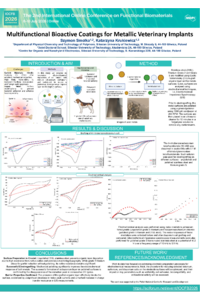
Veterinary implants, including bone implants, are composed of various metals and alloys, such as titanium and stainless steel. However, metallic implants are vulnerable to bacterial infections and potentially can escalate the foreign body response due to the mechanical mismatch between implants and host tissues. Therefore, there is an urgent need for the development of modifications that either reduce bacterial adhesion or exhibit antibacterial properties while maintaining or increasing the biocompatibility of implants.
In this study, 316L stainless steel and titanium grade 2 surfaces are electrochemically coated with a mixture of diazonium, sulphonium, and iodonium salts. The modified surfaces are characterized using Optical Profilometry and Atomic Force Microscopy (AFM) to evaluate roughness, while Scanning Electrochemical Microscopy (SECM) is employed to assess coating uniformity. The biological performance is evaluated via Scanning Electron Microscopy (SEM) imaging after incubation with E. coli (antibacterial activity) and osteoblasts (cell adhesion). Additionally, corrosion resistance is investigated using Electrochemical Impedance Spectroscopy (EIS).
The proposed electrochemical deposition is expected to result in a homogeneous organic layer. Preliminary assumptions suggest that the modified surfaces will exhibit a significant reduction in bacterial counts compared to unmodified samples, as visualized by SEM. Furthermore, EIS analysis is anticipated to demonstrate an enhanced corrosion resistance, with a predicted increase of at least 20 % in the time to the first signs of corrosion. AFM and SECM analyses are expected to confirm that the salt deposition maintains controlled surface roughness, which is conducive to cell integration.
The results obtained in this study demonstrate that electrochemical deposition of an appropriate mixture of diazonium, sulfonium and iodonium salts is an effective strategy for creating a homogeneous layer, which simultaneously protects implants from bacterial adhesion and corrosion while promoting bone cell adhesion. This approach has the potential to enhance the clinical success rate of veterinary implantations.
Keywords
Veterinary implants
diazonium salts
electrografting
Poster
IOCFB poster.pdf
Optimization of Carbon Nanotube Morphology in Self-Supporting Buckypapers for Bioelectronic Interfaces
DOBOT MG400 Robotic Arm-Assisted Electrospinning: A Novel Hybrid Biofabrication Platform for Precise Manufacturing of PVA-Based Drug Delivery Films Containing Natural Active Compounds