Event submissions
Published
This submission belongs to the session S8. Reactive/Smart Biomaterials of the event The 2nd International Online Conference on Functional Biomaterials
Published date
03 Jul, 2026
Academic Editor
'%3e%3cpath%20d='M12.6657%2010.9104C12.4185%2010.325%2012.0599%209.79327%2011.6097%209.34482C11.1609%208.89508%2010.6293%208.5365%2010.0442%208.28888C10.0389%208.28626%2010.0337%208.28495%2010.0285%208.28233C10.8446%207.69279%2011.3752%206.73249%2011.3752%205.64904C11.3752%203.8542%209.92103%202.39999%208.1262%202.39999C6.33136%202.39999%204.87715%203.8542%204.87715%205.64904C4.87715%206.73249%205.40774%207.69279%206.22393%208.28364C6.21869%208.28626%206.21345%208.28757%206.20821%208.29019C5.62129%208.5378%205.09463%208.89284%204.64265%209.34613C4.1929%209.79493%203.83432%2010.3266%203.58671%2010.9117C3.34345%2011.4845%203.21226%2012.0987%203.20023%2012.7209C3.19988%2012.7349%203.20233%2012.7488%203.20744%2012.7619C3.21255%2012.7749%203.22022%2012.7867%203.22998%2012.7968C3.23975%2012.8068%203.25142%2012.8147%203.26431%2012.8202C3.2772%2012.8256%203.29105%2012.8284%203.30504%2012.8284H4.09109C4.14874%2012.8284%204.19459%2012.7825%204.1959%2012.7262C4.2221%2011.7148%204.62823%2010.7676%205.34617%2010.0497C6.08899%209.30683%207.0755%208.89808%208.1262%208.89808C9.17689%208.89808%2010.1634%209.30683%2010.9062%2010.0497C11.6242%2010.7676%2012.0303%2011.7148%2012.0565%2012.7262C12.0578%2012.7838%2012.1037%2012.8284%2012.1613%2012.8284H12.9474C12.9613%2012.8284%2012.9752%2012.8256%2012.9881%2012.8202C13.001%2012.8147%2013.0126%2012.8068%2013.0224%2012.7968C13.0322%2012.7867%2013.0398%2012.7749%2013.0449%2012.7619C13.0501%2012.7488%2013.0525%2012.7349%2013.0522%2012.7209C13.0391%2012.0947%2012.9094%2011.4855%2012.6657%2010.9104ZM8.1262%207.9024C7.52486%207.9024%206.9589%207.6679%206.53312%207.24211C6.10733%206.81633%205.87283%206.25037%205.87283%205.64904C5.87283%205.0477%206.10733%204.48174%206.53312%204.05596C6.9589%203.63018%207.52486%203.39567%208.1262%203.39567C8.72753%203.39567%209.29349%203.63018%209.71927%204.05596C10.1451%204.48174%2010.3796%205.0477%2010.3796%205.64904C10.3796%206.25037%2010.1451%206.81633%209.71927%207.24211C9.29349%207.6679%208.72753%207.9024%208.1262%207.9024Z'%20fill='%235D1EE1'/%3e%3c/g%3e%3c/svg%3e) Pankaj Vadgama
Pankaj VadgamaCitation
Matteo Sestini, Mario Milazzo, Serena Danti, Multiscale Design of Piezoelectric PLA/BaTiO₃ Composites for Electrically Active Bone Grafts, in Proceedings of The 2nd International Online Conference on Functional Biomaterials, 8 July–10 July 2026, MDPI: Basel, Switzerland
Share
Email
Facebook
Twitter
LinkedIn
Multiscale Design of Piezoelectric PLA/BaTiO₃ Composites for Electrically Active Bone Grafts
Multiscale Design of Piezoelectric PLA/BaTiO₃ Composites for Electrically Active Bone Grafts

Matteo Sestini 1,2

Mario Milazzo 2

Serena Danti 2
1. U.O. Otorinolaringoiatria, Audiologia e Foniatria, Azienda Ospedaliero-Universitaria Pisana, Pisa, Italy
2. Department of Civil and Industrial Engineering, University of Pisa, Pisa, Italy
Abstract
Introduction
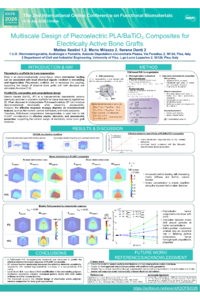
Piezoelectric polymer–ceramic composites based on poly(lactic acid) (PLA) and barium titanate (BT) are promising candidates for bioactive structures capable of enhancing bone regeneration through electromechanical stimulation. In this work, we present a multiphysics computational homogenization framework to evaluate the effective electromechanical response of PLA/BT composites as a function of microstructural parameters.
Methods
A periodic representative volume element (RVE), consisting of a BT inclusion embedded in a PLA matrix, was implemented using a multiphysics finite element framework within structural mechanics and piezoelectric formulations to account for mechano-electrical coupling. The full set of homogenized elastic tensors, piezoelectric stress–charge coefficients, and dielectric properties was derived. The analysis systematically investigates the influence of key microstructural parameters, namely inclusion volume fraction and mechanical contrast between matrix and filler, on the effective composite response.
Results
The homogenization framework provides stable and consistent predictions of the effective electromechanical properties of PLA/BT composites. The results indicate a non-linear dependence of both electromechanical coupling and individual components of the mechanical tensor on BT content, with a marked sensitivity of shear-related terms. This aspect is particularly relevant for bending-dominated structures, where shear contributions can significantly influence strain distribution and, consequently, the generated electrical potential.
Conclusions
The proposed finite element-based framework enables the preliminary design of piezoelectric composites by identifying trade-offs between electromechanical performance and the full mechanical tensor response, supporting the fine-tuning of voltage generation in load-bearing bone grafts to modulate cellular activity. Overall, we establish a first multiscale homogenization approach for PLA/BT systems, capturing non-linear composition effects while emphasizing the importance of rigorous model validation.
Keywords
Piezoelectric materials
Bone tissue engineering
Computational modeling
Microstructure–property relationship
Poster
IOCFB 2026 poster V3.pdf
Glucose-Responsive G-quartet/Protein hydrogels for Smart Insulin Delivery
Investigation of carbon dots for toxic metal chelation therapy employing red blood cell membranes as a biomimetic model