Event submissions
EventsMOL2NET'15, Conference on Molecular, Biomed., Comput. & Network Science and Engineering, 1st ed.
Published

This submission belongs to the session 02. NANOBIO.MAT-01: NANOBIO.MAT-09: Nanotechnology, Biomed. Eng., & Materials Science Congress, Jackson & Fargo, USA, 2015. of the event MOL2NET'15, Conference on Molecular, Biomed., Comput. & Network Science and Engineering, 1st ed.
Published date
04 Dec, 2015
Citation
Ricardo Grau-Crespo, Said Hamad, The symmetry-adapted configurational ensemble approach to the computer simulation of site-disordered solids, in Proceedings of MOL2NET'15, Conference on Molecular, Biomed., Comput. & Network Science and Engineering, 1st ed., 5 December–15 December 2015, MDPI: Basel, Switzerland, doi: 10.3390/MOL2NET-1-c002
Share
Email
Facebook
Twitter
LinkedIn
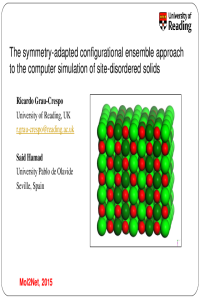
The symmetry-adapted configurational ensemble approach to the computer simulation of site-disordered solids
'%3e%3cpath%20d='M12.6647%2010.9104C12.4176%2010.325%2012.0589%209.7933%2011.6088%209.34485C11.16%208.89511%2010.6283%208.53653%2010.0432%208.28891C10.038%208.28629%2010.0327%208.28498%2010.0275%208.28236C10.8437%207.69282%2011.3743%206.73252%2011.3743%205.64907C11.3743%203.85423%209.92005%202.40002%208.12522%202.40002C6.33038%202.40002%204.87618%203.85423%204.87618%205.64907C4.87618%206.73252%205.40677%207.69282%206.22296%208.28367C6.21772%208.28629%206.21248%208.2876%206.20724%208.29022C5.62031%208.53783%205.09365%208.89287%204.64167%209.34616C4.19192%209.79496%203.83334%2010.3266%203.58573%2010.9117C3.34247%2011.4846%203.21128%2012.0987%203.19925%2012.721C3.1989%2012.735%203.20135%2012.7489%203.20646%2012.7619C3.21157%2012.7749%203.21924%2012.7868%203.22901%2012.7968C3.23877%2012.8068%203.25045%2012.8148%203.26334%2012.8202C3.27623%2012.8256%203.29007%2012.8284%203.30406%2012.8284H4.09012C4.14776%2012.8284%204.19362%2012.7825%204.19493%2012.7262C4.22113%2011.7148%204.62726%2010.7676%205.34519%2010.0497C6.08802%209.30686%207.07452%208.89811%208.12522%208.89811C9.17592%208.89811%2010.1624%209.30686%2010.9052%2010.0497C11.6232%2010.7676%2012.0293%2011.7148%2012.0555%2012.7262C12.0568%2012.7839%2012.1027%2012.8284%2012.1603%2012.8284H12.9464C12.9604%2012.8284%2012.9742%2012.8256%2012.9871%2012.8202C13%2012.8148%2013.0117%2012.8068%2013.0214%2012.7968C13.0312%2012.7868%2013.0389%2012.7749%2013.044%2012.7619C13.0491%2012.7489%2013.0515%2012.735%2013.0512%2012.721C13.0381%2012.0947%2012.9084%2011.4856%2012.6647%2010.9104ZM8.12522%207.90243C7.52388%207.90243%206.95792%207.66793%206.53214%207.24215C6.10636%206.81636%205.87185%206.2504%205.87185%205.64907C5.87185%205.04773%206.10636%204.48177%206.53214%204.05599C6.95792%203.63021%207.52388%203.3957%208.12522%203.3957C8.72655%203.3957%209.29252%203.63021%209.7183%204.05599C10.1441%204.48177%2010.3786%205.04773%2010.3786%205.64907C10.3786%206.2504%2010.1441%206.81636%209.7183%207.24215C9.29252%207.66793%208.72655%207.90243%208.12522%207.90243Z'%20fill='%235D1EE1'/%3e%3c/g%3e%3c/svg%3e)
Ricardo Grau-Crespo 1
Said Hamad 2
1. Department of Chemistry, University of Reading, Whiteknights, Reading RG6 6AD, United Kingdom
2. Universidad Pablo de Olavide, Spain
Abstract
Site-occupancy disorder, defined as the non-periodic occupation of lattice sites in a crystal structure, is a ubiquitous phenomenon in solid-state physics and chemistry. Examples are mineral solid solutions, synthetic non-stoichiometric compounds and metal alloys. The experimental investigation of these materials using diffraction techniques only provides averaged information of their structure. However, many properties of interest in these solids are determined by the local geometry and degree of disorder, which escape an “average crystal” description, either from experiments or from theory. In this paper, I will introduce a methodology for the computer simulation of site-disordered solids, based on the consideration of configurational ensembles and statistical mechanics, where the number of occupancy configurations is reduced by taking advantage of the crystal symmetry of the lattice [1, 2]. Thermodynamics and non-thermodynamic properties are then defined from the statistics in the symmetry-adapted configurational ensemble. I will briefly summarize and discuss some recent applications of this type of methodology to problems in mineralogy and materials science [3-7].
- R Grau-Crespo, S Hamad, CRA Catlow, NH De Leeuw. Symmetry-adapted configurational modelling of fractional site occupancy in solids. Journal of Physics-Condensed Matter, 2007. 19: 256201.
- R Grau-Crespo and UV Waghmare. Simulation of crystals with chemical disorder at lattice sites. In Molecular Modeling for the Design of Novel Performance Chemicals and Materials. Edited by Beena Rai. CRC Press Inc. ISBN 9781439840788 (2012).
- R Grau-Crespo, KC Smith, TS Fisher, NH De Leeuw, UV Waghmare. Thermodynamics of hydrogen vacancies in MgH2 from first-principles calculations and grand-canonical statistical mechanics. Physical Review B, 2009. 80: 174117
- KC Smith, TS Fisher, UV Waghmare, R Grau-Crespo, Dopant-vacancy binding effects in Li-doped magnesium hydride. Physical Review B, 2010. 82: 134109.
- R Grau-Crespo, NH de Leeuw, S Hamad, UV Waghmare. Phase separation and surface segregation in ceria-zirconia solid solutions. Proceedings of the Royal Society A-Mathematical Physical and Engineering Sciences, 2011. 467: 1925-1938.
- SE Ruiz‐Hernandez, R Grau‐Crespo, N Almora‐Barrios, M Wolthers, AR Ruiz‐Salvador, N Fernandez, NH de Leeuw. Mg/Ca partitioning between aqueous solution and aragonite mineral: a molecular dynamics study. Chemistry - A European Journal, 2012. 18: 9828-9833.
- Corps, Paz Vaqueiro, A Aziz, R Grau-Crespo, W Kockelmann, J-C Jumas, AV Powell. The Interplay of Metal-Atom Ordering, Fermi Level Tuning and Thermoelectric Properties in Cobalt Shandites Co3M2S2 (M = Sn, In). Chemistry of Materials, 2015. 27: 3946–3956.
Keywords
site disorder
materials science
density functional theory
solid state chemistry
computer simulation
statistical mechanics
Manuscript
sciforum_006453_MOL2NET_RGC_006453.pdf
Poster
Ricardo-Mol2net-presentation.pdf
14N NMR Spectroscopy for detection of binding interaction between sodium azide and hydrated Fullerene by titration method
Categorisation of continuous variables in a logistic regression model using the R package CatPredi