Event submissions
Published
This submission belongs to the session S2. Surveillance and Epidemiological Modelling at the Human–Animal–Environment Interface of the event The 2nd International Online Conference on Veterinary Sciences
Published date
02 Sep, 2026
Academic Editor
'%3e%3cpath%20d='M12.6657%2010.9104C12.4185%2010.325%2012.0599%209.79327%2011.6097%209.34482C11.1609%208.89508%2010.6293%208.5365%2010.0442%208.28888C10.0389%208.28626%2010.0337%208.28495%2010.0285%208.28233C10.8446%207.69279%2011.3752%206.73249%2011.3752%205.64904C11.3752%203.8542%209.92103%202.39999%208.1262%202.39999C6.33136%202.39999%204.87715%203.8542%204.87715%205.64904C4.87715%206.73249%205.40774%207.69279%206.22393%208.28364C6.21869%208.28626%206.21345%208.28757%206.20821%208.29019C5.62129%208.5378%205.09463%208.89284%204.64265%209.34613C4.1929%209.79493%203.83432%2010.3266%203.58671%2010.9117C3.34345%2011.4845%203.21226%2012.0987%203.20023%2012.7209C3.19988%2012.7349%203.20233%2012.7488%203.20744%2012.7619C3.21255%2012.7749%203.22022%2012.7867%203.22998%2012.7968C3.23975%2012.8068%203.25142%2012.8147%203.26431%2012.8202C3.2772%2012.8256%203.29105%2012.8284%203.30504%2012.8284H4.09109C4.14874%2012.8284%204.19459%2012.7825%204.1959%2012.7262C4.2221%2011.7148%204.62823%2010.7676%205.34617%2010.0497C6.08899%209.30683%207.0755%208.89808%208.1262%208.89808C9.17689%208.89808%2010.1634%209.30683%2010.9062%2010.0497C11.6242%2010.7676%2012.0303%2011.7148%2012.0565%2012.7262C12.0578%2012.7838%2012.1037%2012.8284%2012.1613%2012.8284H12.9474C12.9613%2012.8284%2012.9752%2012.8256%2012.9881%2012.8202C13.001%2012.8147%2013.0126%2012.8068%2013.0224%2012.7968C13.0322%2012.7867%2013.0398%2012.7749%2013.0449%2012.7619C13.0501%2012.7488%2013.0525%2012.7349%2013.0522%2012.7209C13.0391%2012.0947%2012.9094%2011.4855%2012.6657%2010.9104ZM8.1262%207.9024C7.52486%207.9024%206.9589%207.6679%206.53312%207.24211C6.10733%206.81633%205.87283%206.25037%205.87283%205.64904C5.87283%205.0477%206.10733%204.48174%206.53312%204.05596C6.9589%203.63018%207.52486%203.39567%208.1262%203.39567C8.72753%203.39567%209.29349%203.63018%209.71927%204.05596C10.1451%204.48174%2010.3796%205.0477%2010.3796%205.64904C10.3796%206.25037%2010.1451%206.81633%209.71927%207.24211C9.29349%207.6679%208.72753%207.9024%208.1262%207.9024Z'%20fill='%235D1EE1'/%3e%3c/g%3e%3c/svg%3e) Francesco Mira
Francesco MiraCitation
Tamas Petrovic, Gospava Lazic, Sara Savic, Doroteja Marcic, Vladimir Gajdov, Dalibor Todorovic, Marina Zekic, Zivoslav Grgic, Igor Stojanov, Biljana Djurdjevic, Jasna Prodanov Radulovic, Ivan Pusic, Dejan Bugarski, Veterinary Abortion Surveillance as an Epidemiological Tool: A Seven-Year Study in South Bačka and Srem, Serbia (2019–2026), in Proceedings of The 2nd International Online Conference on Veterinary Sciences, 7 September–9 September 2026, MDPI: Basel, Switzerland
Share
Email
Facebook
Twitter
LinkedIn
Veterinary Abortion Surveillance as an Epidemiological Tool: A Seven-Year Study in South Bačka and Srem, Serbia (2019–2026)

Tamas Petrovic 1
'%3e%3cpath%20d='M12.6647%2010.9104C12.4176%2010.325%2012.0589%209.7933%2011.6088%209.34485C11.16%208.89511%2010.6283%208.53653%2010.0432%208.28891C10.038%208.28629%2010.0327%208.28498%2010.0275%208.28236C10.8437%207.69282%2011.3743%206.73252%2011.3743%205.64907C11.3743%203.85423%209.92005%202.40002%208.12522%202.40002C6.33038%202.40002%204.87618%203.85423%204.87618%205.64907C4.87618%206.73252%205.40677%207.69282%206.22296%208.28367C6.21772%208.28629%206.21248%208.2876%206.20724%208.29022C5.62031%208.53783%205.09365%208.89287%204.64167%209.34616C4.19192%209.79496%203.83334%2010.3266%203.58573%2010.9117C3.34247%2011.4846%203.21128%2012.0987%203.19925%2012.721C3.1989%2012.735%203.20135%2012.7489%203.20646%2012.7619C3.21157%2012.7749%203.21924%2012.7868%203.22901%2012.7968C3.23877%2012.8068%203.25045%2012.8148%203.26334%2012.8202C3.27623%2012.8256%203.29007%2012.8284%203.30406%2012.8284H4.09012C4.14776%2012.8284%204.19362%2012.7825%204.19493%2012.7262C4.22113%2011.7148%204.62726%2010.7676%205.34519%2010.0497C6.08802%209.30686%207.07452%208.89811%208.12522%208.89811C9.17592%208.89811%2010.1624%209.30686%2010.9052%2010.0497C11.6232%2010.7676%2012.0293%2011.7148%2012.0555%2012.7262C12.0568%2012.7839%2012.1027%2012.8284%2012.1603%2012.8284H12.9464C12.9604%2012.8284%2012.9742%2012.8256%2012.9871%2012.8202C13%2012.8148%2013.0117%2012.8068%2013.0214%2012.7968C13.0312%2012.7868%2013.0389%2012.7749%2013.044%2012.7619C13.0491%2012.7489%2013.0515%2012.735%2013.0512%2012.721C13.0381%2012.0947%2012.9084%2011.4856%2012.6647%2010.9104ZM8.12522%207.90243C7.52388%207.90243%206.95792%207.66793%206.53214%207.24215C6.10636%206.81636%205.87185%206.2504%205.87185%205.64907C5.87185%205.04773%206.10636%204.48177%206.53214%204.05599C6.95792%203.63021%207.52388%203.3957%208.12522%203.3957C8.72655%203.3957%209.29252%203.63021%209.7183%204.05599C10.1441%204.48177%2010.3786%205.04773%2010.3786%205.64907C10.3786%206.2504%2010.1441%206.81636%209.7183%207.24215C9.29252%207.66793%208.72655%207.90243%208.12522%207.90243Z'%20fill='%235D1EE1'/%3e%3c/g%3e%3c/svg%3e)
Gospava Lazic 1
Sara Savic 2
Doroteja Marcic 3
Vladimir Gajdov 1
Dalibor Todorovic 4
Marina Zekic 2
Zivoslav Grgic 2
Igor Stojanov 4

Biljana Djurdjevic 3
Jasna Prodanov Radulovic 3
Ivan Pusic 3
Dejan Bugarski 3
1. Department of Virology, Scientific Veterinary Institute “Novi Sad”, Novi Sad, Serbia
2. Department of Serology and Biochemistry, Scientific Veterinary Institute “Novi Sad”, Novi Sad, Serbia
3. Department of Epizootiology, Clinical Diagnostics and DDD, Scientific Veterinary Institute “Novi Sad”, Novi Sad, Serbia
4. Department of Clinical Bacteriology, Mycology and Parasitology, Scientific Veterinary Institute “Novi Sad”, Novi Sad, Serbia
Abstract
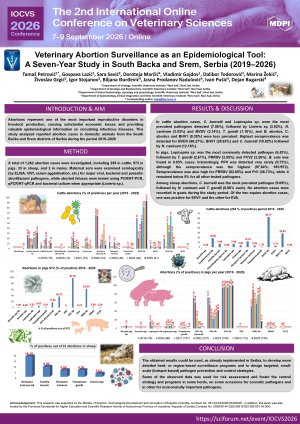
Abortions represent one of the most important reproductive disorders in livestock production, causing substantial economic losses and providing valuable epidemiological information on circulating infectious diseases. This study analyzed reported abortion cases in domestic animals from the South Bačka and Srem districts of Serbia during the period 2019–2026.
A total of 1,262 abortion cases were investigated, including 255 in cattle, 972 in pigs, 33 in sheep, and 2 in mares. Maternal sera were examined serologically for major viral, bacterial and parasitic abortifacient pathogens, while aborted fetuses were tested using PCR/RT-PCR, qPCR/RT-qPCR and bacterial culture when appropriate (Listeria sp.).
In cattle abortion cases, C. burnetii and Leptospira spp. were the most prevalent pathogens detected (7.06%), followed by Listeria spp. (3.92%), N. caninum (3.53%) and BVDV (3.14%). T. gondii (1.18%), and B. abortus, C. abortus and BHV1 (0.39%) were less prevalent. Highest seroprevalence was detected for BVDV (66.27%), BHV1 (28.63%) and C. burnetii (18.82%) followed by N. caninum (12.16%).
In pigs, Leptospira spp. was the most commonly detected pathogen (6.53%), followed by T. gondii (2.61%), PRRSV (2.65%) and PCV2 (2.26%). B. suis was found in 0.93% cases. Interestingly, PPV was detected very rarely (0.73%), although the seroprevalence was the highest (97.84%; 951/972). Seroprevalence was also high for PRRSV (62.65%) and PrV (36.73%), while it remained below 5% for all other tested pathogens.
Among sheep abortions, C. burnetii was the most prevalent pathogen (9.09%), followed by N. caninum and T. gondii (6.06% each). No abortion cases were recorded in goats during the study period. Of the two equine abortion cases, one was positive for EHV1 and the other for EAV.
The obtained results could be used, as already implemented in Serbia, to develop more detailed herd- or region-based surveillance programs and to design targeted, small-scale (hotspot-based) pathogen prevention and control strategies.
Keywords
abortions
cattle
pigs
sheep
horses
infectious agents
Serbia
Poster
Sciforum-194884 Poster Petrovic et al abortions.pdf
Active Circulation of Middle East Respiratory Syndrome Coronavirus at the Camel-Human-Environment Interface in Nigeria: Evidence from One Health Surveillance
Lizards as an unconventional model to evaluate the effects of contaminants on soil organisms.