Event submissions
Published
This submission belongs to the session S3. Antimicrobial Resistance and Food Safety: A One Health Perspective of the event The 2nd International Online Conference on Veterinary Sciences
Published date
02 Sep, 2026
Academic Editor
'%3e%3cpath%20d='M12.6657%2010.9104C12.4185%2010.325%2012.0599%209.79327%2011.6097%209.34482C11.1609%208.89508%2010.6293%208.5365%2010.0442%208.28888C10.0389%208.28626%2010.0337%208.28495%2010.0285%208.28233C10.8446%207.69279%2011.3752%206.73249%2011.3752%205.64904C11.3752%203.8542%209.92103%202.39999%208.1262%202.39999C6.33136%202.39999%204.87715%203.8542%204.87715%205.64904C4.87715%206.73249%205.40774%207.69279%206.22393%208.28364C6.21869%208.28626%206.21345%208.28757%206.20821%208.29019C5.62129%208.5378%205.09463%208.89284%204.64265%209.34613C4.1929%209.79493%203.83432%2010.3266%203.58671%2010.9117C3.34345%2011.4845%203.21226%2012.0987%203.20023%2012.7209C3.19988%2012.7349%203.20233%2012.7488%203.20744%2012.7619C3.21255%2012.7749%203.22022%2012.7867%203.22998%2012.7968C3.23975%2012.8068%203.25142%2012.8147%203.26431%2012.8202C3.2772%2012.8256%203.29105%2012.8284%203.30504%2012.8284H4.09109C4.14874%2012.8284%204.19459%2012.7825%204.1959%2012.7262C4.2221%2011.7148%204.62823%2010.7676%205.34617%2010.0497C6.08899%209.30683%207.0755%208.89808%208.1262%208.89808C9.17689%208.89808%2010.1634%209.30683%2010.9062%2010.0497C11.6242%2010.7676%2012.0303%2011.7148%2012.0565%2012.7262C12.0578%2012.7838%2012.1037%2012.8284%2012.1613%2012.8284H12.9474C12.9613%2012.8284%2012.9752%2012.8256%2012.9881%2012.8202C13.001%2012.8147%2013.0126%2012.8068%2013.0224%2012.7968C13.0322%2012.7867%2013.0398%2012.7749%2013.0449%2012.7619C13.0501%2012.7488%2013.0525%2012.7349%2013.0522%2012.7209C13.0391%2012.0947%2012.9094%2011.4855%2012.6657%2010.9104ZM8.1262%207.9024C7.52486%207.9024%206.9589%207.6679%206.53312%207.24211C6.10733%206.81633%205.87283%206.25037%205.87283%205.64904C5.87283%205.0477%206.10733%204.48174%206.53312%204.05596C6.9589%203.63018%207.52486%203.39567%208.1262%203.39567C8.72753%203.39567%209.29349%203.63018%209.71927%204.05596C10.1451%204.48174%2010.3796%205.0477%2010.3796%205.64904C10.3796%206.25037%2010.1451%206.81633%209.71927%207.24211C9.29349%207.6679%208.72753%207.9024%208.1262%207.9024Z'%20fill='%235D1EE1'/%3e%3c/g%3e%3c/svg%3e) Ruichao Li
Ruichao LiCitation
Margarita Terentjeva, Jeļena Avsejenko, Madara Streikiša, Juris Ķibilds, Olga Valciņa, Aivars Bērziņš, Antimicrobial resistance in Salmonella Enteritidis and Typhimurium isolates from laying hens in Latvia, in Proceedings of The 2nd International Online Conference on Veterinary Sciences, 7 September–9 September 2026, MDPI: Basel, Switzerland
Share
Email
Facebook
Twitter
LinkedIn
Antimicrobial resistance in Salmonella Enteritidis and Typhimurium isolates from laying hens in Latvia

Margarita Terentjeva 1
'%3e%3cpath%20d='M12.6647%2010.9104C12.4176%2010.325%2012.0589%209.7933%2011.6088%209.34485C11.16%208.89511%2010.6283%208.53653%2010.0432%208.28891C10.038%208.28629%2010.0327%208.28498%2010.0275%208.28236C10.8437%207.69282%2011.3743%206.73252%2011.3743%205.64907C11.3743%203.85423%209.92005%202.40002%208.12522%202.40002C6.33038%202.40002%204.87618%203.85423%204.87618%205.64907C4.87618%206.73252%205.40677%207.69282%206.22296%208.28367C6.21772%208.28629%206.21248%208.2876%206.20724%208.29022C5.62031%208.53783%205.09365%208.89287%204.64167%209.34616C4.19192%209.79496%203.83334%2010.3266%203.58573%2010.9117C3.34247%2011.4846%203.21128%2012.0987%203.19925%2012.721C3.1989%2012.735%203.20135%2012.7489%203.20646%2012.7619C3.21157%2012.7749%203.21924%2012.7868%203.22901%2012.7968C3.23877%2012.8068%203.25045%2012.8148%203.26334%2012.8202C3.27623%2012.8256%203.29007%2012.8284%203.30406%2012.8284H4.09012C4.14776%2012.8284%204.19362%2012.7825%204.19493%2012.7262C4.22113%2011.7148%204.62726%2010.7676%205.34519%2010.0497C6.08802%209.30686%207.07452%208.89811%208.12522%208.89811C9.17592%208.89811%2010.1624%209.30686%2010.9052%2010.0497C11.6232%2010.7676%2012.0293%2011.7148%2012.0555%2012.7262C12.0568%2012.7839%2012.1027%2012.8284%2012.1603%2012.8284H12.9464C12.9604%2012.8284%2012.9742%2012.8256%2012.9871%2012.8202C13%2012.8148%2013.0117%2012.8068%2013.0214%2012.7968C13.0312%2012.7868%2013.0389%2012.7749%2013.044%2012.7619C13.0491%2012.7489%2013.0515%2012.735%2013.0512%2012.721C13.0381%2012.0947%2012.9084%2011.4856%2012.6647%2010.9104ZM8.12522%207.90243C7.52388%207.90243%206.95792%207.66793%206.53214%207.24215C6.10636%206.81636%205.87185%206.2504%205.87185%205.64907C5.87185%205.04773%206.10636%204.48177%206.53214%204.05599C6.95792%203.63021%207.52388%203.3957%208.12522%203.3957C8.72655%203.3957%209.29252%203.63021%209.7183%204.05599C10.1441%204.48177%2010.3786%205.04773%2010.3786%205.64907C10.3786%206.2504%2010.1441%206.81636%209.7183%207.24215C9.29252%207.66793%208.72655%207.90243%208.12522%207.90243Z'%20fill='%235D1EE1'/%3e%3c/g%3e%3c/svg%3e)
Jeļena Avsejenko 2
Madara Streikiša 2
Juris Ķibilds 2
Olga Valciņa 2

Aivars Bērziņš 1,2
1. Faculty of Veterinary Medicine, Latvia University of Life Sciences and Technologies, Helmaņa iela 8, Jelgava, LV-3004, Latvia
2. Institute of Food Safety, Animal Health and Environment "BIOR", Lejupes iela 3, Rīga, LV-1076, Latvia
Abstract
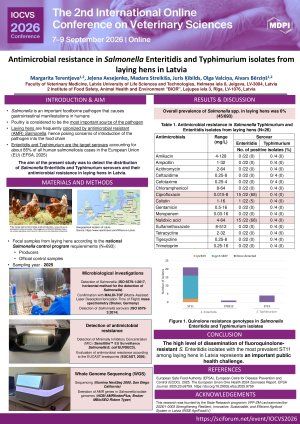
Salmonella is an important foodborne pathogen that causes gastrointestinal manifestations, with poultry remaining an important source of the pathogen. Laying hens are frequently colonized by antimicrobial resistant (AMR) Salmonella, hence posing concerns of introduction of the pathogen into the food chain. The aim of the present study was to detect the distribution of Salmonella Enteritidis and Typhimurium serovars and their antimicrobial resistance in laying hens in Latvia. Salmonella isolates from feces of laying hens from poultry farms in Latvia during 2025, within the frame of official control and self-checks sampling, were used for the detection of antimicrobial resistance. AMR to the following antimicrobials were tested: ampicillin, azithromycin, amikacin, ceftazidime, cefotaxime, chloramphenicol, ciprofloxacin, colistin, gentamycin, meropenem, nalidixic acid, sulfamethoxazole, tetracycline, tigecycline and trimethoprim with the Minimum Inhibitory Concentration (MIC) method. Results were evaluated according to the European Committee on Antimicrobial Susceptibility Testing (EUCAST) requirements. Genetic determinants of AMR resistance were detected with Whole Genome Sequencing (WGS). Salmonella spp. were identified in 45 out of 693 (6%) positive samples. Among Salmonella-positive samples, 26 (58%) were the European Union target serovars Enteritidis and Typhimurium. All S. Typhimurium isolates (4/4, 100%) but only 7 (7/22, 32%) of S. Enteritidis were sensitive to all antimicrobials tested. S. Enteriditis exhibited resistance only to nalidixic acid and ciprofloxacin (15/22, 68%), and one isolate to colistin (1/22, 5%). No multidrug-resistant isolates were identified. Genetic determinants associated with resistance to fluoroquinolones were identified in isolates resistant to nalidixic acid and ciprofloxacin. The high level of dissemination of fluoroquinolone-resistant S. Enteritidis isolates among laying hens in Latvia represents an important public health challenge.
Keywords
Salmonella
antimicrobial resistance
laying hens
Latvia
Poster
MDPI Vet Sci Salmonella in laying hens_28_08_2026.pdf
Lizards as an unconventional model to evaluate the effects of contaminants on soil organisms.
Feed-associated Clostridium perfringens enterotoxemia in cattle: toxin detection in organ and feed samples during clinical field investigations