Event submissions
Published
This submission belongs to the session S1. Advances in Recycling Technologies of the event The 1st International Online Conference on Recycling
Published date
02 Sep, 2026
Academic Editor
'%3e%3cpath%20d='M12.6657%2010.9104C12.4185%2010.325%2012.0599%209.79327%2011.6097%209.34482C11.1609%208.89508%2010.6293%208.5365%2010.0442%208.28888C10.0389%208.28626%2010.0337%208.28495%2010.0285%208.28233C10.8446%207.69279%2011.3752%206.73249%2011.3752%205.64904C11.3752%203.8542%209.92103%202.39999%208.1262%202.39999C6.33136%202.39999%204.87715%203.8542%204.87715%205.64904C4.87715%206.73249%205.40774%207.69279%206.22393%208.28364C6.21869%208.28626%206.21345%208.28757%206.20821%208.29019C5.62129%208.5378%205.09463%208.89284%204.64265%209.34613C4.1929%209.79493%203.83432%2010.3266%203.58671%2010.9117C3.34345%2011.4845%203.21226%2012.0987%203.20023%2012.7209C3.19988%2012.7349%203.20233%2012.7488%203.20744%2012.7619C3.21255%2012.7749%203.22022%2012.7867%203.22998%2012.7968C3.23975%2012.8068%203.25142%2012.8147%203.26431%2012.8202C3.2772%2012.8256%203.29105%2012.8284%203.30504%2012.8284H4.09109C4.14874%2012.8284%204.19459%2012.7825%204.1959%2012.7262C4.2221%2011.7148%204.62823%2010.7676%205.34617%2010.0497C6.08899%209.30683%207.0755%208.89808%208.1262%208.89808C9.17689%208.89808%2010.1634%209.30683%2010.9062%2010.0497C11.6242%2010.7676%2012.0303%2011.7148%2012.0565%2012.7262C12.0578%2012.7838%2012.1037%2012.8284%2012.1613%2012.8284H12.9474C12.9613%2012.8284%2012.9752%2012.8256%2012.9881%2012.8202C13.001%2012.8147%2013.0126%2012.8068%2013.0224%2012.7968C13.0322%2012.7867%2013.0398%2012.7749%2013.0449%2012.7619C13.0501%2012.7488%2013.0525%2012.7349%2013.0522%2012.7209C13.0391%2012.0947%2012.9094%2011.4855%2012.6657%2010.9104ZM8.1262%207.9024C7.52486%207.9024%206.9589%207.6679%206.53312%207.24211C6.10733%206.81633%205.87283%206.25037%205.87283%205.64904C5.87283%205.0477%206.10733%204.48174%206.53312%204.05596C6.9589%203.63018%207.52486%203.39567%208.1262%203.39567C8.72753%203.39567%209.29349%203.63018%209.71927%204.05596C10.1451%204.48174%2010.3796%205.0477%2010.3796%205.64904C10.3796%206.25037%2010.1451%206.81633%209.71927%207.24211C9.29349%207.6679%208.72753%207.9024%208.1262%207.9024Z'%20fill='%235D1EE1'/%3e%3c/g%3e%3c/svg%3e) Huijuan Dong
Huijuan DongCitation
Hongwei Wang, Hui Ye, Kaifeng Xu, Tingting Zhao, Intelligent Prediction of Compressive Strength for Cemented Tailings Backfill Using Bayesian Optimized Machine Learning, in Proceedings of The 1st International Online Conference on Recycling, 7 September–8 September 2026, MDPI: Basel, Switzerland
Share
Email
Facebook
Twitter
LinkedIn
Intelligent Prediction of Compressive Strength for Cemented Tailings Backfill Using Bayesian Optimized Machine Learning

Hongwei Wang 1
'%3e%3cpath%20d='M12.6647%2010.9104C12.4176%2010.325%2012.0589%209.7933%2011.6088%209.34485C11.16%208.89511%2010.6283%208.53653%2010.0432%208.28891C10.038%208.28629%2010.0327%208.28498%2010.0275%208.28236C10.8437%207.69282%2011.3743%206.73252%2011.3743%205.64907C11.3743%203.85423%209.92005%202.40002%208.12522%202.40002C6.33038%202.40002%204.87618%203.85423%204.87618%205.64907C4.87618%206.73252%205.40677%207.69282%206.22296%208.28367C6.21772%208.28629%206.21248%208.2876%206.20724%208.29022C5.62031%208.53783%205.09365%208.89287%204.64167%209.34616C4.19192%209.79496%203.83334%2010.3266%203.58573%2010.9117C3.34247%2011.4846%203.21128%2012.0987%203.19925%2012.721C3.1989%2012.735%203.20135%2012.7489%203.20646%2012.7619C3.21157%2012.7749%203.21924%2012.7868%203.22901%2012.7968C3.23877%2012.8068%203.25045%2012.8148%203.26334%2012.8202C3.27623%2012.8256%203.29007%2012.8284%203.30406%2012.8284H4.09012C4.14776%2012.8284%204.19362%2012.7825%204.19493%2012.7262C4.22113%2011.7148%204.62726%2010.7676%205.34519%2010.0497C6.08802%209.30686%207.07452%208.89811%208.12522%208.89811C9.17592%208.89811%2010.1624%209.30686%2010.9052%2010.0497C11.6232%2010.7676%2012.0293%2011.7148%2012.0555%2012.7262C12.0568%2012.7839%2012.1027%2012.8284%2012.1603%2012.8284H12.9464C12.9604%2012.8284%2012.9742%2012.8256%2012.9871%2012.8202C13%2012.8148%2013.0117%2012.8068%2013.0214%2012.7968C13.0312%2012.7868%2013.0389%2012.7749%2013.044%2012.7619C13.0491%2012.7489%2013.0515%2012.735%2013.0512%2012.721C13.0381%2012.0947%2012.9084%2011.4856%2012.6647%2010.9104ZM8.12522%207.90243C7.52388%207.90243%206.95792%207.66793%206.53214%207.24215C6.10636%206.81636%205.87185%206.2504%205.87185%205.64907C5.87185%205.04773%206.10636%204.48177%206.53214%204.05599C6.95792%203.63021%207.52388%203.3957%208.12522%203.3957C8.72655%203.3957%209.29252%203.63021%209.7183%204.05599C10.1441%204.48177%2010.3786%205.04773%2010.3786%205.64907C10.3786%206.2504%2010.1441%206.81636%209.7183%207.24215C9.29252%207.66793%208.72655%207.90243%208.12522%207.90243Z'%20fill='%235D1EE1'/%3e%3c/g%3e%3c/svg%3e)
Hui Ye 1
Kaifeng Xu 1
Tingting Zhao 1
1. School of Resources and Safety Engineering, Central South University, 410083 Changsha, PR China.
Abstract
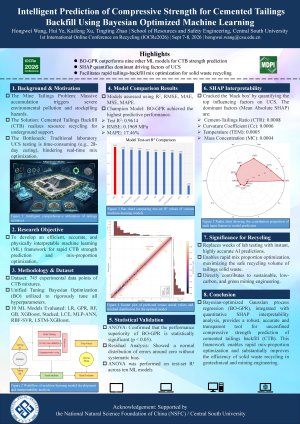
With the increasing demand for sustainable mining, cemented tailings backfill (CTB) realizes the resource recycling of massive mine tailings solid waste and has become a key material for underground mine backfill and support [1]. Rational CTB preparation can drastically reduce tailings stockpiling hazards and alleviate environmental pollution triggered by piled mine solid residues. Unconfined compressive strength (UCS) is a core index to evaluate the performance of backfill, but traditional laboratory tests are time-consuming and inefficient [2]. To achieve efficient and accurate prediction, this study established 10 machine learning models based on 745 experimental data points, and adopted Bayesian optimization (BO) as the unified hyperparameter tuning method. The models include: Gaussian Process Regression (GPR), Linear Regression (LR), Random Forest (RF), Gradient Boosting (GB), XGBoost, Multilayer Perceptron (MLP-ANN), Radial Basis Function-Support Vector Regression (RBF-SVR), Stacked-ensemble, Local Cascade Ensemble (LCE), and LSTM-XGBoost. A comprehensive evaluation was conducted using R2, RMSE, MAE, MSE, and MAPE, while ANOVA and residual analysis were used to verify the statistical validity. The results show that Bayesian optimized Gaussian Process Regression (BO-GPR) achieves the best prediction performance with a test R2 of 0.9614, RMSE of 0.1969 MPa, MAE of 0.0989 MPa, MSE of 0.0388, and MAPE of 17.46%. SHAP analysis quantifies the top-five influencing factors with corresponding mean absolute SHAP values: cement-tailings ratio (CTR, 0.0008), curvature coefficient (Cc, 0.0006), temperature (TEM, 0.0005), mass concentration (MC, 0.0004), and Al₂O₃ (0.0003). This study provides an interpretable and efficient intelligent method for strength prediction and mix proportion optimization of mine cemented tailings backfill materials.
References:
- Wang, J.; Chen, G.; Chen, Y.; Ye, Z.; Lin, M.; Su, R.; Hu, N. Intelligent Mixture Optimization for Stabilized Soil Containing Solid Waste Based on Machine Learning and Evolutionary Algorithms. Constr. Build. Mater.2024, 445, 137794, doi:10.1016/j.conbuildmat.2024.137794.
- Yuan, Z.; Zheng, W.; Qiao, H. Machine Learning Based Optimization for Mix Design of Manufactured Sand Concrete. Constr. Build. Mater.2025, 467, 140256, doi:10.1016/j.conbuildmat.2025.140256.
Keywords
mine cemented tailings backfill materials
unconfined compressive strength
machine learning
Poster
hongwei Wang poster.pdf
Dissolution-based recycling of 3D-printed PLA waste using green solvents: a combined computational and experimental approach
Waste Valorization for Climate Change Mitigation: A Global Meta-Analysis of the Environmental Performance of Biochar Production Systems