Event submissions
Published
This submission belongs to the session S1. Advances in Recycling Technologies of the event The 1st International Online Conference on Recycling
Published date
02 Sep, 2026
Academic Editor
'%3e%3cpath%20d='M12.6657%2010.9104C12.4185%2010.325%2012.0599%209.79327%2011.6097%209.34482C11.1609%208.89508%2010.6293%208.5365%2010.0442%208.28888C10.0389%208.28626%2010.0337%208.28495%2010.0285%208.28233C10.8446%207.69279%2011.3752%206.73249%2011.3752%205.64904C11.3752%203.8542%209.92103%202.39999%208.1262%202.39999C6.33136%202.39999%204.87715%203.8542%204.87715%205.64904C4.87715%206.73249%205.40774%207.69279%206.22393%208.28364C6.21869%208.28626%206.21345%208.28757%206.20821%208.29019C5.62129%208.5378%205.09463%208.89284%204.64265%209.34613C4.1929%209.79493%203.83432%2010.3266%203.58671%2010.9117C3.34345%2011.4845%203.21226%2012.0987%203.20023%2012.7209C3.19988%2012.7349%203.20233%2012.7488%203.20744%2012.7619C3.21255%2012.7749%203.22022%2012.7867%203.22998%2012.7968C3.23975%2012.8068%203.25142%2012.8147%203.26431%2012.8202C3.2772%2012.8256%203.29105%2012.8284%203.30504%2012.8284H4.09109C4.14874%2012.8284%204.19459%2012.7825%204.1959%2012.7262C4.2221%2011.7148%204.62823%2010.7676%205.34617%2010.0497C6.08899%209.30683%207.0755%208.89808%208.1262%208.89808C9.17689%208.89808%2010.1634%209.30683%2010.9062%2010.0497C11.6242%2010.7676%2012.0303%2011.7148%2012.0565%2012.7262C12.0578%2012.7838%2012.1037%2012.8284%2012.1613%2012.8284H12.9474C12.9613%2012.8284%2012.9752%2012.8256%2012.9881%2012.8202C13.001%2012.8147%2013.0126%2012.8068%2013.0224%2012.7968C13.0322%2012.7867%2013.0398%2012.7749%2013.0449%2012.7619C13.0501%2012.7488%2013.0525%2012.7349%2013.0522%2012.7209C13.0391%2012.0947%2012.9094%2011.4855%2012.6657%2010.9104ZM8.1262%207.9024C7.52486%207.9024%206.9589%207.6679%206.53312%207.24211C6.10733%206.81633%205.87283%206.25037%205.87283%205.64904C5.87283%205.0477%206.10733%204.48174%206.53312%204.05596C6.9589%203.63018%207.52486%203.39567%208.1262%203.39567C8.72753%203.39567%209.29349%203.63018%209.71927%204.05596C10.1451%204.48174%2010.3796%205.0477%2010.3796%205.64904C10.3796%206.25037%2010.1451%206.81633%209.71927%207.24211C9.29349%207.6679%208.72753%207.9024%208.1262%207.9024Z'%20fill='%235D1EE1'/%3e%3c/g%3e%3c/svg%3e) Huijuan Dong
Huijuan DongCitation
Jacopo Lupi, Riccardo Chelli, Michele Buono, Thantip Roongcharoen, Francesca Cicogna, Alessandro Nanni, Alessandro Fortunelli, Atomistic simulations of the processes underlying agro-industrial waste valorization as biofillers in plastics, in Proceedings of The 1st International Online Conference on Recycling, 7 September–8 September 2026, MDPI: Basel, Switzerland
Share
Email
Facebook
Twitter
LinkedIn
Atomistic simulations of the processes underlying agro-industrial waste valorization as biofillers in plastics
'%3e%3cpath%20d='M12.6647%2010.9104C12.4176%2010.325%2012.0589%209.7933%2011.6088%209.34485C11.16%208.89511%2010.6283%208.53653%2010.0432%208.28891C10.038%208.28629%2010.0327%208.28498%2010.0275%208.28236C10.8437%207.69282%2011.3743%206.73252%2011.3743%205.64907C11.3743%203.85423%209.92005%202.40002%208.12522%202.40002C6.33038%202.40002%204.87618%203.85423%204.87618%205.64907C4.87618%206.73252%205.40677%207.69282%206.22296%208.28367C6.21772%208.28629%206.21248%208.2876%206.20724%208.29022C5.62031%208.53783%205.09365%208.89287%204.64167%209.34616C4.19192%209.79496%203.83334%2010.3266%203.58573%2010.9117C3.34247%2011.4846%203.21128%2012.0987%203.19925%2012.721C3.1989%2012.735%203.20135%2012.7489%203.20646%2012.7619C3.21157%2012.7749%203.21924%2012.7868%203.22901%2012.7968C3.23877%2012.8068%203.25045%2012.8148%203.26334%2012.8202C3.27623%2012.8256%203.29007%2012.8284%203.30406%2012.8284H4.09012C4.14776%2012.8284%204.19362%2012.7825%204.19493%2012.7262C4.22113%2011.7148%204.62726%2010.7676%205.34519%2010.0497C6.08802%209.30686%207.07452%208.89811%208.12522%208.89811C9.17592%208.89811%2010.1624%209.30686%2010.9052%2010.0497C11.6232%2010.7676%2012.0293%2011.7148%2012.0555%2012.7262C12.0568%2012.7839%2012.1027%2012.8284%2012.1603%2012.8284H12.9464C12.9604%2012.8284%2012.9742%2012.8256%2012.9871%2012.8202C13%2012.8148%2013.0117%2012.8068%2013.0214%2012.7968C13.0312%2012.7868%2013.0389%2012.7749%2013.044%2012.7619C13.0491%2012.7489%2013.0515%2012.735%2013.0512%2012.721C13.0381%2012.0947%2012.9084%2011.4856%2012.6647%2010.9104ZM8.12522%207.90243C7.52388%207.90243%206.95792%207.66793%206.53214%207.24215C6.10636%206.81636%205.87185%206.2504%205.87185%205.64907C5.87185%205.04773%206.10636%204.48177%206.53214%204.05599C6.95792%203.63021%207.52388%203.3957%208.12522%203.3957C8.72655%203.3957%209.29252%203.63021%209.7183%204.05599C10.1441%204.48177%2010.3786%205.04773%2010.3786%205.64907C10.3786%206.2504%2010.1441%206.81636%209.7183%207.24215C9.29252%207.66793%208.72655%207.90243%208.12522%207.90243Z'%20fill='%235D1EE1'/%3e%3c/g%3e%3c/svg%3e)
Jacopo Lupi 1

Riccardo Chelli 2
Michele Buono 3
Thantip Roongcharoen 1

Francesca Cicogna 1
Alessandro Nanni 4

Alessandro Fortunelli 5
1. CNR-ICCOM, Consiglio Nazionale delle Ricerche, Pisa 56124, Italy
2. Dpt. Chemistry, University of Firenze, Via Lastruccia 3, I-50019 Sesto Fiorentino, Italy
3. Dpt. Ingegneria Civile, University of Firenze, Chimica, Ambientale e dei Materiali, Viale del Risorgimento 2, I-40135, Bologna, Italy
4. AgroMateriae srl, Faenza (Ravenna) 48018, Italy
5. CNR-ICCOM, Istituto di Chimica dei Composti Organometallici, Pisa 56124, Italy
Abstract
Introduction
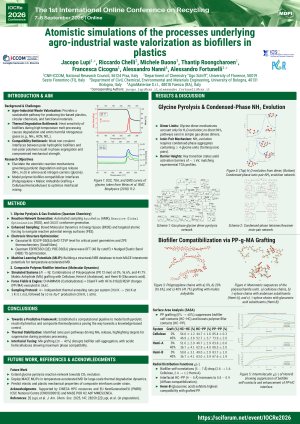
The valorization of agro-industrial waste as biofillers in plastics addresses critical needs in waste management and sustainable materials development. However, the industrial adoption of this process is often hindered by heat sensitivity of the biofiller during mixing with polymer in the melt phase (where heat can lead to biofiller degradation and generate poisonous gases) and/or poor biofiller-polymer compatibility (segregation can degrade mechanical properties of the composite). Using High-Performance Computing (HPC) atomistic simulations, we investigated two processes addressing these limitations: the reaction mechanisms governing thermal degradation of aminoacids (key contributors to emissions of nitrogenous species during pyrolysis), and the role of compatibilizers in stabilizing polymer-biofiller composites.
Methods
Our strategy utilizes stochastic sampling, including (Reactive) Global Optimization, alongside Molecular Dynamics simulations, coupled with QM-based force-fields to compute energy and forces.
Results
We derived a comprehensive reaction network for the thermal decomposition of glycine, the simplest aminoacid [1]. We found that, unlike water evolution, pyrolytic ammonia evolution can only proceed via many-body mechanisms involving ionic-pair proton-exchange polymerization pathways. Properly accounting for these mechanisms reconciles theoretical predictions with TGA experiments.
We investigated composite models of host-polymers/biofillers [2], i.e., we modeled polypropylene (grafted or not with a few percent of maleic anhydride as compatibilizers) mixed with cellulose and hemicellulose (Hemi-A, and Hemi-B). We found that grafting promotes interfacial mixing by systematically suppressing self-contacts and stabilizing biofiller-polymer inner interfaces, with particularly glucuronic acid hemicellulose exhibiting markedly higher compatibility with grafted polypropylene than cellulose.
Conclusions
We present a predictive computational framework to elucidate atomistic degradation pathways and polymer-filler-compatibilizer interactions. The information thus drawn can be exploited to design heat-stabilization and biofiller-functionalization protocols, to overcome thermal and mechanical limitations of biocomposites and paving the way for their industrial use.
References
[1] Lupi, et al. J. Am. Chem. Soc. 2025, 147, 28259−28267.
[2] Lupi, et al. (in preparation).
Keywords
biofiller
polymer composites
atomistic simulations
degradation processes
pyrolisis
reaction mechanisms
Poster
Poster_Recycling.pdf
Waste Valorization for Climate Change Mitigation: A Global Meta-Analysis of the Environmental Performance of Biochar Production Systems
Agro Waste Valorization to Bio Briquettes as a Waste Management Approach