Event submissions
Published
This submission belongs to the session S1. Advances in Recycling Technologies of the event The 1st International Online Conference on Recycling
Published date
02 Sep, 2026
Academic Editor
'%3e%3cpath%20d='M12.6657%2010.9104C12.4185%2010.325%2012.0599%209.79327%2011.6097%209.34482C11.1609%208.89508%2010.6293%208.5365%2010.0442%208.28888C10.0389%208.28626%2010.0337%208.28495%2010.0285%208.28233C10.8446%207.69279%2011.3752%206.73249%2011.3752%205.64904C11.3752%203.8542%209.92103%202.39999%208.1262%202.39999C6.33136%202.39999%204.87715%203.8542%204.87715%205.64904C4.87715%206.73249%205.40774%207.69279%206.22393%208.28364C6.21869%208.28626%206.21345%208.28757%206.20821%208.29019C5.62129%208.5378%205.09463%208.89284%204.64265%209.34613C4.1929%209.79493%203.83432%2010.3266%203.58671%2010.9117C3.34345%2011.4845%203.21226%2012.0987%203.20023%2012.7209C3.19988%2012.7349%203.20233%2012.7488%203.20744%2012.7619C3.21255%2012.7749%203.22022%2012.7867%203.22998%2012.7968C3.23975%2012.8068%203.25142%2012.8147%203.26431%2012.8202C3.2772%2012.8256%203.29105%2012.8284%203.30504%2012.8284H4.09109C4.14874%2012.8284%204.19459%2012.7825%204.1959%2012.7262C4.2221%2011.7148%204.62823%2010.7676%205.34617%2010.0497C6.08899%209.30683%207.0755%208.89808%208.1262%208.89808C9.17689%208.89808%2010.1634%209.30683%2010.9062%2010.0497C11.6242%2010.7676%2012.0303%2011.7148%2012.0565%2012.7262C12.0578%2012.7838%2012.1037%2012.8284%2012.1613%2012.8284H12.9474C12.9613%2012.8284%2012.9752%2012.8256%2012.9881%2012.8202C13.001%2012.8147%2013.0126%2012.8068%2013.0224%2012.7968C13.0322%2012.7867%2013.0398%2012.7749%2013.0449%2012.7619C13.0501%2012.7488%2013.0525%2012.7349%2013.0522%2012.7209C13.0391%2012.0947%2012.9094%2011.4855%2012.6657%2010.9104ZM8.1262%207.9024C7.52486%207.9024%206.9589%207.6679%206.53312%207.24211C6.10733%206.81633%205.87283%206.25037%205.87283%205.64904C5.87283%205.0477%206.10733%204.48174%206.53312%204.05596C6.9589%203.63018%207.52486%203.39567%208.1262%203.39567C8.72753%203.39567%209.29349%203.63018%209.71927%204.05596C10.1451%204.48174%2010.3796%205.0477%2010.3796%205.64904C10.3796%206.25037%2010.1451%206.81633%209.71927%207.24211C9.29349%207.6679%208.72753%207.9024%208.1262%207.9024Z'%20fill='%235D1EE1'/%3e%3c/g%3e%3c/svg%3e) Huijuan Dong
Huijuan DongCitation
Bruno Machini, Filipe Gomes, Filipe Rei, João Almeida, António Tadeu, Performance evaluation of sustainable alkali-activated mortars incorporating pulp and paper industry residues, in Proceedings of The 1st International Online Conference on Recycling, 7 September–8 September 2026, MDPI: Basel, Switzerland
Share
Email
Facebook
Twitter
LinkedIn
Performance evaluation of sustainable alkali-activated mortars incorporating pulp and paper industry residues

Bruno Machini 1,2
'%3e%3cpath%20d='M12.6647%2010.9104C12.4176%2010.325%2012.0589%209.7933%2011.6088%209.34485C11.16%208.89511%2010.6283%208.53653%2010.0432%208.28891C10.038%208.28629%2010.0327%208.28498%2010.0275%208.28236C10.8437%207.69282%2011.3743%206.73252%2011.3743%205.64907C11.3743%203.85423%209.92005%202.40002%208.12522%202.40002C6.33038%202.40002%204.87618%203.85423%204.87618%205.64907C4.87618%206.73252%205.40677%207.69282%206.22296%208.28367C6.21772%208.28629%206.21248%208.2876%206.20724%208.29022C5.62031%208.53783%205.09365%208.89287%204.64167%209.34616C4.19192%209.79496%203.83334%2010.3266%203.58573%2010.9117C3.34247%2011.4846%203.21128%2012.0987%203.19925%2012.721C3.1989%2012.735%203.20135%2012.7489%203.20646%2012.7619C3.21157%2012.7749%203.21924%2012.7868%203.22901%2012.7968C3.23877%2012.8068%203.25045%2012.8148%203.26334%2012.8202C3.27623%2012.8256%203.29007%2012.8284%203.30406%2012.8284H4.09012C4.14776%2012.8284%204.19362%2012.7825%204.19493%2012.7262C4.22113%2011.7148%204.62726%2010.7676%205.34519%2010.0497C6.08802%209.30686%207.07452%208.89811%208.12522%208.89811C9.17592%208.89811%2010.1624%209.30686%2010.9052%2010.0497C11.6232%2010.7676%2012.0293%2011.7148%2012.0555%2012.7262C12.0568%2012.7839%2012.1027%2012.8284%2012.1603%2012.8284H12.9464C12.9604%2012.8284%2012.9742%2012.8256%2012.9871%2012.8202C13%2012.8148%2013.0117%2012.8068%2013.0214%2012.7968C13.0312%2012.7868%2013.0389%2012.7749%2013.044%2012.7619C13.0491%2012.7489%2013.0515%2012.735%2013.0512%2012.721C13.0381%2012.0947%2012.9084%2011.4856%2012.6647%2010.9104ZM8.12522%207.90243C7.52388%207.90243%206.95792%207.66793%206.53214%207.24215C6.10636%206.81636%205.87185%206.2504%205.87185%205.64907C5.87185%205.04773%206.10636%204.48177%206.53214%204.05599C6.95792%203.63021%207.52388%203.3957%208.12522%203.3957C8.72655%203.3957%209.29252%203.63021%209.7183%204.05599C10.1441%204.48177%2010.3786%205.04773%2010.3786%205.64907C10.3786%206.2504%2010.1441%206.81636%209.7183%207.24215C9.29252%207.66793%208.72655%207.90243%208.12522%207.90243Z'%20fill='%235D1EE1'/%3e%3c/g%3e%3c/svg%3e)
Filipe Gomes 3
Filipe Rei 3

João Almeida 1,2
António Tadeu 1,4
1. Itecons – Institute for Research and Technological Development in Construction, Energy, Environment and Sustainability, Rua Pedro Hispano, Coimbra, 3030-289, Portugal
2. CERIS, University of Coimbra, Rua Pedro Hispano, Coimbra, 3030-289, Portugal
3. Primefix, Colas e Argamassas Técnicas, Lda., Zona Industrial das Almas das Domingas, Anadia, 3780-244, Portugal
4. CERIS, Department of Civil Engineering, University of Coimbra, Rua Luís Reis Santos, Polo II, Coimbra, 3030-790, Portugal
Abstract
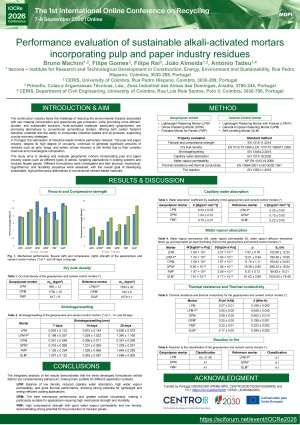
The development of sustainable alkali-activated materials has emerged as a promising pathway to reduce the environmental impact of construction while advancing circular economy strategies. In particular, the incorporation of residues into geopolymer matrices offers a viable route for valorising industrial by-products, reducing landfill disposal, and lowering the reliance on conventional Portland cement-based systems. The objective of this work was to develop and validate multifunctional mortars and modular façade panels based on geopolymer binders incorporating pulp and paper industrial by-products, ensuring adequate mechanical, hygrothermal and durability performance, as well as comparing their performance with reference compositions based on conventional hydraulic binders without residue incorporation. The performance of the geopolymer materials was evaluated through a comprehensive experimental campaign, including physical characterisation, mechanical testing, dimensional stability and hygrothermal behaviour. The results demonstrate that geopolymer-based formulations incorporating industrial by-products achieve performance levels comparable to, and in several aspects exceeding, those of conventional solutions. The developed materials exhibited suitable physical, mechanical and hygrothermal behaviour, confirming their technical viability for rendering systems and modular façade applications. The ability to tailor density and microstructure proved critical, enabling the development of lightweight formulations (with dry bulk density of ≤917 kg/m3) with enhanced compressive strength (up to 15.77 MPa at 28 days) and thermal performance (≤0.652 W/m·K). Furthermore, the materials showed low capillary water absorption (up to 1.04 kg/(m2·min0.5)), controlled vapour permeability (≥1.67×10⁻¹¹ kg/(m.s.Pa)) and stable dimensional behaviour (shrinkage of up to 1.646 mm at 28 days), supporting long-term durability. Overall, the results validate the incorporation of pulp and paper industry residues in geopolymer matrices as a technically robust and sustainable solution, enabling the development of high-performance, versatile and environmentally responsible construction materials aligned with current architectural and industrial challenges.
Funded by Portugal 2030/FEDER (PRIME-MPS, CENTRO2030-FEDER-00526900) and FCT (https://ror.org/00snfqn58, CERIS, UID/6438/2025).
Keywords
Alkali-activation
Circular economy
Geopolymer mortar
Residue valorisation
Waste recycling.
Poster
IOCRe_Machini.pdf
Agro Waste Valorization to Bio Briquettes as a Waste Management Approach
Ash from the incineration of municipal waste as a component of cement mortars with a low water-to-cement ratio