Event submissions
Published
This submission belongs to the session S1. Advances in Recycling Technologies of the event The 1st International Online Conference on Recycling
Published date
02 Sep, 2026
Academic Editor
'%3e%3cpath%20d='M12.6657%2010.9104C12.4185%2010.325%2012.0599%209.79327%2011.6097%209.34482C11.1609%208.89508%2010.6293%208.5365%2010.0442%208.28888C10.0389%208.28626%2010.0337%208.28495%2010.0285%208.28233C10.8446%207.69279%2011.3752%206.73249%2011.3752%205.64904C11.3752%203.8542%209.92103%202.39999%208.1262%202.39999C6.33136%202.39999%204.87715%203.8542%204.87715%205.64904C4.87715%206.73249%205.40774%207.69279%206.22393%208.28364C6.21869%208.28626%206.21345%208.28757%206.20821%208.29019C5.62129%208.5378%205.09463%208.89284%204.64265%209.34613C4.1929%209.79493%203.83432%2010.3266%203.58671%2010.9117C3.34345%2011.4845%203.21226%2012.0987%203.20023%2012.7209C3.19988%2012.7349%203.20233%2012.7488%203.20744%2012.7619C3.21255%2012.7749%203.22022%2012.7867%203.22998%2012.7968C3.23975%2012.8068%203.25142%2012.8147%203.26431%2012.8202C3.2772%2012.8256%203.29105%2012.8284%203.30504%2012.8284H4.09109C4.14874%2012.8284%204.19459%2012.7825%204.1959%2012.7262C4.2221%2011.7148%204.62823%2010.7676%205.34617%2010.0497C6.08899%209.30683%207.0755%208.89808%208.1262%208.89808C9.17689%208.89808%2010.1634%209.30683%2010.9062%2010.0497C11.6242%2010.7676%2012.0303%2011.7148%2012.0565%2012.7262C12.0578%2012.7838%2012.1037%2012.8284%2012.1613%2012.8284H12.9474C12.9613%2012.8284%2012.9752%2012.8256%2012.9881%2012.8202C13.001%2012.8147%2013.0126%2012.8068%2013.0224%2012.7968C13.0322%2012.7867%2013.0398%2012.7749%2013.0449%2012.7619C13.0501%2012.7488%2013.0525%2012.7349%2013.0522%2012.7209C13.0391%2012.0947%2012.9094%2011.4855%2012.6657%2010.9104ZM8.1262%207.9024C7.52486%207.9024%206.9589%207.6679%206.53312%207.24211C6.10733%206.81633%205.87283%206.25037%205.87283%205.64904C5.87283%205.0477%206.10733%204.48174%206.53312%204.05596C6.9589%203.63018%207.52486%203.39567%208.1262%203.39567C8.72753%203.39567%209.29349%203.63018%209.71927%204.05596C10.1451%204.48174%2010.3796%205.0477%2010.3796%205.64904C10.3796%206.25037%2010.1451%206.81633%209.71927%207.24211C9.29349%207.6679%208.72753%207.9024%208.1262%207.9024Z'%20fill='%235D1EE1'/%3e%3c/g%3e%3c/svg%3e) Huijuan Dong
Huijuan DongCitation
Nayamma Almeida da Silva, Luis Picado Santos, Iran Rocha Segundo, Fernando Martinho, Silvino Capitão, COMBINED USE OF RAP AND LIGNIN FOR REDUCING VIRGIN BITUMEN CONTENT IN AC 14 ASPHALT MIXTURES, in Proceedings of The 1st International Online Conference on Recycling, 7 September–8 September 2026, MDPI: Basel, Switzerland
Share
Email
Facebook
Twitter
LinkedIn
COMBINED USE OF RAP AND LIGNIN FOR REDUCING VIRGIN BITUMEN CONTENT IN AC 14 ASPHALT MIXTURES
'%3e%3cpath%20d='M12.6647%2010.9104C12.4176%2010.325%2012.0589%209.7933%2011.6088%209.34485C11.16%208.89511%2010.6283%208.53653%2010.0432%208.28891C10.038%208.28629%2010.0327%208.28498%2010.0275%208.28236C10.8437%207.69282%2011.3743%206.73252%2011.3743%205.64907C11.3743%203.85423%209.92005%202.40002%208.12522%202.40002C6.33038%202.40002%204.87618%203.85423%204.87618%205.64907C4.87618%206.73252%205.40677%207.69282%206.22296%208.28367C6.21772%208.28629%206.21248%208.2876%206.20724%208.29022C5.62031%208.53783%205.09365%208.89287%204.64167%209.34616C4.19192%209.79496%203.83334%2010.3266%203.58573%2010.9117C3.34247%2011.4846%203.21128%2012.0987%203.19925%2012.721C3.1989%2012.735%203.20135%2012.7489%203.20646%2012.7619C3.21157%2012.7749%203.21924%2012.7868%203.22901%2012.7968C3.23877%2012.8068%203.25045%2012.8148%203.26334%2012.8202C3.27623%2012.8256%203.29007%2012.8284%203.30406%2012.8284H4.09012C4.14776%2012.8284%204.19362%2012.7825%204.19493%2012.7262C4.22113%2011.7148%204.62726%2010.7676%205.34519%2010.0497C6.08802%209.30686%207.07452%208.89811%208.12522%208.89811C9.17592%208.89811%2010.1624%209.30686%2010.9052%2010.0497C11.6232%2010.7676%2012.0293%2011.7148%2012.0555%2012.7262C12.0568%2012.7839%2012.1027%2012.8284%2012.1603%2012.8284H12.9464C12.9604%2012.8284%2012.9742%2012.8256%2012.9871%2012.8202C13%2012.8148%2013.0117%2012.8068%2013.0214%2012.7968C13.0312%2012.7868%2013.0389%2012.7749%2013.044%2012.7619C13.0491%2012.7489%2013.0515%2012.735%2013.0512%2012.721C13.0381%2012.0947%2012.9084%2011.4856%2012.6647%2010.9104ZM8.12522%207.90243C7.52388%207.90243%206.95792%207.66793%206.53214%207.24215C6.10636%206.81636%205.87185%206.2504%205.87185%205.64907C5.87185%205.04773%206.10636%204.48177%206.53214%204.05599C6.95792%203.63021%207.52388%203.3957%208.12522%203.3957C8.72655%203.3957%209.29252%203.63021%209.7183%204.05599C10.1441%204.48177%2010.3786%205.04773%2010.3786%205.64907C10.3786%206.2504%2010.1441%206.81636%209.7183%207.24215C9.29252%207.66793%208.72655%207.90243%208.12522%207.90243Z'%20fill='%235D1EE1'/%3e%3c/g%3e%3c/svg%3e)
Nayamma Almeida da Silva 1

Luis Picado Santos 1

Iran Rocha Segundo 1

Fernando Martinho 2,3

Silvino Capitão 4
1. CERIS—Civil Engineering Research and Innovation for Sustainability, Instituto Superior Técnico, University of Lisbon, Av. Rovisco Pais, Lisbon, 1049-001, Portugal
2. CERENA—Centro de Recursos Naturais e Ambiente, Instituto Superior Técnico, University of Lisbon, Av. Rovisco Pais, Lisbon, 1049-001, Portugal
3. Submerci Ltd., Estrada do Zambujeiro No. 60, Serra do Bouro, Caldas da Rainha, 2500-719, Portugal
4. Instituto Superior de Engenharia de Coimbra, Polytechnic University of Coimbra, Rua Pedro Nunes, Coimbra, 3030-199, Portugal
Abstract
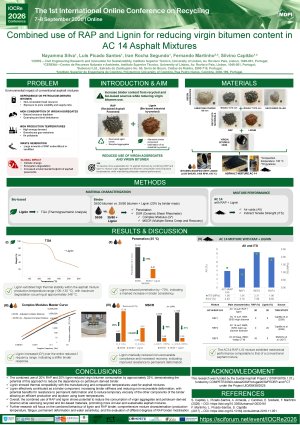
In pavement engineering, virgin bitumen is one of the most expensive components of asphalt mixtures, motivating the development of technologies to reduce virgin binder consumption while maintaining adequate mechanical performance. Also, reducing the consumption of high-quality virgin materials contributes to environmental sustainability. In this context, reclaimed asphalt pavement (RAP) has become an important alternative due to its potential to reuse aged asphalt binder and aggregates from milled pavements. Lignin, a by-product of the wood, paper, and biofuel industries, has potential as a binder. This study investigates the development of recycled asphalt mixtures using a combination of RAP and lignin, aiming to reduce the consumption of virgin bitumen and aggregates, as well as the production and compaction temperatures of the mixtures. AC 14 asphalt mixtures containing 20% RAP were produced with lignin contents corresponding to 20% by binder mass. The mixtures were manufactured at lower temperatures than in conventional hot-mix asphalt production processes. Tests were carried out on the virgin asphalt binder, the binder recovered from RAP, and lignin to compare their properties and to understand the influence of the binder blend on the performance of the asphalt mixtures produced. Experimental results demonstrated that the investigated formulations exhibited satisfactory mechanical behaviour and adequate performance potential for wearing-course applications. Furthermore, these sustainable asphalt paving solutions contribute to lower energy consumption and reduced atmospheric emissions during asphalt mixture manufacturing.
Keywords
sustainable pavement materials
bio-based components
by-product valorization
energy efficiency
Poster
Poster_IOCRe2026_190268_final version.pdf
Performance evaluation of sustainable alkali-activated mortars incorporating pulp and paper industry residues
Ash from the incineration of municipal waste as a component of cement mortars with a low water-to-cement ratio