Event submissions
Published
This submission belongs to the session S1. Advances in Recycling Technologies of the event The 1st International Online Conference on Recycling
Published date
02 Sep, 2026
Academic Editor
'%3e%3cpath%20d='M12.6657%2010.9104C12.4185%2010.325%2012.0599%209.79327%2011.6097%209.34482C11.1609%208.89508%2010.6293%208.5365%2010.0442%208.28888C10.0389%208.28626%2010.0337%208.28495%2010.0285%208.28233C10.8446%207.69279%2011.3752%206.73249%2011.3752%205.64904C11.3752%203.8542%209.92103%202.39999%208.1262%202.39999C6.33136%202.39999%204.87715%203.8542%204.87715%205.64904C4.87715%206.73249%205.40774%207.69279%206.22393%208.28364C6.21869%208.28626%206.21345%208.28757%206.20821%208.29019C5.62129%208.5378%205.09463%208.89284%204.64265%209.34613C4.1929%209.79493%203.83432%2010.3266%203.58671%2010.9117C3.34345%2011.4845%203.21226%2012.0987%203.20023%2012.7209C3.19988%2012.7349%203.20233%2012.7488%203.20744%2012.7619C3.21255%2012.7749%203.22022%2012.7867%203.22998%2012.7968C3.23975%2012.8068%203.25142%2012.8147%203.26431%2012.8202C3.2772%2012.8256%203.29105%2012.8284%203.30504%2012.8284H4.09109C4.14874%2012.8284%204.19459%2012.7825%204.1959%2012.7262C4.2221%2011.7148%204.62823%2010.7676%205.34617%2010.0497C6.08899%209.30683%207.0755%208.89808%208.1262%208.89808C9.17689%208.89808%2010.1634%209.30683%2010.9062%2010.0497C11.6242%2010.7676%2012.0303%2011.7148%2012.0565%2012.7262C12.0578%2012.7838%2012.1037%2012.8284%2012.1613%2012.8284H12.9474C12.9613%2012.8284%2012.9752%2012.8256%2012.9881%2012.8202C13.001%2012.8147%2013.0126%2012.8068%2013.0224%2012.7968C13.0322%2012.7867%2013.0398%2012.7749%2013.0449%2012.7619C13.0501%2012.7488%2013.0525%2012.7349%2013.0522%2012.7209C13.0391%2012.0947%2012.9094%2011.4855%2012.6657%2010.9104ZM8.1262%207.9024C7.52486%207.9024%206.9589%207.6679%206.53312%207.24211C6.10733%206.81633%205.87283%206.25037%205.87283%205.64904C5.87283%205.0477%206.10733%204.48174%206.53312%204.05596C6.9589%203.63018%207.52486%203.39567%208.1262%203.39567C8.72753%203.39567%209.29349%203.63018%209.71927%204.05596C10.1451%204.48174%2010.3796%205.0477%2010.3796%205.64904C10.3796%206.25037%2010.1451%206.81633%209.71927%207.24211C9.29349%207.6679%208.72753%207.9024%208.1262%207.9024Z'%20fill='%235D1EE1'/%3e%3c/g%3e%3c/svg%3e) Huijuan Dong
Huijuan DongCitation
Rupali Bhalchandra Shimpi, Sanjay Javarilal Surana, Development of Eco-friendly Biopolymer Isolate from Banana Pseudo-Stem for Industrial Applications, in Proceedings of The 1st International Online Conference on Recycling, 7 September–8 September 2026, MDPI: Basel, Switzerland
Share
Email
Facebook
Twitter
LinkedIn
Development of Eco-friendly Biopolymer Isolate from Banana Pseudo-Stem for Industrial Applications
'%3e%3cpath%20d='M12.6647%2010.9104C12.4176%2010.325%2012.0589%209.7933%2011.6088%209.34485C11.16%208.89511%2010.6283%208.53653%2010.0432%208.28891C10.038%208.28629%2010.0327%208.28498%2010.0275%208.28236C10.8437%207.69282%2011.3743%206.73252%2011.3743%205.64907C11.3743%203.85423%209.92005%202.40002%208.12522%202.40002C6.33038%202.40002%204.87618%203.85423%204.87618%205.64907C4.87618%206.73252%205.40677%207.69282%206.22296%208.28367C6.21772%208.28629%206.21248%208.2876%206.20724%208.29022C5.62031%208.53783%205.09365%208.89287%204.64167%209.34616C4.19192%209.79496%203.83334%2010.3266%203.58573%2010.9117C3.34247%2011.4846%203.21128%2012.0987%203.19925%2012.721C3.1989%2012.735%203.20135%2012.7489%203.20646%2012.7619C3.21157%2012.7749%203.21924%2012.7868%203.22901%2012.7968C3.23877%2012.8068%203.25045%2012.8148%203.26334%2012.8202C3.27623%2012.8256%203.29007%2012.8284%203.30406%2012.8284H4.09012C4.14776%2012.8284%204.19362%2012.7825%204.19493%2012.7262C4.22113%2011.7148%204.62726%2010.7676%205.34519%2010.0497C6.08802%209.30686%207.07452%208.89811%208.12522%208.89811C9.17592%208.89811%2010.1624%209.30686%2010.9052%2010.0497C11.6232%2010.7676%2012.0293%2011.7148%2012.0555%2012.7262C12.0568%2012.7839%2012.1027%2012.8284%2012.1603%2012.8284H12.9464C12.9604%2012.8284%2012.9742%2012.8256%2012.9871%2012.8202C13%2012.8148%2013.0117%2012.8068%2013.0214%2012.7968C13.0312%2012.7868%2013.0389%2012.7749%2013.044%2012.7619C13.0491%2012.7489%2013.0515%2012.735%2013.0512%2012.721C13.0381%2012.0947%2012.9084%2011.4856%2012.6647%2010.9104ZM8.12522%207.90243C7.52388%207.90243%206.95792%207.66793%206.53214%207.24215C6.10636%206.81636%205.87185%206.2504%205.87185%205.64907C5.87185%205.04773%206.10636%204.48177%206.53214%204.05599C6.95792%203.63021%207.52388%203.3957%208.12522%203.3957C8.72655%203.3957%209.29252%203.63021%209.7183%204.05599C10.1441%204.48177%2010.3786%205.04773%2010.3786%205.64907C10.3786%206.2504%2010.1441%206.81636%209.7183%207.24215C9.29252%207.66793%208.72655%207.90243%208.12522%207.90243Z'%20fill='%235D1EE1'/%3e%3c/g%3e%3c/svg%3e)
Rupali Bhalchandra Shimpi 1
Sanjay Javarilal Surana 1
1. Pharmacognosy in R.C.Patel Institute Of Pharmaceutical Education and Research Shirpur, K.B.C.North Maharashtra University Jalgaon, Shirpur, Dist-Dhule 425405, India
Abstract
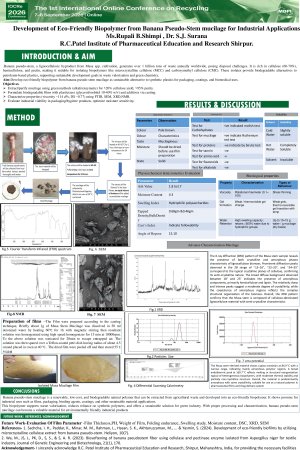
Banana cultivation produces large quantities of pseudo-stem residues that present disposal challenges and environmental burden. Banana pseudo-stem mucilage, rich in cellulose and mucilaginous polysaccharides, is a promising renewable feedstock for biopolymer production that enables waste valorization and replacement of conventional plastics. This study aimed to extract mucilage from banana pseudo-stem and develop biodegradable films with properties suitable for industrial applications such as packaging. Healthy pseudo-stems were collected, cleaned, and processed using an optimized extraction protocol to isolate mucilage with high yield and purity. Films were cast by solvent evaporation to achieve uniform thickness and integrity. Prepared films were characterized for yield and purity, mechanical properties (tensile strength, elongation at break, flexibility), water solubility, permeability, and microstructure. Results indicated significant mucilage recovery and efficient conversion using the selected extraction method. Film composition and plasticizer content strongly influenced functional performance: increasing plasticizer concentration improved flexibility and elongation but reduced tensile strength. Different plasticizer types (glycerol, sorbitol) differentially affected water solubility and oxygen permeability. Films without added plasticizer exhibited the highest tensile strength, whereas formulations with higher sorbitol or glycerol showed greater elongation and faster degradation. Biodegradation tests demonstrated rapid and complete breakdown of films within 24–48 hours under moist soil burial, confirming environmental compatibility and potential to mitigate persistent plastic pollution. Overall, banana pseudo-stem mucilage proved to be a viable, sustainable raw material for producing biodegradable films that meet key industrial benchmarks for strength, flexibility, and solubility while offering rapid biodegradability. Valorizing banana agricultural waste into biopolymer films supports circular economy models and presents an ecofriendly alternative for packaging and related industries.
Keywords
Banana pseudo-stem mucilage
Biopolymer films
Waste valorisation
Biodegradable packaging
Film casting (solvent evaporation)
Plasticizers (glycerol
sorbitol)
Mechanical properties (tensile strength
elongation)
Water solubility and permeability
B
Poster
poster mdpi RBS.pdf
Valorization of Pineapple Peel Waste: Isolation and Characterization of Pectin for Sustainable Food Packaging
From Medical Plastic Waste to Resource Recovery through Thermochemical Treatments