Event submissions
Published
This submission belongs to the session S1. Advances in Recycling Technologies of the event The 1st International Online Conference on Recycling
Published date
02 Sep, 2026
Academic Editor
'%3e%3cpath%20d='M12.6657%2010.9104C12.4185%2010.325%2012.0599%209.79327%2011.6097%209.34482C11.1609%208.89508%2010.6293%208.5365%2010.0442%208.28888C10.0389%208.28626%2010.0337%208.28495%2010.0285%208.28233C10.8446%207.69279%2011.3752%206.73249%2011.3752%205.64904C11.3752%203.8542%209.92103%202.39999%208.1262%202.39999C6.33136%202.39999%204.87715%203.8542%204.87715%205.64904C4.87715%206.73249%205.40774%207.69279%206.22393%208.28364C6.21869%208.28626%206.21345%208.28757%206.20821%208.29019C5.62129%208.5378%205.09463%208.89284%204.64265%209.34613C4.1929%209.79493%203.83432%2010.3266%203.58671%2010.9117C3.34345%2011.4845%203.21226%2012.0987%203.20023%2012.7209C3.19988%2012.7349%203.20233%2012.7488%203.20744%2012.7619C3.21255%2012.7749%203.22022%2012.7867%203.22998%2012.7968C3.23975%2012.8068%203.25142%2012.8147%203.26431%2012.8202C3.2772%2012.8256%203.29105%2012.8284%203.30504%2012.8284H4.09109C4.14874%2012.8284%204.19459%2012.7825%204.1959%2012.7262C4.2221%2011.7148%204.62823%2010.7676%205.34617%2010.0497C6.08899%209.30683%207.0755%208.89808%208.1262%208.89808C9.17689%208.89808%2010.1634%209.30683%2010.9062%2010.0497C11.6242%2010.7676%2012.0303%2011.7148%2012.0565%2012.7262C12.0578%2012.7838%2012.1037%2012.8284%2012.1613%2012.8284H12.9474C12.9613%2012.8284%2012.9752%2012.8256%2012.9881%2012.8202C13.001%2012.8147%2013.0126%2012.8068%2013.0224%2012.7968C13.0322%2012.7867%2013.0398%2012.7749%2013.0449%2012.7619C13.0501%2012.7488%2013.0525%2012.7349%2013.0522%2012.7209C13.0391%2012.0947%2012.9094%2011.4855%2012.6657%2010.9104ZM8.1262%207.9024C7.52486%207.9024%206.9589%207.6679%206.53312%207.24211C6.10733%206.81633%205.87283%206.25037%205.87283%205.64904C5.87283%205.0477%206.10733%204.48174%206.53312%204.05596C6.9589%203.63018%207.52486%203.39567%208.1262%203.39567C8.72753%203.39567%209.29349%203.63018%209.71927%204.05596C10.1451%204.48174%2010.3796%205.0477%2010.3796%205.64904C10.3796%206.25037%2010.1451%206.81633%209.71927%207.24211C9.29349%207.6679%208.72753%207.9024%208.1262%207.9024Z'%20fill='%235D1EE1'/%3e%3c/g%3e%3c/svg%3e) Huijuan Dong
Huijuan DongCitation
Inmaculada Mula Pérez, María Camila Quintero Quintana, Domingo Cabrera Gallardo, Fernando Vidal Barrero, Judith González Arias, From Medical Plastic Waste to Resource Recovery through Thermochemical Treatments, in Proceedings of The 1st International Online Conference on Recycling, 7 September–8 September 2026, MDPI: Basel, Switzerland
Share
Email
Facebook
Twitter
LinkedIn
From Medical Plastic Waste to Resource Recovery through Thermochemical Treatments
'%3e%3cpath%20d='M12.6647%2010.9104C12.4176%2010.325%2012.0589%209.7933%2011.6088%209.34485C11.16%208.89511%2010.6283%208.53653%2010.0432%208.28891C10.038%208.28629%2010.0327%208.28498%2010.0275%208.28236C10.8437%207.69282%2011.3743%206.73252%2011.3743%205.64907C11.3743%203.85423%209.92005%202.40002%208.12522%202.40002C6.33038%202.40002%204.87618%203.85423%204.87618%205.64907C4.87618%206.73252%205.40677%207.69282%206.22296%208.28367C6.21772%208.28629%206.21248%208.2876%206.20724%208.29022C5.62031%208.53783%205.09365%208.89287%204.64167%209.34616C4.19192%209.79496%203.83334%2010.3266%203.58573%2010.9117C3.34247%2011.4846%203.21128%2012.0987%203.19925%2012.721C3.1989%2012.735%203.20135%2012.7489%203.20646%2012.7619C3.21157%2012.7749%203.21924%2012.7868%203.22901%2012.7968C3.23877%2012.8068%203.25045%2012.8148%203.26334%2012.8202C3.27623%2012.8256%203.29007%2012.8284%203.30406%2012.8284H4.09012C4.14776%2012.8284%204.19362%2012.7825%204.19493%2012.7262C4.22113%2011.7148%204.62726%2010.7676%205.34519%2010.0497C6.08802%209.30686%207.07452%208.89811%208.12522%208.89811C9.17592%208.89811%2010.1624%209.30686%2010.9052%2010.0497C11.6232%2010.7676%2012.0293%2011.7148%2012.0555%2012.7262C12.0568%2012.7839%2012.1027%2012.8284%2012.1603%2012.8284H12.9464C12.9604%2012.8284%2012.9742%2012.8256%2012.9871%2012.8202C13%2012.8148%2013.0117%2012.8068%2013.0214%2012.7968C13.0312%2012.7868%2013.0389%2012.7749%2013.044%2012.7619C13.0491%2012.7489%2013.0515%2012.735%2013.0512%2012.721C13.0381%2012.0947%2012.9084%2011.4856%2012.6647%2010.9104ZM8.12522%207.90243C7.52388%207.90243%206.95792%207.66793%206.53214%207.24215C6.10636%206.81636%205.87185%206.2504%205.87185%205.64907C5.87185%205.04773%206.10636%204.48177%206.53214%204.05599C6.95792%203.63021%207.52388%203.3957%208.12522%203.3957C8.72655%203.3957%209.29252%203.63021%209.7183%204.05599C10.1441%204.48177%2010.3786%205.04773%2010.3786%205.64907C10.3786%206.2504%2010.1441%206.81636%209.7183%207.24215C9.29252%207.66793%208.72655%207.90243%208.12522%207.90243Z'%20fill='%235D1EE1'/%3e%3c/g%3e%3c/svg%3e)
Inmaculada Mula Pérez 1
María Camila Quintero Quintana 1
Domingo Cabrera Gallardo 1
Fernando Vidal Barrero 1
Judith González Arias 1
1. Chemical and Environmental Engineering Department, Technical School of Engineering, University of Seville, C/ Camino de los Descubrimientos s/n, Sevilla 41092, Spain
Abstract
Introduction
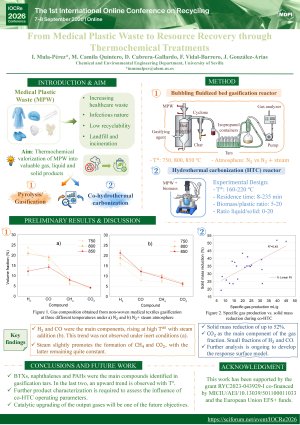
The rapid increase in healthcare-related waste has raised significant environmental concerns due to the limitations of conventional disposal methods such as landfilling and incineration. Medical plastics generated from personal protective equipment, laboratory consumables, and single-use devices represent a potentially valuable carbon-rich feedstock that can be converted into useful products through thermochemical technologies. In this context, sustainable waste valorization strategies are essential to promote resource recovery and support circular economy approaches.
Methods
This study explores the potential of different thermochemical treatments such as gasification or co-hydrothermal carbonization (co-HTC) for the valorization of representative medical plastic waste streams. Different medical plastic wastes are being evaluated both individually and in combination with biomass-based materials under controlled thermochemical conditions. Gasification experiments focus on the production of synthesis gas and the distribution of products, while co-HTC process aims to produce carbon-rich hydrochar, along with a liquid fraction and a gaseous stream. The influence of operating parameters, including temperature and residence time, is investigated to assess process performance and product characteristics.
Results
Preliminary findings indicate that both thermochemical pathways offer promising opportunities for resource recovery from medical plastic waste. Initial observations suggest that gasification favors the production of fuel gas streams rich in H₂ and CO, along with a fraction of tars rich in BTXs and naphthalenes. Co-HTC, on the other hand, promotes the formation of carbonaceous solid products with potential energy and material applications. Ongoing work focuses on the characterization of products and the search for alternative ways to valorize them. One possible future research pathway will be the catalytic conversion of both gaseous streams into high-value products for the industry.
Conclusions
Gasification and co-hydrothermal carbonization represent complementary strategies for the sustainable management of medical plastic waste, contributing to reduce environmental impacts associated with conventional disposal while enabling the recovery of valuable products.
Keywords
Medical plastic waste
Gasification
Co-hydrothermal carbonization
Resource recovery
Circular economy
Sustainable waste management
Poster
Poster I. Mula-Perez.pdf
Development of Eco-friendly Biopolymer Isolate from Banana Pseudo-Stem for Industrial Applications
Circular Valorization of Orange Peel Waste into Alkaline Pectinases Using Polyextremotolerant Bacillus amyloliquefaciens