Event submissions
Published
This submission belongs to the session S1. Advances in Recycling Technologies of the event The 1st International Online Conference on Recycling
Published date
02 Sep, 2026
Academic Editor
'%3e%3cpath%20d='M12.6657%2010.9104C12.4185%2010.325%2012.0599%209.79327%2011.6097%209.34482C11.1609%208.89508%2010.6293%208.5365%2010.0442%208.28888C10.0389%208.28626%2010.0337%208.28495%2010.0285%208.28233C10.8446%207.69279%2011.3752%206.73249%2011.3752%205.64904C11.3752%203.8542%209.92103%202.39999%208.1262%202.39999C6.33136%202.39999%204.87715%203.8542%204.87715%205.64904C4.87715%206.73249%205.40774%207.69279%206.22393%208.28364C6.21869%208.28626%206.21345%208.28757%206.20821%208.29019C5.62129%208.5378%205.09463%208.89284%204.64265%209.34613C4.1929%209.79493%203.83432%2010.3266%203.58671%2010.9117C3.34345%2011.4845%203.21226%2012.0987%203.20023%2012.7209C3.19988%2012.7349%203.20233%2012.7488%203.20744%2012.7619C3.21255%2012.7749%203.22022%2012.7867%203.22998%2012.7968C3.23975%2012.8068%203.25142%2012.8147%203.26431%2012.8202C3.2772%2012.8256%203.29105%2012.8284%203.30504%2012.8284H4.09109C4.14874%2012.8284%204.19459%2012.7825%204.1959%2012.7262C4.2221%2011.7148%204.62823%2010.7676%205.34617%2010.0497C6.08899%209.30683%207.0755%208.89808%208.1262%208.89808C9.17689%208.89808%2010.1634%209.30683%2010.9062%2010.0497C11.6242%2010.7676%2012.0303%2011.7148%2012.0565%2012.7262C12.0578%2012.7838%2012.1037%2012.8284%2012.1613%2012.8284H12.9474C12.9613%2012.8284%2012.9752%2012.8256%2012.9881%2012.8202C13.001%2012.8147%2013.0126%2012.8068%2013.0224%2012.7968C13.0322%2012.7867%2013.0398%2012.7749%2013.0449%2012.7619C13.0501%2012.7488%2013.0525%2012.7349%2013.0522%2012.7209C13.0391%2012.0947%2012.9094%2011.4855%2012.6657%2010.9104ZM8.1262%207.9024C7.52486%207.9024%206.9589%207.6679%206.53312%207.24211C6.10733%206.81633%205.87283%206.25037%205.87283%205.64904C5.87283%205.0477%206.10733%204.48174%206.53312%204.05596C6.9589%203.63018%207.52486%203.39567%208.1262%203.39567C8.72753%203.39567%209.29349%203.63018%209.71927%204.05596C10.1451%204.48174%2010.3796%205.0477%2010.3796%205.64904C10.3796%206.25037%2010.1451%206.81633%209.71927%207.24211C9.29349%207.6679%208.72753%207.9024%208.1262%207.9024Z'%20fill='%235D1EE1'/%3e%3c/g%3e%3c/svg%3e) Huijuan Dong
Huijuan DongCitation
Fatima Zohra Kaissar, Amira Missouri, Sid Ahmed Saadi, Amina Khaldi, Giovanni Emiliani, Sara Barberini, Seif El Islam Lebouachera, Circular Valorization of Orange Peel Waste into Alkaline Pectinases Using Polyextremotolerant Bacillus amyloliquefaciens, in Proceedings of The 1st International Online Conference on Recycling, 7 September–8 September 2026, MDPI: Basel, Switzerland
Share
Email
Facebook
Twitter
LinkedIn
Circular Valorization of Orange Peel Waste into Alkaline Pectinases Using Polyextremotolerant Bacillus amyloliquefaciens
'%3e%3cpath%20d='M12.6647%2010.9104C12.4176%2010.325%2012.0589%209.7933%2011.6088%209.34485C11.16%208.89511%2010.6283%208.53653%2010.0432%208.28891C10.038%208.28629%2010.0327%208.28498%2010.0275%208.28236C10.8437%207.69282%2011.3743%206.73252%2011.3743%205.64907C11.3743%203.85423%209.92005%202.40002%208.12522%202.40002C6.33038%202.40002%204.87618%203.85423%204.87618%205.64907C4.87618%206.73252%205.40677%207.69282%206.22296%208.28367C6.21772%208.28629%206.21248%208.2876%206.20724%208.29022C5.62031%208.53783%205.09365%208.89287%204.64167%209.34616C4.19192%209.79496%203.83334%2010.3266%203.58573%2010.9117C3.34247%2011.4846%203.21128%2012.0987%203.19925%2012.721C3.1989%2012.735%203.20135%2012.7489%203.20646%2012.7619C3.21157%2012.7749%203.21924%2012.7868%203.22901%2012.7968C3.23877%2012.8068%203.25045%2012.8148%203.26334%2012.8202C3.27623%2012.8256%203.29007%2012.8284%203.30406%2012.8284H4.09012C4.14776%2012.8284%204.19362%2012.7825%204.19493%2012.7262C4.22113%2011.7148%204.62726%2010.7676%205.34519%2010.0497C6.08802%209.30686%207.07452%208.89811%208.12522%208.89811C9.17592%208.89811%2010.1624%209.30686%2010.9052%2010.0497C11.6232%2010.7676%2012.0293%2011.7148%2012.0555%2012.7262C12.0568%2012.7839%2012.1027%2012.8284%2012.1603%2012.8284H12.9464C12.9604%2012.8284%2012.9742%2012.8256%2012.9871%2012.8202C13%2012.8148%2013.0117%2012.8068%2013.0214%2012.7968C13.0312%2012.7868%2013.0389%2012.7749%2013.044%2012.7619C13.0491%2012.7489%2013.0515%2012.735%2013.0512%2012.721C13.0381%2012.0947%2012.9084%2011.4856%2012.6647%2010.9104ZM8.12522%207.90243C7.52388%207.90243%206.95792%207.66793%206.53214%207.24215C6.10636%206.81636%205.87185%206.2504%205.87185%205.64907C5.87185%205.04773%206.10636%204.48177%206.53214%204.05599C6.95792%203.63021%207.52388%203.3957%208.12522%203.3957C8.72655%203.3957%209.29252%203.63021%209.7183%204.05599C10.1441%204.48177%2010.3786%205.04773%2010.3786%205.64907C10.3786%206.2504%2010.1441%206.81636%209.7183%207.24215C9.29252%207.66793%208.72655%207.90243%208.12522%207.90243Z'%20fill='%235D1EE1'/%3e%3c/g%3e%3c/svg%3e)
Fatima Zohra Kaissar 1
Amira Missouri 1
Sid Ahmed Saadi 2
Amina Khaldi 1

Giovanni Emiliani 3
Sara Barberini 3

Seif El Islam Lebouachera 4
1. Synthesis of Environmental Information Laboratory (LSIE), Djillali Liabes University, 22000, Sidi Bel Abbes, Algeria
2. Biology of Microbial systems Laboratory (LBSM), Kouba, Normal Higher School (ENS), BP 92 Vieux Kouba, 16050, Algiers, Algeria
3. Institute for Sustainable Plant Protection, National Research Council of (CNR-IPSP), Via Madonna del Piano 10 Sesto Fiorentino, 50019 Firenze, Italy.
4. Institute of Analytical Sciences and Physico-Chemistry for the Environment and Materials (IPREM), UMR 5254, CNRS, University of Pau and Pays de l’Adour, 2 Avenue Pierre Angot, Hélioparc Technopole, 64000 Pau, France
Abstract
Introduction
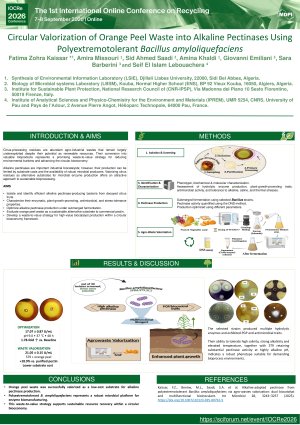
Agro-industrial citrus residues constitute a major environmental burden but also represent promising renewable substrates for sustainable bioprocesses. This study investigated the recycling potential of orange peel waste for low-cost alkaline pectinase production using multifunctional polyextremotolerant bacterial strains.
Methods
Thirty pectinolytic bacterial isolates were recovered from decayed fruits collected in Algeria and screened for alkaline pectinase production. Three high-performing strains were identified as Bacillus amyloliquefaciens through phenotypic and 16S rRNA analyses. Fermentation parameters were optimized using a one-factor-at-a-time approach, and commercial pectin was replaced with different agro-industrial wastes to evaluate substrate valorization efficiency.
Results
Optimal pectinase production was achieved at pH 9.0, 37 °C, and 48 h of submerged fermentation. Among the tested strains, ST9 showed the highest enzymatic activity, reaching 22.4 U/mL under optimized conditions. Orange peel waste significantly enhanced pectinase yield compared with commercial pectin while reducing substrate costs by approximately 99 %. The selected strains also demonstrated remarkable polyextremotolerance, maintaining growth under highly alkaline, saline, and thermal stress conditions. In addition, the isolates exhibited multiple hydrolytic activities, plant-growth-promoting traits, and antimicrobial activity against phytopathogenic fungi and bacteria.
Conclusions
This study demonstrates an efficient waste-to-value strategy for converting citrus-processing residues into high-value alkaline biocatalysts. The obtained results highlight the potential of polyextremotolerant Bacillus amyloliquefaciens strains for sustainable enzyme biomanufacturing and circular bioeconomy applications in agro-industrial waste recycling.
Keywords
Agro-waste recycling
Orange peel valorization
Alkaline pectinase
Circular bioeconomy
Bacillus amyloliquefaciens
Sustainable bioprocessing
Waste-to-value biotechnology
Polyextremotolerance.
Poster
MDPI poster FATIMA ZOHRA KAISSAR et al..pdf
From Medical Plastic Waste to Resource Recovery through Thermochemical Treatments
Microbial-Assisted Anaerobic Biotransformation for the Valorization of Agricultural Residues into Biofertilizers