Event submissions
Published
This submission belongs to the session S1. Advances in Recycling Technologies of the event The 1st International Online Conference on Recycling
Published date
02 Sep, 2026
Academic Editor
'%3e%3cpath%20d='M12.6657%2010.9104C12.4185%2010.325%2012.0599%209.79327%2011.6097%209.34482C11.1609%208.89508%2010.6293%208.5365%2010.0442%208.28888C10.0389%208.28626%2010.0337%208.28495%2010.0285%208.28233C10.8446%207.69279%2011.3752%206.73249%2011.3752%205.64904C11.3752%203.8542%209.92103%202.39999%208.1262%202.39999C6.33136%202.39999%204.87715%203.8542%204.87715%205.64904C4.87715%206.73249%205.40774%207.69279%206.22393%208.28364C6.21869%208.28626%206.21345%208.28757%206.20821%208.29019C5.62129%208.5378%205.09463%208.89284%204.64265%209.34613C4.1929%209.79493%203.83432%2010.3266%203.58671%2010.9117C3.34345%2011.4845%203.21226%2012.0987%203.20023%2012.7209C3.19988%2012.7349%203.20233%2012.7488%203.20744%2012.7619C3.21255%2012.7749%203.22022%2012.7867%203.22998%2012.7968C3.23975%2012.8068%203.25142%2012.8147%203.26431%2012.8202C3.2772%2012.8256%203.29105%2012.8284%203.30504%2012.8284H4.09109C4.14874%2012.8284%204.19459%2012.7825%204.1959%2012.7262C4.2221%2011.7148%204.62823%2010.7676%205.34617%2010.0497C6.08899%209.30683%207.0755%208.89808%208.1262%208.89808C9.17689%208.89808%2010.1634%209.30683%2010.9062%2010.0497C11.6242%2010.7676%2012.0303%2011.7148%2012.0565%2012.7262C12.0578%2012.7838%2012.1037%2012.8284%2012.1613%2012.8284H12.9474C12.9613%2012.8284%2012.9752%2012.8256%2012.9881%2012.8202C13.001%2012.8147%2013.0126%2012.8068%2013.0224%2012.7968C13.0322%2012.7867%2013.0398%2012.7749%2013.0449%2012.7619C13.0501%2012.7488%2013.0525%2012.7349%2013.0522%2012.7209C13.0391%2012.0947%2012.9094%2011.4855%2012.6657%2010.9104ZM8.1262%207.9024C7.52486%207.9024%206.9589%207.6679%206.53312%207.24211C6.10733%206.81633%205.87283%206.25037%205.87283%205.64904C5.87283%205.0477%206.10733%204.48174%206.53312%204.05596C6.9589%203.63018%207.52486%203.39567%208.1262%203.39567C8.72753%203.39567%209.29349%203.63018%209.71927%204.05596C10.1451%204.48174%2010.3796%205.0477%2010.3796%205.64904C10.3796%206.25037%2010.1451%206.81633%209.71927%207.24211C9.29349%207.6679%208.72753%207.9024%208.1262%207.9024Z'%20fill='%235D1EE1'/%3e%3c/g%3e%3c/svg%3e) Huijuan DONG
Huijuan DONGCitation
Erika Indovino, Luigi Botta, Francesco Paolo La Mantia, VALORIZATION OF MECHANICAL RECYCLED FISHING NETS IN MONOPOLYMER BLEND WITH CHEMICAL RECYCLED FISHING NETS, in Proceedings of The 1st International Online Conference on Recycling, 7 September–8 September 2026, MDPI: Basel, Switzerland
Share
Email
Facebook
Twitter
LinkedIn
VALORIZATION OF MECHANICAL RECYCLED FISHING NETS IN MONOPOLYMER BLEND WITH CHEMICAL RECYCLED FISHING NETS
'%3e%3cpath%20d='M12.6647%2010.9104C12.4176%2010.325%2012.0589%209.7933%2011.6088%209.34485C11.16%208.89511%2010.6283%208.53653%2010.0432%208.28891C10.038%208.28629%2010.0327%208.28498%2010.0275%208.28236C10.8437%207.69282%2011.3743%206.73252%2011.3743%205.64907C11.3743%203.85423%209.92005%202.40002%208.12522%202.40002C6.33038%202.40002%204.87618%203.85423%204.87618%205.64907C4.87618%206.73252%205.40677%207.69282%206.22296%208.28367C6.21772%208.28629%206.21248%208.2876%206.20724%208.29022C5.62031%208.53783%205.09365%208.89287%204.64167%209.34616C4.19192%209.79496%203.83334%2010.3266%203.58573%2010.9117C3.34247%2011.4846%203.21128%2012.0987%203.19925%2012.721C3.1989%2012.735%203.20135%2012.7489%203.20646%2012.7619C3.21157%2012.7749%203.21924%2012.7868%203.22901%2012.7968C3.23877%2012.8068%203.25045%2012.8148%203.26334%2012.8202C3.27623%2012.8256%203.29007%2012.8284%203.30406%2012.8284H4.09012C4.14776%2012.8284%204.19362%2012.7825%204.19493%2012.7262C4.22113%2011.7148%204.62726%2010.7676%205.34519%2010.0497C6.08802%209.30686%207.07452%208.89811%208.12522%208.89811C9.17592%208.89811%2010.1624%209.30686%2010.9052%2010.0497C11.6232%2010.7676%2012.0293%2011.7148%2012.0555%2012.7262C12.0568%2012.7839%2012.1027%2012.8284%2012.1603%2012.8284H12.9464C12.9604%2012.8284%2012.9742%2012.8256%2012.9871%2012.8202C13%2012.8148%2013.0117%2012.8068%2013.0214%2012.7968C13.0312%2012.7868%2013.0389%2012.7749%2013.044%2012.7619C13.0491%2012.7489%2013.0515%2012.735%2013.0512%2012.721C13.0381%2012.0947%2012.9084%2011.4856%2012.6647%2010.9104ZM8.12522%207.90243C7.52388%207.90243%206.95792%207.66793%206.53214%207.24215C6.10636%206.81636%205.87185%206.2504%205.87185%205.64907C5.87185%205.04773%206.10636%204.48177%206.53214%204.05599C6.95792%203.63021%207.52388%203.3957%208.12522%203.3957C8.72655%203.3957%209.29252%203.63021%209.7183%204.05599C10.1441%204.48177%2010.3786%205.04773%2010.3786%205.64907C10.3786%206.2504%2010.1441%206.81636%209.7183%207.24215C9.29252%207.66793%208.72655%207.90243%208.12522%207.90243Z'%20fill='%235D1EE1'/%3e%3c/g%3e%3c/svg%3e)
Erika Indovino 1,2

Luigi Botta 1,2

Francesco Paolo La Mantia 1,2
1. Department of Engineering, University of Palermo, V. delle scienze, 90128 Palermo, Italy
2. INSTM Consortium on Materials Science and Technology, Via G. Giusti 9, 50125, Florence, Italy
Abstract
Introduction
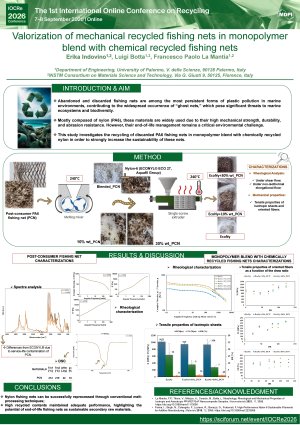
Discarded fishing nets in marine environments constitute one of the most persistent forms of plastic pollution, contributing to the “ghost nets” phenomenon, which poses severe threats to marine ecosystems and biodiversity. These materials are primarily composed of nylon (PA6), widely employed for its high mechanical strength, durability, and abrasion resistance. However, their end-of-life management remains a major environmental challenge, as recovery operations are difficult and contamination, weathering, and mechanical degradation significantly limit recyclability. Current valorization strategies mainly involve mechanical recycling for secondary composite materials and chemical recycling through depolymerization, enabling the recovery of regenerated nylon with properties comparable to virgin polymers. In this study, we investigate the possibility of recycling discarded nylon fishing nets in monopolymer blends with chemically recycled nylon to enhance sustainability.
Methods
Post-consumer nylon fishing nets were collected and mechanically recycled. The recovered material was blended with chemically recycled Nylon-6 (ECONYL® ECO 27, Aquafil Group) to obtain formulations containing 10 wt% and 30 wt% recycled content. The blends were compounded via extrusion and characterized in terms of rheological behavior and mechanical performance.
Results
All formulations exhibited a slight low-frequency plateau and shear-thinning behavior at high frequencies. The incorporation of recycled nets reduced complex viscosity without significantly altering overall rheological behavior compared with ECONYL®. The recycled Nylon-6 showed an elastic modulus of 1021 MPa, tensile strength of 31 MPa, and elongation at break of 16%. Higher recycled content caused a moderate decrease in mechanical properties, but the blends maintained satisfactory structural integrity and tensile strength.
Conclusions
This work demonstrates that recycled nylon fishing nets can be effectively reprocessed through conventional melt-processing techniques. Despite slight reductions in viscosity and mechanical performance at higher recycled contents, the blends maintained adequate properties, confirming the potential of end-of-life fishing nets as sustainable secondary raw materials within a circular economy framework.
Keywords
Recycled nylon fishing nets
polymer blend
mechanical recycling
sustainability
Poster
Poster IOCRe2026_Erika Indovino.pdf
Waste Valorization Pathways for the Development of Advanced Inorganic Materials
Sustainable Valorization of Agricultural Waste through Green Chemistry and Recycling Technologies: A Systematic Review