Event submissions
Published
This submission belongs to the session S1. Advances in Recycling Technologies of the event The 1st International Online Conference on Recycling
Published date
02 Sep, 2026
Academic Editor
'%3e%3cpath%20d='M12.6657%2010.9104C12.4185%2010.325%2012.0599%209.79327%2011.6097%209.34482C11.1609%208.89508%2010.6293%208.5365%2010.0442%208.28888C10.0389%208.28626%2010.0337%208.28495%2010.0285%208.28233C10.8446%207.69279%2011.3752%206.73249%2011.3752%205.64904C11.3752%203.8542%209.92103%202.39999%208.1262%202.39999C6.33136%202.39999%204.87715%203.8542%204.87715%205.64904C4.87715%206.73249%205.40774%207.69279%206.22393%208.28364C6.21869%208.28626%206.21345%208.28757%206.20821%208.29019C5.62129%208.5378%205.09463%208.89284%204.64265%209.34613C4.1929%209.79493%203.83432%2010.3266%203.58671%2010.9117C3.34345%2011.4845%203.21226%2012.0987%203.20023%2012.7209C3.19988%2012.7349%203.20233%2012.7488%203.20744%2012.7619C3.21255%2012.7749%203.22022%2012.7867%203.22998%2012.7968C3.23975%2012.8068%203.25142%2012.8147%203.26431%2012.8202C3.2772%2012.8256%203.29105%2012.8284%203.30504%2012.8284H4.09109C4.14874%2012.8284%204.19459%2012.7825%204.1959%2012.7262C4.2221%2011.7148%204.62823%2010.7676%205.34617%2010.0497C6.08899%209.30683%207.0755%208.89808%208.1262%208.89808C9.17689%208.89808%2010.1634%209.30683%2010.9062%2010.0497C11.6242%2010.7676%2012.0303%2011.7148%2012.0565%2012.7262C12.0578%2012.7838%2012.1037%2012.8284%2012.1613%2012.8284H12.9474C12.9613%2012.8284%2012.9752%2012.8256%2012.9881%2012.8202C13.001%2012.8147%2013.0126%2012.8068%2013.0224%2012.7968C13.0322%2012.7867%2013.0398%2012.7749%2013.0449%2012.7619C13.0501%2012.7488%2013.0525%2012.7349%2013.0522%2012.7209C13.0391%2012.0947%2012.9094%2011.4855%2012.6657%2010.9104ZM8.1262%207.9024C7.52486%207.9024%206.9589%207.6679%206.53312%207.24211C6.10733%206.81633%205.87283%206.25037%205.87283%205.64904C5.87283%205.0477%206.10733%204.48174%206.53312%204.05596C6.9589%203.63018%207.52486%203.39567%208.1262%203.39567C8.72753%203.39567%209.29349%203.63018%209.71927%204.05596C10.1451%204.48174%2010.3796%205.0477%2010.3796%205.64904C10.3796%206.25037%2010.1451%206.81633%209.71927%207.24211C9.29349%207.6679%208.72753%207.9024%208.1262%207.9024Z'%20fill='%235D1EE1'/%3e%3c/g%3e%3c/svg%3e) Huijuan Dong
Huijuan DongCitation
Surajit De Mandal, Sustainable Valorization of Agricultural Waste through Green Chemistry and Recycling Technologies: A Systematic Review, in Proceedings of The 1st International Online Conference on Recycling, 7 September–8 September 2026, MDPI: Basel, Switzerland
Share
Email
Facebook
Twitter
LinkedIn
Sustainable Valorization of Agricultural Waste through Green Chemistry and Recycling Technologies: A Systematic Review
'%3e%3cpath%20d='M12.6647%2010.9104C12.4176%2010.325%2012.0589%209.7933%2011.6088%209.34485C11.16%208.89511%2010.6283%208.53653%2010.0432%208.28891C10.038%208.28629%2010.0327%208.28498%2010.0275%208.28236C10.8437%207.69282%2011.3743%206.73252%2011.3743%205.64907C11.3743%203.85423%209.92005%202.40002%208.12522%202.40002C6.33038%202.40002%204.87618%203.85423%204.87618%205.64907C4.87618%206.73252%205.40677%207.69282%206.22296%208.28367C6.21772%208.28629%206.21248%208.2876%206.20724%208.29022C5.62031%208.53783%205.09365%208.89287%204.64167%209.34616C4.19192%209.79496%203.83334%2010.3266%203.58573%2010.9117C3.34247%2011.4846%203.21128%2012.0987%203.19925%2012.721C3.1989%2012.735%203.20135%2012.7489%203.20646%2012.7619C3.21157%2012.7749%203.21924%2012.7868%203.22901%2012.7968C3.23877%2012.8068%203.25045%2012.8148%203.26334%2012.8202C3.27623%2012.8256%203.29007%2012.8284%203.30406%2012.8284H4.09012C4.14776%2012.8284%204.19362%2012.7825%204.19493%2012.7262C4.22113%2011.7148%204.62726%2010.7676%205.34519%2010.0497C6.08802%209.30686%207.07452%208.89811%208.12522%208.89811C9.17592%208.89811%2010.1624%209.30686%2010.9052%2010.0497C11.6232%2010.7676%2012.0293%2011.7148%2012.0555%2012.7262C12.0568%2012.7839%2012.1027%2012.8284%2012.1603%2012.8284H12.9464C12.9604%2012.8284%2012.9742%2012.8256%2012.9871%2012.8202C13%2012.8148%2013.0117%2012.8068%2013.0214%2012.7968C13.0312%2012.7868%2013.0389%2012.7749%2013.044%2012.7619C13.0491%2012.7489%2013.0515%2012.735%2013.0512%2012.721C13.0381%2012.0947%2012.9084%2011.4856%2012.6647%2010.9104ZM8.12522%207.90243C7.52388%207.90243%206.95792%207.66793%206.53214%207.24215C6.10636%206.81636%205.87185%206.2504%205.87185%205.64907C5.87185%205.04773%206.10636%204.48177%206.53214%204.05599C6.95792%203.63021%207.52388%203.3957%208.12522%203.3957C8.72655%203.3957%209.29252%203.63021%209.7183%204.05599C10.1441%204.48177%2010.3786%205.04773%2010.3786%205.64907C10.3786%206.2504%2010.1441%206.81636%209.7183%207.24215C9.29252%207.66793%208.72655%207.90243%208.12522%207.90243Z'%20fill='%235D1EE1'/%3e%3c/g%3e%3c/svg%3e)
Surajit De Mandal 1
1. Department of Microbiology, Shri Davara University, Raipur, 493661, India
Abstract
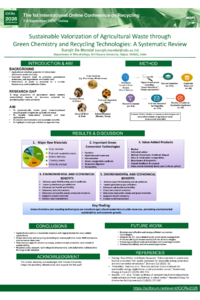
Introduction: Agricultural activities generate substantial quantities of organic waste, such as rice husks, wheat straw, sugarcane bagasse, fruit peels, coconut shells, and animal manure. Improper waste management—including open burning and indiscriminate dumping—leads to environmental pollution, greenhouse gas emissions, and soil degradation. Employing sustainable recycling technologies to transform agricultural waste into high-value green materials has emerged as an effective waste management strategy, contributing to the development of a circular economy. The objective of this systematic review is to evaluate recent advancements in sustainable technologies for converting agricultural waste into value-added products.
Methods: A systematic literature search using the terms "agricultural waste recycling," "green chemistry," and "waste valorization” was carried out in Google Scholar to retrieve related papers published between 2015 and 2025. The inclusion criteria were relevance to agricultural waste conversion technologies and the value-added products.
Results: Based on the inclusion criteria, 45 studies were selected for this study. An in-depth review demonstrated that commonly utilized raw materials include crop residues, fruit and vegetable waste, animal biomass, and forestry waste. By employing conversion technologies such as pyrolysis, carbonization, fermentation, hydrothermal treatment, and nanoparticle synthesis, products such as biochar, activated carbon, biofuels, silica, biopolymers, and green nanoparticles can be produced. These materials can be utilized for various beneficial purposes—such as soil remediation, renewable energy generation, energy conservation, and wastewater treatment—thereby reducing biomass combustion, greenhouse gas emissions, improving soil health, and conserving natural resources. However, several limitations—including high processing costs, limited availability of raw materials and technological limitations—stand as obstacles to the successful implementation of these sustainable conversion technologies.
Conclusion: Conversion of agricultural waste through green chemistry and advanced recycling technologies offers a promising strategy to produce value-added products in a sustainable manner. Further technological advancements and supporting government policies may facilitate large-scale industrial adoption of these recycling technologies and the development of a circular bioeconomy.
Keywords
Agricultural waste
Green chemistry
Circular economy
Recycling technologies
Poster
sciforum-183597 .pdf
VALORIZATION OF MECHANICAL RECYCLED FISHING NETS IN MONOPOLYMER BLEND WITH CHEMICAL RECYCLED FISHING NETS
Bioconversion and Valorization of Moroccan Prunus dulcis Cultivars: Upcycling Plant Biomass into Functional Probiotic Bio-Matrices via Symbiotic Fermentation