Event submissions
Published
This submission belongs to the session S3. Antimicrobial Resistance and Food Safety: A One Health Perspective of the event The 2nd International Online Conference on Veterinary Sciences
Published date
02 Sep, 2026
Academic Editor
'%3e%3cpath%20d='M12.6657%2010.9104C12.4185%2010.325%2012.0599%209.79327%2011.6097%209.34482C11.1609%208.89508%2010.6293%208.5365%2010.0442%208.28888C10.0389%208.28626%2010.0337%208.28495%2010.0285%208.28233C10.8446%207.69279%2011.3752%206.73249%2011.3752%205.64904C11.3752%203.8542%209.92103%202.39999%208.1262%202.39999C6.33136%202.39999%204.87715%203.8542%204.87715%205.64904C4.87715%206.73249%205.40774%207.69279%206.22393%208.28364C6.21869%208.28626%206.21345%208.28757%206.20821%208.29019C5.62129%208.5378%205.09463%208.89284%204.64265%209.34613C4.1929%209.79493%203.83432%2010.3266%203.58671%2010.9117C3.34345%2011.4845%203.21226%2012.0987%203.20023%2012.7209C3.19988%2012.7349%203.20233%2012.7488%203.20744%2012.7619C3.21255%2012.7749%203.22022%2012.7867%203.22998%2012.7968C3.23975%2012.8068%203.25142%2012.8147%203.26431%2012.8202C3.2772%2012.8256%203.29105%2012.8284%203.30504%2012.8284H4.09109C4.14874%2012.8284%204.19459%2012.7825%204.1959%2012.7262C4.2221%2011.7148%204.62823%2010.7676%205.34617%2010.0497C6.08899%209.30683%207.0755%208.89808%208.1262%208.89808C9.17689%208.89808%2010.1634%209.30683%2010.9062%2010.0497C11.6242%2010.7676%2012.0303%2011.7148%2012.0565%2012.7262C12.0578%2012.7838%2012.1037%2012.8284%2012.1613%2012.8284H12.9474C12.9613%2012.8284%2012.9752%2012.8256%2012.9881%2012.8202C13.001%2012.8147%2013.0126%2012.8068%2013.0224%2012.7968C13.0322%2012.7867%2013.0398%2012.7749%2013.0449%2012.7619C13.0501%2012.7488%2013.0525%2012.7349%2013.0522%2012.7209C13.0391%2012.0947%2012.9094%2011.4855%2012.6657%2010.9104ZM8.1262%207.9024C7.52486%207.9024%206.9589%207.6679%206.53312%207.24211C6.10733%206.81633%205.87283%206.25037%205.87283%205.64904C5.87283%205.0477%206.10733%204.48174%206.53312%204.05596C6.9589%203.63018%207.52486%203.39567%208.1262%203.39567C8.72753%203.39567%209.29349%203.63018%209.71927%204.05596C10.1451%204.48174%2010.3796%205.0477%2010.3796%205.64904C10.3796%206.25037%2010.1451%206.81633%209.71927%207.24211C9.29349%207.6679%208.72753%207.9024%208.1262%207.9024Z'%20fill='%235D1EE1'/%3e%3c/g%3e%3c/svg%3e) BeiBei Li
BeiBei LiCitation
Oumaima CHARAFEDDINE, Oussama RAFIK, Karima MOHTADI, Ayoub BELGHITI, Hassan TAKI, Evaluation of the Effect of Doxycycline Administration on Growth Performance and Tissue Residue Accumulation Kinetics in Hubbard Broiler Chickens, in Proceedings of The 2nd International Online Conference on Veterinary Sciences, 7 September–9 September 2026, MDPI: Basel, Switzerland
Share
Email
Facebook
Twitter
LinkedIn
Evaluation of the Effect of Doxycycline Administration on Growth Performance and Tissue Residue Accumulation Kinetics in Hubbard Broiler Chickens
'%3e%3cpath%20d='M12.6647%2010.9104C12.4176%2010.325%2012.0589%209.7933%2011.6088%209.34485C11.16%208.89511%2010.6283%208.53653%2010.0432%208.28891C10.038%208.28629%2010.0327%208.28498%2010.0275%208.28236C10.8437%207.69282%2011.3743%206.73252%2011.3743%205.64907C11.3743%203.85423%209.92005%202.40002%208.12522%202.40002C6.33038%202.40002%204.87618%203.85423%204.87618%205.64907C4.87618%206.73252%205.40677%207.69282%206.22296%208.28367C6.21772%208.28629%206.21248%208.2876%206.20724%208.29022C5.62031%208.53783%205.09365%208.89287%204.64167%209.34616C4.19192%209.79496%203.83334%2010.3266%203.58573%2010.9117C3.34247%2011.4846%203.21128%2012.0987%203.19925%2012.721C3.1989%2012.735%203.20135%2012.7489%203.20646%2012.7619C3.21157%2012.7749%203.21924%2012.7868%203.22901%2012.7968C3.23877%2012.8068%203.25045%2012.8148%203.26334%2012.8202C3.27623%2012.8256%203.29007%2012.8284%203.30406%2012.8284H4.09012C4.14776%2012.8284%204.19362%2012.7825%204.19493%2012.7262C4.22113%2011.7148%204.62726%2010.7676%205.34519%2010.0497C6.08802%209.30686%207.07452%208.89811%208.12522%208.89811C9.17592%208.89811%2010.1624%209.30686%2010.9052%2010.0497C11.6232%2010.7676%2012.0293%2011.7148%2012.0555%2012.7262C12.0568%2012.7839%2012.1027%2012.8284%2012.1603%2012.8284H12.9464C12.9604%2012.8284%2012.9742%2012.8256%2012.9871%2012.8202C13%2012.8148%2013.0117%2012.8068%2013.0214%2012.7968C13.0312%2012.7868%2013.0389%2012.7749%2013.044%2012.7619C13.0491%2012.7489%2013.0515%2012.735%2013.0512%2012.721C13.0381%2012.0947%2012.9084%2011.4856%2012.6647%2010.9104ZM8.12522%207.90243C7.52388%207.90243%206.95792%207.66793%206.53214%207.24215C6.10636%206.81636%205.87185%206.2504%205.87185%205.64907C5.87185%205.04773%206.10636%204.48177%206.53214%204.05599C6.95792%203.63021%207.52388%203.3957%208.12522%203.3957C8.72655%203.3957%209.29252%203.63021%209.7183%204.05599C10.1441%204.48177%2010.3786%205.04773%2010.3786%205.64907C10.3786%206.2504%2010.1441%206.81636%209.7183%207.24215C9.29252%207.66793%208.72655%207.90243%208.12522%207.90243Z'%20fill='%235D1EE1'/%3e%3c/g%3e%3c/svg%3e)
Oumaima CHARAFEDDINE 1
Oussama RAFIK 2
Karima MOHTADI 1
Ayoub BELGHITI 2,3
Hassan TAKI 1
1. Department of Biology, Laboratory of Biology and Health, Faculty of Sciences Ben M’Sick, Hassan II University of Casablanca, Casablanca, Morocco
2. Department of Biology, Applied Microbiology Team, Laboratory of Ecology and Environment, Faculty of Sciences Ben M’Sick, Hassan II University of Casablanca, Casablanca, Morocco
3. Science and Technology Research Team, Higher School of Technology of Laayoune, Ibn Zohr University, Laayoune, Morocco
Abstract
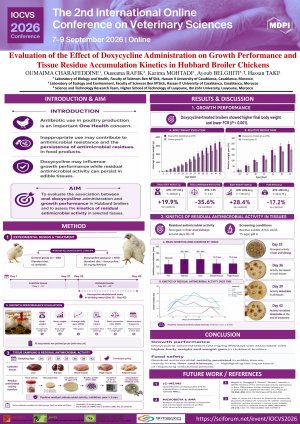
Antibiotic administration in poultry production remains an important One Health concern, particularly because inappropriate use may contribute to antimicrobial resistance and the persistence of antimicrobial residues in food products. This study aimed to evaluate the association between oral doxycycline administration and growth performance in Hubbard broiler chickens, as well as to assess the kinetics of residual antimicrobial activity in selected tissues.
A total of 200 one-day-old Hubbard broiler chicks were divided into two groups of 100 birds each: a control group receiving a standard diet without doxycycline treatment and a treated group receiving doxycycline at 20 mg/kg body weight through drinking water from day 22 to day 42 of rearing. Growth performance was assessed by monitoring body weight, feed intake, and average daily gain. In parallel, tissue samples, including liver, kidneys, muscle, and adipose tissue, were collected to evaluate residue accumulation using a microbiological inhibition assay based on the detection of residual antimicrobial activity.
The doxycycline-treated group showed higher body weight and greater weight gain compared with the control group. Statistical analysis confirmed a significant association between doxycycline administration and improved growth-related parameters (p < 0.001). Residual antimicrobial activity was detected in all analysed tissues, with greater accumulation observed in the liver and kidneys.
These findings indicate that, under the conditions of this study, doxycycline administration was associated with improved growth performance in Hubbard broiler chickens. However, the persistence of residual antimicrobial activity in edible tissues raises important food safety concerns. Therefore, doxycycline use in poultry production should be strictly controlled to ensure food safety and compliance with One Health principles.
Keywords
Doxycycline
broiler chickens
growth performance
antimicrobial residues
food safety
One Health
Poster
CHARAFEDDINE POSTER IOCVS.pdf
Feed-associated Clostridium perfringens enterotoxemia in cattle: toxin detection in organ and feed samples during clinical field investigations
Detection of Bovine Tuberculosis in Animals Using Interferon-Gamma Release Assays and Its Public Health Relevance in the One Health Approach