Event submissions
Published
This submission belongs to the session S1. Advances in Recycling Technologies of the event The 1st International Online Conference on Recycling
Published date
02 Sep, 2026
Academic Editor
'%3e%3cpath%20d='M12.6657%2010.9104C12.4185%2010.325%2012.0599%209.79327%2011.6097%209.34482C11.1609%208.89508%2010.6293%208.5365%2010.0442%208.28888C10.0389%208.28626%2010.0337%208.28495%2010.0285%208.28233C10.8446%207.69279%2011.3752%206.73249%2011.3752%205.64904C11.3752%203.8542%209.92103%202.39999%208.1262%202.39999C6.33136%202.39999%204.87715%203.8542%204.87715%205.64904C4.87715%206.73249%205.40774%207.69279%206.22393%208.28364C6.21869%208.28626%206.21345%208.28757%206.20821%208.29019C5.62129%208.5378%205.09463%208.89284%204.64265%209.34613C4.1929%209.79493%203.83432%2010.3266%203.58671%2010.9117C3.34345%2011.4845%203.21226%2012.0987%203.20023%2012.7209C3.19988%2012.7349%203.20233%2012.7488%203.20744%2012.7619C3.21255%2012.7749%203.22022%2012.7867%203.22998%2012.7968C3.23975%2012.8068%203.25142%2012.8147%203.26431%2012.8202C3.2772%2012.8256%203.29105%2012.8284%203.30504%2012.8284H4.09109C4.14874%2012.8284%204.19459%2012.7825%204.1959%2012.7262C4.2221%2011.7148%204.62823%2010.7676%205.34617%2010.0497C6.08899%209.30683%207.0755%208.89808%208.1262%208.89808C9.17689%208.89808%2010.1634%209.30683%2010.9062%2010.0497C11.6242%2010.7676%2012.0303%2011.7148%2012.0565%2012.7262C12.0578%2012.7838%2012.1037%2012.8284%2012.1613%2012.8284H12.9474C12.9613%2012.8284%2012.9752%2012.8256%2012.9881%2012.8202C13.001%2012.8147%2013.0126%2012.8068%2013.0224%2012.7968C13.0322%2012.7867%2013.0398%2012.7749%2013.0449%2012.7619C13.0501%2012.7488%2013.0525%2012.7349%2013.0522%2012.7209C13.0391%2012.0947%2012.9094%2011.4855%2012.6657%2010.9104ZM8.1262%207.9024C7.52486%207.9024%206.9589%207.6679%206.53312%207.24211C6.10733%206.81633%205.87283%206.25037%205.87283%205.64904C5.87283%205.0477%206.10733%204.48174%206.53312%204.05596C6.9589%203.63018%207.52486%203.39567%208.1262%203.39567C8.72753%203.39567%209.29349%203.63018%209.71927%204.05596C10.1451%204.48174%2010.3796%205.0477%2010.3796%205.64904C10.3796%206.25037%2010.1451%206.81633%209.71927%207.24211C9.29349%207.6679%208.72753%207.9024%208.1262%207.9024Z'%20fill='%235D1EE1'/%3e%3c/g%3e%3c/svg%3e) Huijuan Dong
Huijuan DongCitation
Lívia Firmani Silva, Ana Paula Ferreira, Hélder Teixeira Gomes, Development of Geopolymer-Carbon Composite for Wastewater Treatment, in Proceedings of The 1st International Online Conference on Recycling, 7 September–8 September 2026, MDPI: Basel, Switzerland
Share
Email
Facebook
Twitter
LinkedIn
Development of Geopolymer-Carbon Composite for Wastewater Treatment
'%3e%3cpath%20d='M12.6647%2010.9104C12.4176%2010.325%2012.0589%209.7933%2011.6088%209.34485C11.16%208.89511%2010.6283%208.53653%2010.0432%208.28891C10.038%208.28629%2010.0327%208.28498%2010.0275%208.28236C10.8437%207.69282%2011.3743%206.73252%2011.3743%205.64907C11.3743%203.85423%209.92005%202.40002%208.12522%202.40002C6.33038%202.40002%204.87618%203.85423%204.87618%205.64907C4.87618%206.73252%205.40677%207.69282%206.22296%208.28367C6.21772%208.28629%206.21248%208.2876%206.20724%208.29022C5.62031%208.53783%205.09365%208.89287%204.64167%209.34616C4.19192%209.79496%203.83334%2010.3266%203.58573%2010.9117C3.34247%2011.4846%203.21128%2012.0987%203.19925%2012.721C3.1989%2012.735%203.20135%2012.7489%203.20646%2012.7619C3.21157%2012.7749%203.21924%2012.7868%203.22901%2012.7968C3.23877%2012.8068%203.25045%2012.8148%203.26334%2012.8202C3.27623%2012.8256%203.29007%2012.8284%203.30406%2012.8284H4.09012C4.14776%2012.8284%204.19362%2012.7825%204.19493%2012.7262C4.22113%2011.7148%204.62726%2010.7676%205.34519%2010.0497C6.08802%209.30686%207.07452%208.89811%208.12522%208.89811C9.17592%208.89811%2010.1624%209.30686%2010.9052%2010.0497C11.6232%2010.7676%2012.0293%2011.7148%2012.0555%2012.7262C12.0568%2012.7839%2012.1027%2012.8284%2012.1603%2012.8284H12.9464C12.9604%2012.8284%2012.9742%2012.8256%2012.9871%2012.8202C13%2012.8148%2013.0117%2012.8068%2013.0214%2012.7968C13.0312%2012.7868%2013.0389%2012.7749%2013.044%2012.7619C13.0491%2012.7489%2013.0515%2012.735%2013.0512%2012.721C13.0381%2012.0947%2012.9084%2011.4856%2012.6647%2010.9104ZM8.12522%207.90243C7.52388%207.90243%206.95792%207.66793%206.53214%207.24215C6.10636%206.81636%205.87185%206.2504%205.87185%205.64907C5.87185%205.04773%206.10636%204.48177%206.53214%204.05599C6.95792%203.63021%207.52388%203.3957%208.12522%203.3957C8.72655%203.3957%209.29252%203.63021%209.7183%204.05599C10.1441%204.48177%2010.3786%205.04773%2010.3786%205.64907C10.3786%206.2504%2010.1441%206.81636%209.7183%207.24215C9.29252%207.66793%208.72655%207.90243%208.12522%207.90243Z'%20fill='%235D1EE1'/%3e%3c/g%3e%3c/svg%3e)
Lívia Firmani Silva 1
Ana Paula Ferreira 1

Hélder Teixeira Gomes 1
1. CIMO - Mountain Research Center / LA SusTEC, Polytechnic Institute of Bragança (IPB), Bragança 5300-253, Portugal
Abstract
The occurrence of contaminants of emerging concern (CECs) in aquatic environments has driven the development of alternatives to conventional water treatment technologies. Ceramic membranes exhibit high removal efficiency but are associated with high energy consumption and production costs. Geopolymers have emerged as a low-cost option due to low-temperature synthesis and the use of industrial residues. The incorporation of biomass-derived activated carbon (AC) enhances adsorption performance while maintaining structural stability. In this study, a geopolymer–activated carbon composite was synthesized and subjected to hydrothermal treatment to promote structural stabilization and zeolitic phase formation, aiming at enhanced CEC removal from water.
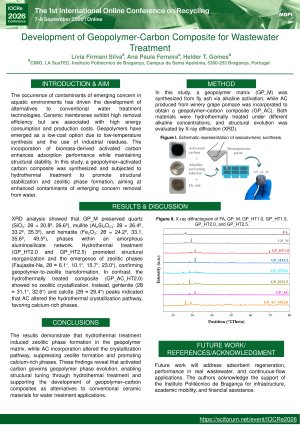
A geopolymer matrix (GP_M) was synthesized from fly ash via alkaline activation, while AC produced from winery grape pomace was incorporated to obtain a geopolymer–carbon composite (GP_AC). Both materials were hydrothermally treated under different alkaline concentrations, and structural evolution was evaluated by X-ray diffraction (XRD).
XRD analysis showed that GP_M preserved quartz (SiO₂: 2θ = 20.8º, 26.6º), mullite (Al₆Si₂O₁₃: 2θ = 26.4º, 33.2º, 35.3º), and hematite (Fe₂O₃: 2θ = 24.2º, 33.1, 35.6º, 49.5º), phases within an amorphous aluminosilicate network. Hydrothermal treatment (GP_HT2.0 and GP_HT2.5) promoted structural reorganization and the emergence of zeolitic phases (Faujasite-Na, 2θ ≈ 6.1°, 10.1°, 15.7°, 23.0°), confirming geopolymer-to-zeolite transformation. In contrast, the hydrothermally treated composite (GP_AC_HT2.0) showed no zeolitic crystallization. Instead, gehlenite (2θ ≈ 31.1°, 32.6°) and calcite (2θ ≈ 29.4°) peaks indicated that AC altered the hydrothermal crystallization pathway, favoring calcium-rich phases.
The results demonstrate that hydrothermal treatment induced zeolitic phase formation in the geopolymer matrix, while AC incorporation altered the crystallization pathway, suppressing zeolite formation and promoting calcium-rich phases. These findings reveal that AC governs geopolymer phase evolution, enabling structural tuning through hydrothermal treatment and supporting the development of geopolymer–carbon composites as alternatives to conventional ceramic materials for water treatment applications.
Keywords
Wastewater treatment
Geopolymer
Activated Carbon
Circular Economy
Poster
Abstract - IOCRe.pdf
METAL REMOVAL FROM ACIDIC ZINC-PLATING EFFLUENTS USING THE INVASIVE MACROALGA RUGULOPTERYX OKAMURAE
Exploring Snail Shell as an Alternative Material for Mortar Preparation