Event submissions
Published
This submission belongs to the session S1. Advances in Recycling Technologies of the event The 1st International Online Conference on Recycling
Published date
02 Sep, 2026
Academic Editor
'%3e%3cpath%20d='M12.6657%2010.9104C12.4185%2010.325%2012.0599%209.79327%2011.6097%209.34482C11.1609%208.89508%2010.6293%208.5365%2010.0442%208.28888C10.0389%208.28626%2010.0337%208.28495%2010.0285%208.28233C10.8446%207.69279%2011.3752%206.73249%2011.3752%205.64904C11.3752%203.8542%209.92103%202.39999%208.1262%202.39999C6.33136%202.39999%204.87715%203.8542%204.87715%205.64904C4.87715%206.73249%205.40774%207.69279%206.22393%208.28364C6.21869%208.28626%206.21345%208.28757%206.20821%208.29019C5.62129%208.5378%205.09463%208.89284%204.64265%209.34613C4.1929%209.79493%203.83432%2010.3266%203.58671%2010.9117C3.34345%2011.4845%203.21226%2012.0987%203.20023%2012.7209C3.19988%2012.7349%203.20233%2012.7488%203.20744%2012.7619C3.21255%2012.7749%203.22022%2012.7867%203.22998%2012.7968C3.23975%2012.8068%203.25142%2012.8147%203.26431%2012.8202C3.2772%2012.8256%203.29105%2012.8284%203.30504%2012.8284H4.09109C4.14874%2012.8284%204.19459%2012.7825%204.1959%2012.7262C4.2221%2011.7148%204.62823%2010.7676%205.34617%2010.0497C6.08899%209.30683%207.0755%208.89808%208.1262%208.89808C9.17689%208.89808%2010.1634%209.30683%2010.9062%2010.0497C11.6242%2010.7676%2012.0303%2011.7148%2012.0565%2012.7262C12.0578%2012.7838%2012.1037%2012.8284%2012.1613%2012.8284H12.9474C12.9613%2012.8284%2012.9752%2012.8256%2012.9881%2012.8202C13.001%2012.8147%2013.0126%2012.8068%2013.0224%2012.7968C13.0322%2012.7867%2013.0398%2012.7749%2013.0449%2012.7619C13.0501%2012.7488%2013.0525%2012.7349%2013.0522%2012.7209C13.0391%2012.0947%2012.9094%2011.4855%2012.6657%2010.9104ZM8.1262%207.9024C7.52486%207.9024%206.9589%207.6679%206.53312%207.24211C6.10733%206.81633%205.87283%206.25037%205.87283%205.64904C5.87283%205.0477%206.10733%204.48174%206.53312%204.05596C6.9589%203.63018%207.52486%203.39567%208.1262%203.39567C8.72753%203.39567%209.29349%203.63018%209.71927%204.05596C10.1451%204.48174%2010.3796%205.0477%2010.3796%205.64904C10.3796%206.25037%2010.1451%206.81633%209.71927%207.24211C9.29349%207.6679%208.72753%207.9024%208.1262%207.9024Z'%20fill='%235D1EE1'/%3e%3c/g%3e%3c/svg%3e) Huijuan Dong
Huijuan DongCitation
Nathalia Hammes, Inês M. E. Pinheiro, Orlando Lima Jr., Elina Marinho, Andrea Zille, Maria Manuela Silva, Manuel Filipe Costa, Helena Prado Felgueiras, Iran Rocha Segundo, Joaquim Carneiro, Recycled Cellulose Acetate-Based Coaxial Phase Change Fibres for Circular Thermal Energy Storage Applications, in Proceedings of The 1st International Online Conference on Recycling, 7 September–8 September 2026, MDPI: Basel, Switzerland
Share
Email
Facebook
Twitter
LinkedIn
Recycled Cellulose Acetate-Based Coaxial Phase Change Fibres for Circular Thermal Energy Storage Applications
'%3e%3cpath%20d='M12.6647%2010.9104C12.4176%2010.325%2012.0589%209.7933%2011.6088%209.34485C11.16%208.89511%2010.6283%208.53653%2010.0432%208.28891C10.038%208.28629%2010.0327%208.28498%2010.0275%208.28236C10.8437%207.69282%2011.3743%206.73252%2011.3743%205.64907C11.3743%203.85423%209.92005%202.40002%208.12522%202.40002C6.33038%202.40002%204.87618%203.85423%204.87618%205.64907C4.87618%206.73252%205.40677%207.69282%206.22296%208.28367C6.21772%208.28629%206.21248%208.2876%206.20724%208.29022C5.62031%208.53783%205.09365%208.89287%204.64167%209.34616C4.19192%209.79496%203.83334%2010.3266%203.58573%2010.9117C3.34247%2011.4846%203.21128%2012.0987%203.19925%2012.721C3.1989%2012.735%203.20135%2012.7489%203.20646%2012.7619C3.21157%2012.7749%203.21924%2012.7868%203.22901%2012.7968C3.23877%2012.8068%203.25045%2012.8148%203.26334%2012.8202C3.27623%2012.8256%203.29007%2012.8284%203.30406%2012.8284H4.09012C4.14776%2012.8284%204.19362%2012.7825%204.19493%2012.7262C4.22113%2011.7148%204.62726%2010.7676%205.34519%2010.0497C6.08802%209.30686%207.07452%208.89811%208.12522%208.89811C9.17592%208.89811%2010.1624%209.30686%2010.9052%2010.0497C11.6232%2010.7676%2012.0293%2011.7148%2012.0555%2012.7262C12.0568%2012.7839%2012.1027%2012.8284%2012.1603%2012.8284H12.9464C12.9604%2012.8284%2012.9742%2012.8256%2012.9871%2012.8202C13%2012.8148%2013.0117%2012.8068%2013.0214%2012.7968C13.0312%2012.7868%2013.0389%2012.7749%2013.044%2012.7619C13.0491%2012.7489%2013.0515%2012.735%2013.0512%2012.721C13.0381%2012.0947%2012.9084%2011.4856%2012.6647%2010.9104ZM8.12522%207.90243C7.52388%207.90243%206.95792%207.66793%206.53214%207.24215C6.10636%206.81636%205.87185%206.2504%205.87185%205.64907C5.87185%205.04773%206.10636%204.48177%206.53214%204.05599C6.95792%203.63021%207.52388%203.3957%208.12522%203.3957C8.72655%203.3957%209.29252%203.63021%209.7183%204.05599C10.1441%204.48177%2010.3786%205.04773%2010.3786%205.64907C10.3786%206.2504%2010.1441%206.81636%209.7183%207.24215C9.29252%207.66793%208.72655%207.90243%208.12522%207.90243Z'%20fill='%235D1EE1'/%3e%3c/g%3e%3c/svg%3e)
Nathalia Hammes 1,2,3
Inês M. E. Pinheiro 4

Orlando Lima Jr. 1,5
Elina Marinho 2

Andrea Zille 2

Maria Manuela Silva 6

Manuel Filipe Costa 1

Helena Prado Felgueiras 2

Iran Rocha Segundo 3

Joaquim Carneiro 1
1. Centre of Physics of Minho and Porto Universities (CF-UM-UP), University of Minho, Campus of Azurém, Guimarães, 4800-058, Portugal
2. Centre for Textile Science and Technology (2C2T), University of Minho, Campus of Azurém, Guimarães, 4800-058, Portugal
3. CERIS, Instituto Superior Técnico, University of Lisbon, Lisbon, 1049-001, Portugal
4. Earth Sciences Department, University of Minho, Campus of Gualtar, Braga, 4710-057, Portugal
5. ISISE, ARISE, Department of Civil Engineering, University of Minho, Campus of Azurém, Guimarães, 4800-058, Portugal
6. Chemistry Centre of University of Minho (CQ-UM), University of Minho, Campus of Gualtar, Braga, 4710-057, Portugal
Abstract
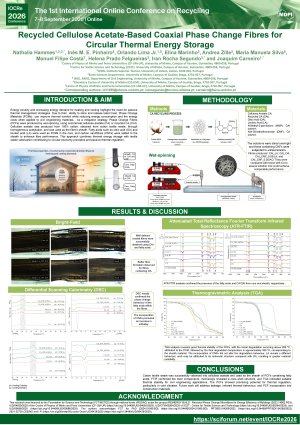
The increasing instability of the global energy sector, intensified by recent geopolitical conflicts, and the growing impact of urban heat islands (UHI) have highlighted the urgent need for passive thermal management strategies in the built environment. Simultaneously, the accumulation of textile waste, particularly cotton-based residues, which are commonly disposed of in landfills or subjected to low-value end-of-life routes, represents a major environmental challenge. In this context, phase change materials (PCMs) have attracted significant interest for their ability to store and release latent heat, improving thermal comfort and reducing energy demand. However, their direct incorporation into construction materials remains limited by leakage and physicochemical incompatibilities during phase transitions. Consequently, the development of coaxial polymeric fibres based on recycled cellulose acetate obtained from textile waste emerges as a promising strategy to ensure PCM stability, promote waste valorisation, and support circular economy principles. This work proposes the development of coaxial polymeric phase change fibres (PCFs) via wet-spinning, enabling the formation of core–sheath structures through phase inversion in a coagulation bath. The fibre sheath is based on cellulose acetate, including both a commercial and a recycled alternative (CAt), obtained through the homogeneous acetylation of 100% cotton textile waste. Fatty acids were incorporated into the fibre core as PCMs to provide latent heat storage capability, while carbon nanofibres (CNFs) were incorporated into the sheath to enhance the thermal and viscoelastic performance of the fibres. A comprehensive characterisation is being carried out to evaluate morphological (bright-field microscopy), chemical (attenuated total reflectance–Fourier transform infrared spectroscopy, ATR-FTIR), and thermal (thermogravimetric analysis, TGA; differential scanning calorimetry, DSC), aiming to establish structure–property–function relationships. This approach highlights the potential of converting textile waste into advanced functional materials for passive thermal regulation, promoting waste valorisation, circular economy principles, enhanced thermal comfort, and reduced energy dependency in urban environments.
Keywords
Circular economy
Coaxial fibres
Recycled cellulose acetate
Phase change materials
Carbon nanofibres
Thermal energy storage.
Poster
Poster Conferência Recycling_Nathalia Hammes.pdf
Can Wastewater Sludge Become a Raw Material for Sanitaryware?
Valorisation of Banana Pseudostem Waste into Reusable, Biodegradable Sponge for Sustainable Household Applications