Event submissions
Published
This submission belongs to the session S1. Advances in Recycling Technologies of the event The 1st International Online Conference on Recycling
Published date
02 Sep, 2026
Academic Editor
'%3e%3cpath%20d='M12.6657%2010.9104C12.4185%2010.325%2012.0599%209.79327%2011.6097%209.34482C11.1609%208.89508%2010.6293%208.5365%2010.0442%208.28888C10.0389%208.28626%2010.0337%208.28495%2010.0285%208.28233C10.8446%207.69279%2011.3752%206.73249%2011.3752%205.64904C11.3752%203.8542%209.92103%202.39999%208.1262%202.39999C6.33136%202.39999%204.87715%203.8542%204.87715%205.64904C4.87715%206.73249%205.40774%207.69279%206.22393%208.28364C6.21869%208.28626%206.21345%208.28757%206.20821%208.29019C5.62129%208.5378%205.09463%208.89284%204.64265%209.34613C4.1929%209.79493%203.83432%2010.3266%203.58671%2010.9117C3.34345%2011.4845%203.21226%2012.0987%203.20023%2012.7209C3.19988%2012.7349%203.20233%2012.7488%203.20744%2012.7619C3.21255%2012.7749%203.22022%2012.7867%203.22998%2012.7968C3.23975%2012.8068%203.25142%2012.8147%203.26431%2012.8202C3.2772%2012.8256%203.29105%2012.8284%203.30504%2012.8284H4.09109C4.14874%2012.8284%204.19459%2012.7825%204.1959%2012.7262C4.2221%2011.7148%204.62823%2010.7676%205.34617%2010.0497C6.08899%209.30683%207.0755%208.89808%208.1262%208.89808C9.17689%208.89808%2010.1634%209.30683%2010.9062%2010.0497C11.6242%2010.7676%2012.0303%2011.7148%2012.0565%2012.7262C12.0578%2012.7838%2012.1037%2012.8284%2012.1613%2012.8284H12.9474C12.9613%2012.8284%2012.9752%2012.8256%2012.9881%2012.8202C13.001%2012.8147%2013.0126%2012.8068%2013.0224%2012.7968C13.0322%2012.7867%2013.0398%2012.7749%2013.0449%2012.7619C13.0501%2012.7488%2013.0525%2012.7349%2013.0522%2012.7209C13.0391%2012.0947%2012.9094%2011.4855%2012.6657%2010.9104ZM8.1262%207.9024C7.52486%207.9024%206.9589%207.6679%206.53312%207.24211C6.10733%206.81633%205.87283%206.25037%205.87283%205.64904C5.87283%205.0477%206.10733%204.48174%206.53312%204.05596C6.9589%203.63018%207.52486%203.39567%208.1262%203.39567C8.72753%203.39567%209.29349%203.63018%209.71927%204.05596C10.1451%204.48174%2010.3796%205.0477%2010.3796%205.64904C10.3796%206.25037%2010.1451%206.81633%209.71927%207.24211C9.29349%207.6679%208.72753%207.9024%208.1262%207.9024Z'%20fill='%235D1EE1'/%3e%3c/g%3e%3c/svg%3e) Huijuan Dong
Huijuan DongCitation
Alangelico Ortiz San Pascual, Maurice B Gravidez, Annalissa L Aquino, Elliard Roswell S Yanza, Valorization of Rice Wash Wastewater as a Circular Bio-Resource for Seed Priming: Enhancing Germination and Seedling Vigor in Waxy Corn and Papaya, in Proceedings of The 1st International Online Conference on Recycling, 7 September–8 September 2026, MDPI: Basel, Switzerland
Share
Email
Facebook
Twitter
LinkedIn
Valorization of Rice Wash Wastewater as a Circular Bio-Resource for Seed Priming: Enhancing Germination and Seedling Vigor in Waxy Corn and Papaya
'%3e%3cpath%20d='M12.6647%2010.9104C12.4176%2010.325%2012.0589%209.7933%2011.6088%209.34485C11.16%208.89511%2010.6283%208.53653%2010.0432%208.28891C10.038%208.28629%2010.0327%208.28498%2010.0275%208.28236C10.8437%207.69282%2011.3743%206.73252%2011.3743%205.64907C11.3743%203.85423%209.92005%202.40002%208.12522%202.40002C6.33038%202.40002%204.87618%203.85423%204.87618%205.64907C4.87618%206.73252%205.40677%207.69282%206.22296%208.28367C6.21772%208.28629%206.21248%208.2876%206.20724%208.29022C5.62031%208.53783%205.09365%208.89287%204.64167%209.34616C4.19192%209.79496%203.83334%2010.3266%203.58573%2010.9117C3.34247%2011.4846%203.21128%2012.0987%203.19925%2012.721C3.1989%2012.735%203.20135%2012.7489%203.20646%2012.7619C3.21157%2012.7749%203.21924%2012.7868%203.22901%2012.7968C3.23877%2012.8068%203.25045%2012.8148%203.26334%2012.8202C3.27623%2012.8256%203.29007%2012.8284%203.30406%2012.8284H4.09012C4.14776%2012.8284%204.19362%2012.7825%204.19493%2012.7262C4.22113%2011.7148%204.62726%2010.7676%205.34519%2010.0497C6.08802%209.30686%207.07452%208.89811%208.12522%208.89811C9.17592%208.89811%2010.1624%209.30686%2010.9052%2010.0497C11.6232%2010.7676%2012.0293%2011.7148%2012.0555%2012.7262C12.0568%2012.7839%2012.1027%2012.8284%2012.1603%2012.8284H12.9464C12.9604%2012.8284%2012.9742%2012.8256%2012.9871%2012.8202C13%2012.8148%2013.0117%2012.8068%2013.0214%2012.7968C13.0312%2012.7868%2013.0389%2012.7749%2013.044%2012.7619C13.0491%2012.7489%2013.0515%2012.735%2013.0512%2012.721C13.0381%2012.0947%2012.9084%2011.4856%2012.6647%2010.9104ZM8.12522%207.90243C7.52388%207.90243%206.95792%207.66793%206.53214%207.24215C6.10636%206.81636%205.87185%206.2504%205.87185%205.64907C5.87185%205.04773%206.10636%204.48177%206.53214%204.05599C6.95792%203.63021%207.52388%203.3957%208.12522%203.3957C8.72655%203.3957%209.29252%203.63021%209.7183%204.05599C10.1441%204.48177%2010.3786%205.04773%2010.3786%205.64907C10.3786%206.2504%2010.1441%206.81636%209.7183%207.24215C9.29252%207.66793%208.72655%207.90243%208.12522%207.90243Z'%20fill='%235D1EE1'/%3e%3c/g%3e%3c/svg%3e)
Alangelico Ortiz San Pascual 1
Maurice B Gravidez 2
Annalissa L Aquino 3
Elliard Roswell S Yanza 1
1. Research Unit, Philippine Science High School - Main Campus Quezon City, Metro Manila, 1101, Philippines
2. Integrated School, De La Salle Araneta University, Potrero, Malabon City, Metro Manila, 1475, Philippines
3. Seed Science Laboratory, Institute of Crop Science, College of Agriculture and Food Science, University of the Philippines Los Baños, Los Baños, Laguna, 4031, Philippines
Abstract
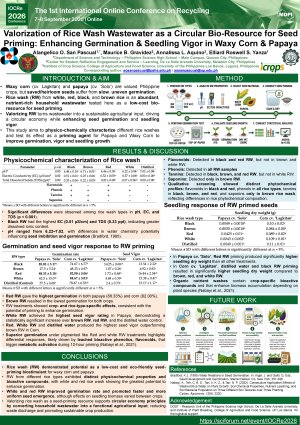
Waxy corn and papaya are high-value, nutrient-dense crops in the Philippines, yet farmer-kept and heirloom seeds often exhibit delayed and uneven germination. This study situates rice wash (RW), an underutilized household wastewater, within a circular economy framework by evaluating its potential as a recycled bio-resource for seed priming. RW derived from different rice types (white, red, black, and brown) was characterized for pH, electrical conductivity (EC), total dissolved solids (TDS), and bioactive compounds including flavonoids, phenolics, tannins, and saponins. Seeds were primed through 12-hour soaking, air-dried, and germinated using the top-of-paper method following ISTA protocols. Germination rate (GR), vigor index (VI), and seedling dry weight (SDW) were assessed under a Completely Randomized Design with three replications and analyzed using ANOVA and LSD at α = 0.05.
Results showed significant variation (p=0.00) in RW physicochemical properties across rice types, reflecting differences in resource recovery potential. All RW samples contained phenolic compounds, while saponins were detected only in brown rice wash. White and red RW significantly enhanced germination, promoting faster and more uniform seed emergence, although biomass responses were crop-specific. These findings demonstrate that rice wash can be effectively valorized as a low-cost, eco-friendly biostimulant, transforming household wastewater into a functional agricultural input. This approach supports decentralized resource recovery, reduces liquid waste discharge, and advances circular economy strategies in sustainable crop production systems.
Keywords
Domestic kitchen waste
Pawpaw
Ricewash waste water
Seed priming
Waxy Corn,
Poster
RICE WASH IOCRE NEW.pdf
Eco-Friendly Hybrid Cellulosic Adsorbents for Simultaneous Nitrate and Phosphate Removal from Wastewater and Further Use as Controlled-Release Fertilizer for Plant Growth
Saponification as a chemical tool for the recycling of biobased thermosetting resins: closing the loop toward circular materials