Event submissions
Published
This submission belongs to the session S3. Antimicrobial Resistance and Food Safety: A One Health Perspective of the event The 2nd International Online Conference on Veterinary Sciences
Published date
02 Sep, 2026
Academic Editor
'%3e%3cpath%20d='M12.6657%2010.9104C12.4185%2010.325%2012.0599%209.79327%2011.6097%209.34482C11.1609%208.89508%2010.6293%208.5365%2010.0442%208.28888C10.0389%208.28626%2010.0337%208.28495%2010.0285%208.28233C10.8446%207.69279%2011.3752%206.73249%2011.3752%205.64904C11.3752%203.8542%209.92103%202.39999%208.1262%202.39999C6.33136%202.39999%204.87715%203.8542%204.87715%205.64904C4.87715%206.73249%205.40774%207.69279%206.22393%208.28364C6.21869%208.28626%206.21345%208.28757%206.20821%208.29019C5.62129%208.5378%205.09463%208.89284%204.64265%209.34613C4.1929%209.79493%203.83432%2010.3266%203.58671%2010.9117C3.34345%2011.4845%203.21226%2012.0987%203.20023%2012.7209C3.19988%2012.7349%203.20233%2012.7488%203.20744%2012.7619C3.21255%2012.7749%203.22022%2012.7867%203.22998%2012.7968C3.23975%2012.8068%203.25142%2012.8147%203.26431%2012.8202C3.2772%2012.8256%203.29105%2012.8284%203.30504%2012.8284H4.09109C4.14874%2012.8284%204.19459%2012.7825%204.1959%2012.7262C4.2221%2011.7148%204.62823%2010.7676%205.34617%2010.0497C6.08899%209.30683%207.0755%208.89808%208.1262%208.89808C9.17689%208.89808%2010.1634%209.30683%2010.9062%2010.0497C11.6242%2010.7676%2012.0303%2011.7148%2012.0565%2012.7262C12.0578%2012.7838%2012.1037%2012.8284%2012.1613%2012.8284H12.9474C12.9613%2012.8284%2012.9752%2012.8256%2012.9881%2012.8202C13.001%2012.8147%2013.0126%2012.8068%2013.0224%2012.7968C13.0322%2012.7867%2013.0398%2012.7749%2013.0449%2012.7619C13.0501%2012.7488%2013.0525%2012.7349%2013.0522%2012.7209C13.0391%2012.0947%2012.9094%2011.4855%2012.6657%2010.9104ZM8.1262%207.9024C7.52486%207.9024%206.9589%207.6679%206.53312%207.24211C6.10733%206.81633%205.87283%206.25037%205.87283%205.64904C5.87283%205.0477%206.10733%204.48174%206.53312%204.05596C6.9589%203.63018%207.52486%203.39567%208.1262%203.39567C8.72753%203.39567%209.29349%203.63018%209.71927%204.05596C10.1451%204.48174%2010.3796%205.0477%2010.3796%205.64904C10.3796%206.25037%2010.1451%206.81633%209.71927%207.24211C9.29349%207.6679%208.72753%207.9024%208.1262%207.9024Z'%20fill='%235D1EE1'/%3e%3c/g%3e%3c/svg%3e) Ruichao Li
Ruichao LiCitation
Pegah Valitabar, Morteza Poormohammad, Niloufar Mardani, Mahla Yousefi, Prevalence and Antimicrobial Resistance Patterns of Multidrug-Resistant Escherichia coli in Commercial Broiler Farms in Iran: A Cross-Sectional Study, in Proceedings of The 2nd International Online Conference on Veterinary Sciences, 7 September–9 September 2026, MDPI: Basel, Switzerland
Share
Email
Facebook
Twitter
LinkedIn
Prevalence and Antimicrobial Resistance Patterns of Multidrug-Resistant Escherichia coli in Commercial Broiler Farms in Iran: A Cross-Sectional Study
'%3e%3cpath%20d='M12.6647%2010.9104C12.4176%2010.325%2012.0589%209.7933%2011.6088%209.34485C11.16%208.89511%2010.6283%208.53653%2010.0432%208.28891C10.038%208.28629%2010.0327%208.28498%2010.0275%208.28236C10.8437%207.69282%2011.3743%206.73252%2011.3743%205.64907C11.3743%203.85423%209.92005%202.40002%208.12522%202.40002C6.33038%202.40002%204.87618%203.85423%204.87618%205.64907C4.87618%206.73252%205.40677%207.69282%206.22296%208.28367C6.21772%208.28629%206.21248%208.2876%206.20724%208.29022C5.62031%208.53783%205.09365%208.89287%204.64167%209.34616C4.19192%209.79496%203.83334%2010.3266%203.58573%2010.9117C3.34247%2011.4846%203.21128%2012.0987%203.19925%2012.721C3.1989%2012.735%203.20135%2012.7489%203.20646%2012.7619C3.21157%2012.7749%203.21924%2012.7868%203.22901%2012.7968C3.23877%2012.8068%203.25045%2012.8148%203.26334%2012.8202C3.27623%2012.8256%203.29007%2012.8284%203.30406%2012.8284H4.09012C4.14776%2012.8284%204.19362%2012.7825%204.19493%2012.7262C4.22113%2011.7148%204.62726%2010.7676%205.34519%2010.0497C6.08802%209.30686%207.07452%208.89811%208.12522%208.89811C9.17592%208.89811%2010.1624%209.30686%2010.9052%2010.0497C11.6232%2010.7676%2012.0293%2011.7148%2012.0555%2012.7262C12.0568%2012.7839%2012.1027%2012.8284%2012.1603%2012.8284H12.9464C12.9604%2012.8284%2012.9742%2012.8256%2012.9871%2012.8202C13%2012.8148%2013.0117%2012.8068%2013.0214%2012.7968C13.0312%2012.7868%2013.0389%2012.7749%2013.044%2012.7619C13.0491%2012.7489%2013.0515%2012.735%2013.0512%2012.721C13.0381%2012.0947%2012.9084%2011.4856%2012.6647%2010.9104ZM8.12522%207.90243C7.52388%207.90243%206.95792%207.66793%206.53214%207.24215C6.10636%206.81636%205.87185%206.2504%205.87185%205.64907C5.87185%205.04773%206.10636%204.48177%206.53214%204.05599C6.95792%203.63021%207.52388%203.3957%208.12522%203.3957C8.72655%203.3957%209.29252%203.63021%209.7183%204.05599C10.1441%204.48177%2010.3786%205.04773%2010.3786%205.64907C10.3786%206.2504%2010.1441%206.81636%209.7183%207.24215C9.29252%207.66793%208.72655%207.90243%208.12522%207.90243Z'%20fill='%235D1EE1'/%3e%3c/g%3e%3c/svg%3e)
Pegah Valitabar 1
Morteza Poormohammad 2
Niloufar Mardani 2
Mahla Yousefi 3
1. Department of Avian Diseases, Faculty of Veterinary Medicine, Tehran University, Tehran, Iran
2. DVM Graduated, Faculty of Veterinary Medicine, Karaj Branch, Islamic Azad University, Karaj, Iran
3. Department of Internal Medicine, Faculty of Veterinary Medicine, Karaj Branch, Islamic Azad University, Karaj, Iran
Abstract
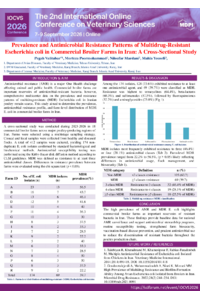
Introduction: Antimicrobial resistance (AMR) is a major One Health challenge affecting animal and public health. Commercial broiler farms are important reservoirs of antimicrobial-resistant bacteria; however, comprehensive multicenter data on the prevalence and resistance patterns of multidrug-resistant (MDR) Escherichia coli in Iranian poultry remain scarce. This study aimed to determine the prevalence, antimicrobial resistance profile, and farm-level distribution of MDR E. coli in commercial broiler farms in Iran.
Materials and Methods: A cross-sectional study was conducted during 2025-2026 in 18 commercial broiler farms across major poultry-producing regions of Iran. Farms were selected using a multistage sampling strategy. Cloacal and fecal samples were collected from healthy and diseased flocks. A total of 412 samples were cultured, yielding 174 non-duplicate E. coli isolates confirmed by standard bacteriological and biochemical methods. Antimicrobial susceptibility testing was performed using the Kirby-Bauer disk diffusion method according to CLSI guidelines. MDR was defined as resistance to at least three antimicrobial classes. Differences in resistance prevalence between farms were evaluated using the chi-square test (p < 0.05).
Results: Among the 174 isolates, 128 (73.6%) exhibited resistance to at least one antimicrobial agent, and 69 (39.7%) were classified as MDR. Resistance was highest to tetracyclines (64.4%), beta-lactams (60.3%), and sulfonamides (57.5%), followed by fluoroquinolones (32.2%) and aminoglycosides (23.0%). MDR isolates most frequently exhibited resistance to three (46.4%) or four (28.1%) antimicrobial classes. Farm-level MDR prevalence ranged from 21.7% to 56.4%, likely reflecting differences in antimicrobial usage, flock management, and biosecurity.
Conclusions: The high prevalence of AMR and MDR E. coli highlights commercial broiler farms as important reservoirs of resistant bacteria in Iran. These findings provide baseline data for national AMR surveillance and support antimicrobial stewardship programs, routine susceptibility testing, strengthened farm biosecurity, vaccination-based disease prevention, and prudent antimicrobial use to reduce the dissemination of resistant bacteria throughout the poultry production chain.
Keywords
Escherichia coli
antimicrobial resistance
multidrug resistance
broiler chickens
poultry production
One Health
Iran.
Poster
Antimicrobial Resistance Patterns of Multidrug-Resistant Escherichia coli.pdf
Detection of Bovine Tuberculosis in Animals Using Interferon-Gamma Release Assays and Its Public Health Relevance in the One Health Approach
Canine Transmissible Venereal Tumor as a One Health-Relevant Model of Contagious Cancer: A Case of Combined Vincristine and Exosome-Based Immunotherapy