Event submissions
Published
This submission belongs to the session S1. One Health Approaches to Emerging Zoonotic Threats of the event The 2nd International Online Conference on Veterinary Sciences
Published date
02 Sep, 2026
Academic Editor
'%3e%3cpath%20d='M12.6657%2010.9104C12.4185%2010.325%2012.0599%209.79327%2011.6097%209.34482C11.1609%208.89508%2010.6293%208.5365%2010.0442%208.28888C10.0389%208.28626%2010.0337%208.28495%2010.0285%208.28233C10.8446%207.69279%2011.3752%206.73249%2011.3752%205.64904C11.3752%203.8542%209.92103%202.39999%208.1262%202.39999C6.33136%202.39999%204.87715%203.8542%204.87715%205.64904C4.87715%206.73249%205.40774%207.69279%206.22393%208.28364C6.21869%208.28626%206.21345%208.28757%206.20821%208.29019C5.62129%208.5378%205.09463%208.89284%204.64265%209.34613C4.1929%209.79493%203.83432%2010.3266%203.58671%2010.9117C3.34345%2011.4845%203.21226%2012.0987%203.20023%2012.7209C3.19988%2012.7349%203.20233%2012.7488%203.20744%2012.7619C3.21255%2012.7749%203.22022%2012.7867%203.22998%2012.7968C3.23975%2012.8068%203.25142%2012.8147%203.26431%2012.8202C3.2772%2012.8256%203.29105%2012.8284%203.30504%2012.8284H4.09109C4.14874%2012.8284%204.19459%2012.7825%204.1959%2012.7262C4.2221%2011.7148%204.62823%2010.7676%205.34617%2010.0497C6.08899%209.30683%207.0755%208.89808%208.1262%208.89808C9.17689%208.89808%2010.1634%209.30683%2010.9062%2010.0497C11.6242%2010.7676%2012.0303%2011.7148%2012.0565%2012.7262C12.0578%2012.7838%2012.1037%2012.8284%2012.1613%2012.8284H12.9474C12.9613%2012.8284%2012.9752%2012.8256%2012.9881%2012.8202C13.001%2012.8147%2013.0126%2012.8068%2013.0224%2012.7968C13.0322%2012.7867%2013.0398%2012.7749%2013.0449%2012.7619C13.0501%2012.7488%2013.0525%2012.7349%2013.0522%2012.7209C13.0391%2012.0947%2012.9094%2011.4855%2012.6657%2010.9104ZM8.1262%207.9024C7.52486%207.9024%206.9589%207.6679%206.53312%207.24211C6.10733%206.81633%205.87283%206.25037%205.87283%205.64904C5.87283%205.0477%206.10733%204.48174%206.53312%204.05596C6.9589%203.63018%207.52486%203.39567%208.1262%203.39567C8.72753%203.39567%209.29349%203.63018%209.71927%204.05596C10.1451%204.48174%2010.3796%205.0477%2010.3796%205.64904C10.3796%206.25037%2010.1451%206.81633%209.71927%207.24211C9.29349%207.6679%208.72753%207.9024%208.1262%207.9024Z'%20fill='%235D1EE1'/%3e%3c/g%3e%3c/svg%3e) Vittorio Sarchese
Vittorio SarcheseCitation
Mahsa Abedi Raveshi, Sadra Adlifard, Jalil Mehrzad, Canine Transmissible Venereal Tumor as a One Health-Relevant Model of Contagious Cancer: A Case of Combined Vincristine and Exosome-Based Immunotherapy, in Proceedings of The 2nd International Online Conference on Veterinary Sciences, 7 September–9 September 2026, MDPI: Basel, Switzerland
Share
Email
Facebook
Twitter
LinkedIn
Canine Transmissible Venereal Tumor as a One Health-Relevant Model of Contagious Cancer: A Case of Combined Vincristine and Exosome-Based Immunotherapy
'%3e%3cpath%20d='M12.6647%2010.9104C12.4176%2010.325%2012.0589%209.7933%2011.6088%209.34485C11.16%208.89511%2010.6283%208.53653%2010.0432%208.28891C10.038%208.28629%2010.0327%208.28498%2010.0275%208.28236C10.8437%207.69282%2011.3743%206.73252%2011.3743%205.64907C11.3743%203.85423%209.92005%202.40002%208.12522%202.40002C6.33038%202.40002%204.87618%203.85423%204.87618%205.64907C4.87618%206.73252%205.40677%207.69282%206.22296%208.28367C6.21772%208.28629%206.21248%208.2876%206.20724%208.29022C5.62031%208.53783%205.09365%208.89287%204.64167%209.34616C4.19192%209.79496%203.83334%2010.3266%203.58573%2010.9117C3.34247%2011.4846%203.21128%2012.0987%203.19925%2012.721C3.1989%2012.735%203.20135%2012.7489%203.20646%2012.7619C3.21157%2012.7749%203.21924%2012.7868%203.22901%2012.7968C3.23877%2012.8068%203.25045%2012.8148%203.26334%2012.8202C3.27623%2012.8256%203.29007%2012.8284%203.30406%2012.8284H4.09012C4.14776%2012.8284%204.19362%2012.7825%204.19493%2012.7262C4.22113%2011.7148%204.62726%2010.7676%205.34519%2010.0497C6.08802%209.30686%207.07452%208.89811%208.12522%208.89811C9.17592%208.89811%2010.1624%209.30686%2010.9052%2010.0497C11.6232%2010.7676%2012.0293%2011.7148%2012.0555%2012.7262C12.0568%2012.7839%2012.1027%2012.8284%2012.1603%2012.8284H12.9464C12.9604%2012.8284%2012.9742%2012.8256%2012.9871%2012.8202C13%2012.8148%2013.0117%2012.8068%2013.0214%2012.7968C13.0312%2012.7868%2013.0389%2012.7749%2013.044%2012.7619C13.0491%2012.7489%2013.0515%2012.735%2013.0512%2012.721C13.0381%2012.0947%2012.9084%2011.4856%2012.6647%2010.9104ZM8.12522%207.90243C7.52388%207.90243%206.95792%207.66793%206.53214%207.24215C6.10636%206.81636%205.87185%206.2504%205.87185%205.64907C5.87185%205.04773%206.10636%204.48177%206.53214%204.05599C6.95792%203.63021%207.52388%203.3957%208.12522%203.3957C8.72655%203.3957%209.29252%203.63021%209.7183%204.05599C10.1441%204.48177%2010.3786%205.04773%2010.3786%205.64907C10.3786%206.2504%2010.1441%206.81636%209.7183%207.24215C9.29252%207.66793%208.72655%207.90243%208.12522%207.90243Z'%20fill='%235D1EE1'/%3e%3c/g%3e%3c/svg%3e)
Mahsa Abedi Raveshi 1
Sadra Adlifard 1
Jalil Mehrzad 1
1. Department of Microbiology and Immunology, Faculty of Veterinary Medicine, University of Tehran, Tehran, Iran
Abstract
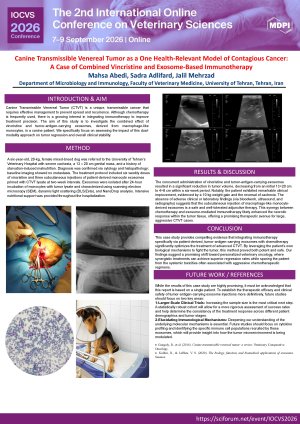
Background: Canine Transmissible Venereal Tumor (CTVT) is a unique clonally transmissible cancer. Although not zoonotic, its contagious nature makes it a valuable comparative model for host–tumor immune interactions within the One Health framework. This case report evaluates the clinical outcome of combining vincristine chemotherapy with immunotherapy using exosomes derived from macrophage-like monocytes primed with CTVT tumor lysate in a severely debilitated patient.
Methods: A six-year-old, 20-kg, female mixed-breed dog was referred to the University of Tehran’s Veterinary Hospital with severe cachexia, a 13 × 20 cm genital mass, and a history of starvation-induced malnutrition. Diagnosis was confirmed via cytology and histopathology; baseline imaging showed no metastasis. The treatment protocol included six weekly doses of vincristine and three subcutaneous injections of patient-derived monocyte exosomes primed with CTVT lysate at two-week intervals. Exosomes were isolated after 24-hour incubation of monocytes with tumor lysate and characterized using scanning electron microscopy (SEM), dynamic light scattering (DLS/Zeta), and NanoDrop analysis. Intensive nutritional support was provided throughout the hospitalization.
Results: The combined approach resulted in marked tumor necrosis and a significant volume reduction to approximately 4 × 6 cm. Parallel to tumor regression, the patient’s body weight increased by 10 kg, reflecting successful cachexia reversal and recovery from malnutrition. No systemic or local toxicity was detected based on longitudinal hematological, biochemical, and ultrasonographic monitoring.
Conclusion: The combination of vincristine and monocyte-derived exosomes, supported by intensive nutritional management, was associated with substantial tumor regression and clinical recovery. However, given the limitations of a single-case report, these findings remain preliminary and necessitate validation through larger controlled studies to confirm therapeutic efficacy. From a One Health perspective, utilizing transmissible animal tumors in comparative oncology offers valuable insights into fundamental cancer biology, immune evasion, and host–tumor co-evolution, ultimately contributing to translational biomedical research while enhancing animal welfare.
Keywords
Canine transmissible venereal tumor (CTVT)
One Health
Comparative oncology
Exosome-based immunotherapy
Infectious-like cancer.
Poster
poster-Mahsa Abedi.pdf
Prevalence and Antimicrobial Resistance Patterns of Multidrug-Resistant Escherichia coli in Commercial Broiler Farms in Iran: A Cross-Sectional Study
Environmental and organ distribution of copper in Cervids from regions with different levels of human activity