Event submissions
Published
This submission belongs to the session S2. Circular Economy and Policy Innovations towards Improved Resource Recovery of the event The 1st International Online Conference on Recycling
Published date
02 Sep, 2026
Academic Editor
'%3e%3cpath%20d='M12.6657%2010.9104C12.4185%2010.325%2012.0599%209.79327%2011.6097%209.34482C11.1609%208.89508%2010.6293%208.5365%2010.0442%208.28888C10.0389%208.28626%2010.0337%208.28495%2010.0285%208.28233C10.8446%207.69279%2011.3752%206.73249%2011.3752%205.64904C11.3752%203.8542%209.92103%202.39999%208.1262%202.39999C6.33136%202.39999%204.87715%203.8542%204.87715%205.64904C4.87715%206.73249%205.40774%207.69279%206.22393%208.28364C6.21869%208.28626%206.21345%208.28757%206.20821%208.29019C5.62129%208.5378%205.09463%208.89284%204.64265%209.34613C4.1929%209.79493%203.83432%2010.3266%203.58671%2010.9117C3.34345%2011.4845%203.21226%2012.0987%203.20023%2012.7209C3.19988%2012.7349%203.20233%2012.7488%203.20744%2012.7619C3.21255%2012.7749%203.22022%2012.7867%203.22998%2012.7968C3.23975%2012.8068%203.25142%2012.8147%203.26431%2012.8202C3.2772%2012.8256%203.29105%2012.8284%203.30504%2012.8284H4.09109C4.14874%2012.8284%204.19459%2012.7825%204.1959%2012.7262C4.2221%2011.7148%204.62823%2010.7676%205.34617%2010.0497C6.08899%209.30683%207.0755%208.89808%208.1262%208.89808C9.17689%208.89808%2010.1634%209.30683%2010.9062%2010.0497C11.6242%2010.7676%2012.0303%2011.7148%2012.0565%2012.7262C12.0578%2012.7838%2012.1037%2012.8284%2012.1613%2012.8284H12.9474C12.9613%2012.8284%2012.9752%2012.8256%2012.9881%2012.8202C13.001%2012.8147%2013.0126%2012.8068%2013.0224%2012.7968C13.0322%2012.7867%2013.0398%2012.7749%2013.0449%2012.7619C13.0501%2012.7488%2013.0525%2012.7349%2013.0522%2012.7209C13.0391%2012.0947%2012.9094%2011.4855%2012.6657%2010.9104ZM8.1262%207.9024C7.52486%207.9024%206.9589%207.6679%206.53312%207.24211C6.10733%206.81633%205.87283%206.25037%205.87283%205.64904C5.87283%205.0477%206.10733%204.48174%206.53312%204.05596C6.9589%203.63018%207.52486%203.39567%208.1262%203.39567C8.72753%203.39567%209.29349%203.63018%209.71927%204.05596C10.1451%204.48174%2010.3796%205.0477%2010.3796%205.64904C10.3796%206.25037%2010.1451%206.81633%209.71927%207.24211C9.29349%207.6679%208.72753%207.9024%208.1262%207.9024Z'%20fill='%235D1EE1'/%3e%3c/g%3e%3c/svg%3e) Eric Van Hullebusch
Eric Van HullebuschCitation
Nela Vujovic, Vesna Alivojvodic, Aleksandar Jovanovic, Miroslav Sokic, Digital Transformation as an Enabler of 10R Circular Economy Strategies Across the Mining Lifecycle, in Proceedings of The 1st International Online Conference on Recycling, 7 September–8 September 2026, MDPI: Basel, Switzerland
Share
Email
Facebook
Twitter
LinkedIn
Digital Transformation as an Enabler of 10R Circular Economy Strategies Across the Mining Lifecycle
'%3e%3cpath%20d='M12.6647%2010.9104C12.4176%2010.325%2012.0589%209.7933%2011.6088%209.34485C11.16%208.89511%2010.6283%208.53653%2010.0432%208.28891C10.038%208.28629%2010.0327%208.28498%2010.0275%208.28236C10.8437%207.69282%2011.3743%206.73252%2011.3743%205.64907C11.3743%203.85423%209.92005%202.40002%208.12522%202.40002C6.33038%202.40002%204.87618%203.85423%204.87618%205.64907C4.87618%206.73252%205.40677%207.69282%206.22296%208.28367C6.21772%208.28629%206.21248%208.2876%206.20724%208.29022C5.62031%208.53783%205.09365%208.89287%204.64167%209.34616C4.19192%209.79496%203.83334%2010.3266%203.58573%2010.9117C3.34247%2011.4846%203.21128%2012.0987%203.19925%2012.721C3.1989%2012.735%203.20135%2012.7489%203.20646%2012.7619C3.21157%2012.7749%203.21924%2012.7868%203.22901%2012.7968C3.23877%2012.8068%203.25045%2012.8148%203.26334%2012.8202C3.27623%2012.8256%203.29007%2012.8284%203.30406%2012.8284H4.09012C4.14776%2012.8284%204.19362%2012.7825%204.19493%2012.7262C4.22113%2011.7148%204.62726%2010.7676%205.34519%2010.0497C6.08802%209.30686%207.07452%208.89811%208.12522%208.89811C9.17592%208.89811%2010.1624%209.30686%2010.9052%2010.0497C11.6232%2010.7676%2012.0293%2011.7148%2012.0555%2012.7262C12.0568%2012.7839%2012.1027%2012.8284%2012.1603%2012.8284H12.9464C12.9604%2012.8284%2012.9742%2012.8256%2012.9871%2012.8202C13%2012.8148%2013.0117%2012.8068%2013.0214%2012.7968C13.0312%2012.7868%2013.0389%2012.7749%2013.044%2012.7619C13.0491%2012.7489%2013.0515%2012.735%2013.0512%2012.721C13.0381%2012.0947%2012.9084%2011.4856%2012.6647%2010.9104ZM8.12522%207.90243C7.52388%207.90243%206.95792%207.66793%206.53214%207.24215C6.10636%206.81636%205.87185%206.2504%205.87185%205.64907C5.87185%205.04773%206.10636%204.48177%206.53214%204.05599C6.95792%203.63021%207.52388%203.3957%208.12522%203.3957C8.72655%203.3957%209.29252%203.63021%209.7183%204.05599C10.1441%204.48177%2010.3786%205.04773%2010.3786%205.64907C10.3786%206.2504%2010.1441%206.81636%209.7183%207.24215C9.29252%207.66793%208.72655%207.90243%208.12522%207.90243Z'%20fill='%235D1EE1'/%3e%3c/g%3e%3c/svg%3e)
Nela Vujovic 1
Vesna Alivojvodic 2
Aleksandar Jovanovic 1
Miroslav Sokic 1
1. Institute for Technology of Nuclear and other Mineral Raw Materials, Belgrade, 11000, Serbia
2. The Academy of Applied Studies Polytechnic, Belgrade, 11000, Serbia
Abstract
Mining remains structurally dependent on linear production models characterised by intensive resource extraction, high energy and water consumption, and substantial waste generation. The sector accounts for approximately 4–7% of global energy-related CO₂ emissions from mineral processing alone, while global material consumption already exceeds planetary regenerative capacity by a factor of 1.75. Despite growing interest in circular economy principles, their systematic implementation in the mining sector remains limited, with the literature identifying three principal research gaps: tailings and waste management, regulatory and governance challenges, and circular value chain integration.
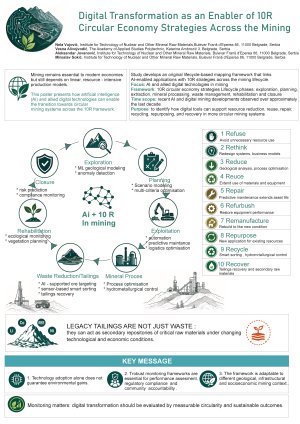
This study develops an original lifecycle-based mapping framework examining how artificial intelligence (AI) and allied digital technologies can enable the transition towards circular mining systems across the full 10R hierarchy — Refuse, Rethink, Reduce, Reuse, Repair, Refurbish, Remanufacture, Repurpose, Recycle, and Recover. The mine lifecycle is treated as an integrated system spanning exploration, planning, extraction, mineral processing, waste management, rehabilitation, and closure. The temporal scope covers AI and digital mining developments observed over approximately the last decade, rather than a historical case-study period or a conventional systematic-review interval.
AI-enabled applications are organised by lifecycle phase and linked to individual 10R strategies according to their circularity function. Applications considered include machine-learning-based geological modelling and anomaly detection (exploration); scenario modelling and multi-criteria optimisation (planning); automation, predictive maintenance, and logistics optimisation (exploitation); AI-supported ore targeting, sensor-based smart sorting, and tailings recovery (waste reduction); ecological monitoring and vegetation planning (rehabilitation); and risk prediction and compliance monitoring (closure). Legacy tailings and mining waste are further examined as overlooked repositories of recoverable critical raw materials.
The study argues that technology adoption does not automatically generate improved environmental outcomes. Robust monitoring frameworks are essential for performance assessment, regulatory compliance, and community accountability. The proposed framework is presented as an adaptable research instrument applicable across diverse geological, infrastructural, and socioeconomic mining contexts.
Keywords
Digital transformation
artificial intelligence (AI)
circular economy
10R framework
mining lifecycle
Poster
Sciforum-190464 poster.pdf
A circular economy pathway implementation in a real case industry: from landfill biogas to dimethyl ether
A Plan for Environmental and Socioeconomic Balance in General Lavalle