Event submissions
Published
This submission belongs to the session S2. Circular Economy and Policy Innovations towards Improved Resource Recovery of the event The 1st International Online Conference on Recycling
Published date
02 Sep, 2026
Academic Editor
'%3e%3cpath%20d='M12.6657%2010.9104C12.4185%2010.325%2012.0599%209.79327%2011.6097%209.34482C11.1609%208.89508%2010.6293%208.5365%2010.0442%208.28888C10.0389%208.28626%2010.0337%208.28495%2010.0285%208.28233C10.8446%207.69279%2011.3752%206.73249%2011.3752%205.64904C11.3752%203.8542%209.92103%202.39999%208.1262%202.39999C6.33136%202.39999%204.87715%203.8542%204.87715%205.64904C4.87715%206.73249%205.40774%207.69279%206.22393%208.28364C6.21869%208.28626%206.21345%208.28757%206.20821%208.29019C5.62129%208.5378%205.09463%208.89284%204.64265%209.34613C4.1929%209.79493%203.83432%2010.3266%203.58671%2010.9117C3.34345%2011.4845%203.21226%2012.0987%203.20023%2012.7209C3.19988%2012.7349%203.20233%2012.7488%203.20744%2012.7619C3.21255%2012.7749%203.22022%2012.7867%203.22998%2012.7968C3.23975%2012.8068%203.25142%2012.8147%203.26431%2012.8202C3.2772%2012.8256%203.29105%2012.8284%203.30504%2012.8284H4.09109C4.14874%2012.8284%204.19459%2012.7825%204.1959%2012.7262C4.2221%2011.7148%204.62823%2010.7676%205.34617%2010.0497C6.08899%209.30683%207.0755%208.89808%208.1262%208.89808C9.17689%208.89808%2010.1634%209.30683%2010.9062%2010.0497C11.6242%2010.7676%2012.0303%2011.7148%2012.0565%2012.7262C12.0578%2012.7838%2012.1037%2012.8284%2012.1613%2012.8284H12.9474C12.9613%2012.8284%2012.9752%2012.8256%2012.9881%2012.8202C13.001%2012.8147%2013.0126%2012.8068%2013.0224%2012.7968C13.0322%2012.7867%2013.0398%2012.7749%2013.0449%2012.7619C13.0501%2012.7488%2013.0525%2012.7349%2013.0522%2012.7209C13.0391%2012.0947%2012.9094%2011.4855%2012.6657%2010.9104ZM8.1262%207.9024C7.52486%207.9024%206.9589%207.6679%206.53312%207.24211C6.10733%206.81633%205.87283%206.25037%205.87283%205.64904C5.87283%205.0477%206.10733%204.48174%206.53312%204.05596C6.9589%203.63018%207.52486%203.39567%208.1262%203.39567C8.72753%203.39567%209.29349%203.63018%209.71927%204.05596C10.1451%204.48174%2010.3796%205.0477%2010.3796%205.64904C10.3796%206.25037%2010.1451%206.81633%209.71927%207.24211C9.29349%207.6679%208.72753%207.9024%208.1262%207.9024Z'%20fill='%235D1EE1'/%3e%3c/g%3e%3c/svg%3e) Eric Van Hullebusch
Eric Van HullebuschCitation
Vesna Alivojvodic, Magdalena Nikolic, Dragan Ugrinov, Nela Vujovic, CIRCULARITY PERFORMANCE ASSESSMENT OF CRITICAL RAW MATERIAL RECOVERY FROM WASTE PRINTED CIRCUIT BOARDS UNDER THE ISO 59020:2024 FRAMEWORK, in Proceedings of The 1st International Online Conference on Recycling, 7 September–8 September 2026, MDPI: Basel, Switzerland
Share
Email
Facebook
Twitter
LinkedIn
CIRCULARITY PERFORMANCE ASSESSMENT OF CRITICAL RAW MATERIAL RECOVERY FROM WASTE PRINTED CIRCUIT BOARDS UNDER THE ISO 59020:2024 FRAMEWORK
'%3e%3cpath%20d='M12.6647%2010.9104C12.4176%2010.325%2012.0589%209.7933%2011.6088%209.34485C11.16%208.89511%2010.6283%208.53653%2010.0432%208.28891C10.038%208.28629%2010.0327%208.28498%2010.0275%208.28236C10.8437%207.69282%2011.3743%206.73252%2011.3743%205.64907C11.3743%203.85423%209.92005%202.40002%208.12522%202.40002C6.33038%202.40002%204.87618%203.85423%204.87618%205.64907C4.87618%206.73252%205.40677%207.69282%206.22296%208.28367C6.21772%208.28629%206.21248%208.2876%206.20724%208.29022C5.62031%208.53783%205.09365%208.89287%204.64167%209.34616C4.19192%209.79496%203.83334%2010.3266%203.58573%2010.9117C3.34247%2011.4846%203.21128%2012.0987%203.19925%2012.721C3.1989%2012.735%203.20135%2012.7489%203.20646%2012.7619C3.21157%2012.7749%203.21924%2012.7868%203.22901%2012.7968C3.23877%2012.8068%203.25045%2012.8148%203.26334%2012.8202C3.27623%2012.8256%203.29007%2012.8284%203.30406%2012.8284H4.09012C4.14776%2012.8284%204.19362%2012.7825%204.19493%2012.7262C4.22113%2011.7148%204.62726%2010.7676%205.34519%2010.0497C6.08802%209.30686%207.07452%208.89811%208.12522%208.89811C9.17592%208.89811%2010.1624%209.30686%2010.9052%2010.0497C11.6232%2010.7676%2012.0293%2011.7148%2012.0555%2012.7262C12.0568%2012.7839%2012.1027%2012.8284%2012.1603%2012.8284H12.9464C12.9604%2012.8284%2012.9742%2012.8256%2012.9871%2012.8202C13%2012.8148%2013.0117%2012.8068%2013.0214%2012.7968C13.0312%2012.7868%2013.0389%2012.7749%2013.044%2012.7619C13.0491%2012.7489%2013.0515%2012.735%2013.0512%2012.721C13.0381%2012.0947%2012.9084%2011.4856%2012.6647%2010.9104ZM8.12522%207.90243C7.52388%207.90243%206.95792%207.66793%206.53214%207.24215C6.10636%206.81636%205.87185%206.2504%205.87185%205.64907C5.87185%205.04773%206.10636%204.48177%206.53214%204.05599C6.95792%203.63021%207.52388%203.3957%208.12522%203.3957C8.72655%203.3957%209.29252%203.63021%209.7183%204.05599C10.1441%204.48177%2010.3786%205.04773%2010.3786%205.64907C10.3786%206.2504%2010.1441%206.81636%209.7183%207.24215C9.29252%207.66793%208.72655%207.90243%208.12522%207.90243Z'%20fill='%235D1EE1'/%3e%3c/g%3e%3c/svg%3e)
Vesna Alivojvodic 1
Magdalena Nikolic 1
Dragan Ugrinov 2
Nela Vujovic 3
1. The Academy of Applied Studies Polytechnic, Belgrade 11000, Serbia
2. Faculty of Management, Sremski Karlovci, University “Union Nikola Tesla”, Sremski Karlovci, Serbia
3. Institute for Technology of Nuclear and other Mineral Raw Materials, Belgrade 11000, Serbia
Abstract
Waste printed circuit boards (WPCBs) are among the most valuable fractions of electrical and electronic equipment waste, owing to concentrations of critical metals such as gold, palladium, tantalum, and selected rare earth elements that, for several of these metals, exceed those of exploitable primary ores. Yet the circularity of WPCB recycling remains poorly characterised at the level of individual metals, as prevailing aggregate recycling rate metrics obscure the fate of individual critical raw materials (CRMs). Because the EU Critical Raw Materials Act (Regulation (EU) 2024/1252) sets targets per strategic raw material — including a 25% domestic recycling capacity threshold by 2030 — this measurement gap impedes monitoring and verification of regulatory progress.
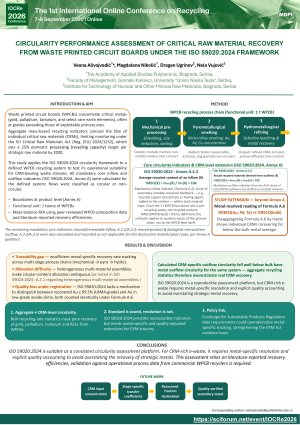
This study applies the ISO 59020:2024 framework to a defined WPCB recycling system to assess its operational suitability for CRM-bearing waste streams. System boundaries were delineated at the product level in accordance with Annex A guidance. A mass-balance resource flow analysis was performed for a functional unit of one tonne of WPCBs, drawing on peer-reviewed compositional data and literature-reported recovery efficiencies across mechanical pre-processing, pyrometallurgical smelting, and hydrometallurgical refining. The mandatory core inflow and outflow indicators were calculated, and resource flows classified as circular or non-circular.
The framework yielded reproducible indicator values while exposing three structural limitations: insufficient traceability of metal-specific recovery rates across multi-stage process chains; difficulty allocating circular content within heterogeneous multi-material assemblies; and partial registration of quality losses, whereby functional downgrading of recovered metals is inadequately captured. Calculated CRM outflow circularity fell well below that of bulk base metals, indicating that aggregate statistics overestimate CRM circularity for this system. ISO 59020:2024 is therefore suitable as a consistent assessment platform but, for CRM-rich e-waste, requires metal-specific resolution and explicit quality accounting. The information requirements of the Ecodesign for Sustainable Products Regulation could operationalise such data, strengthening the evidence base for CRM recovery policy.
Keywords
critical raw materials
waste printed circuit boards
ISO 59020:2024
circularity indicators
e-waste recycling
hydrometallurgy
pyrometallurgy
Poster
poster_IOCRe2026_Alivojvodic et al..pdf
Dynamic capabilities digitally enabled by Agentic AI towards regenerative circular deep tech (biocircular) and sustainable performance
From Linear to Circular: Consumer Priorities for Advancing Circular Economy Policy in Taiwan